LAST DAY IN MEXICO CITY

July 4, 2025

No fourth of July celebration for us today. We have something much more interesting planned. We are going on a private tour of the pyramids of Teotihuacan. Once again we enjoyed a quick breakfast at our favorite bakery. At exactly 9:00 AM we were picked up by our guide Ulysses, from TonaTours.

Teotihuacan is an amazing archeological site located 31 miles outside of Mexico City, which translates to over an hour drive each way. The ride gave us the opportunity to see the countryside outside CDMX. For the most part it was a continuation of the non-stop development we’ve been seeing, albeit a lot more hilly. What we found unique was that a system of gondolas or cable cars (Cablebus) connected people between these hillside communities providing a safe and efficient means of transportation. As we closed in on the pyramids, the crowded hillsides gave way and we began to catch a glimpse of rural Mexico.
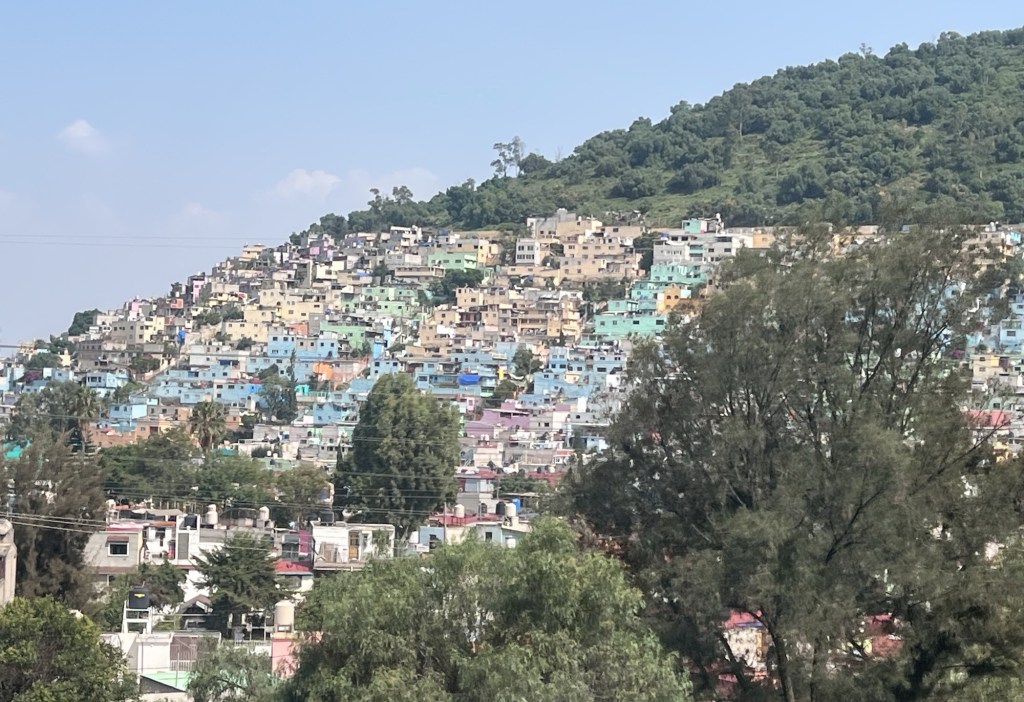
Crowded Hillsides
Gondolas

Prior to the arrival of the Aztecs, a powerful Mesoamerican city flourished at Teotihuacan from about 100 BCE to 800 CE. The city was massive, covering 8 square miles. At its height it has been estimated that a population of between 100,000 to 200,000 occupants lived there. The ceremonial center had two avenues dividing the city into quadrants. The Avenue of the Dead was the main thoroughfare with key structures built along it including the Pyramid of the Sun, the Pyramid of the Moon, and the Temple of the Feathered Serpent.

Very little is known about Teotihuacan other than it was a complex society that included residential compounds that housed up to 2,000 people. The arts flourished as could be seen by mural paintings, ceramics and stonework. Through the mural paintings archeologists learned that the inhabitants grew corn, squash, nopal (prickly pear cactus) and Maguey (agave). There was also evidence that the city had a sophisticated drainage system.

Walking along the 1-1/2 mile Avenue of the Dead. The Pyramid of the Sun and the Pyramid of the Moon are visible off in the distance.

Teotihuacan collapsed between 700-800 CE. It is thought that class tensions between multiethnic groups who were living in segregated neighborhoods were partly responsible. Other factors included droughts, external threats, overpopulation, and fires that destroyed many of the city’s core monuments. Does any of this have a familiar ring to you? It sure does to me.

Abandoned for centuries, the Aztecs re-discovered the city and gave it the name Teotihuacan, “the place where the gods were created”. The Aztecs revered the ruins and incorporated them into their religious beliefs.
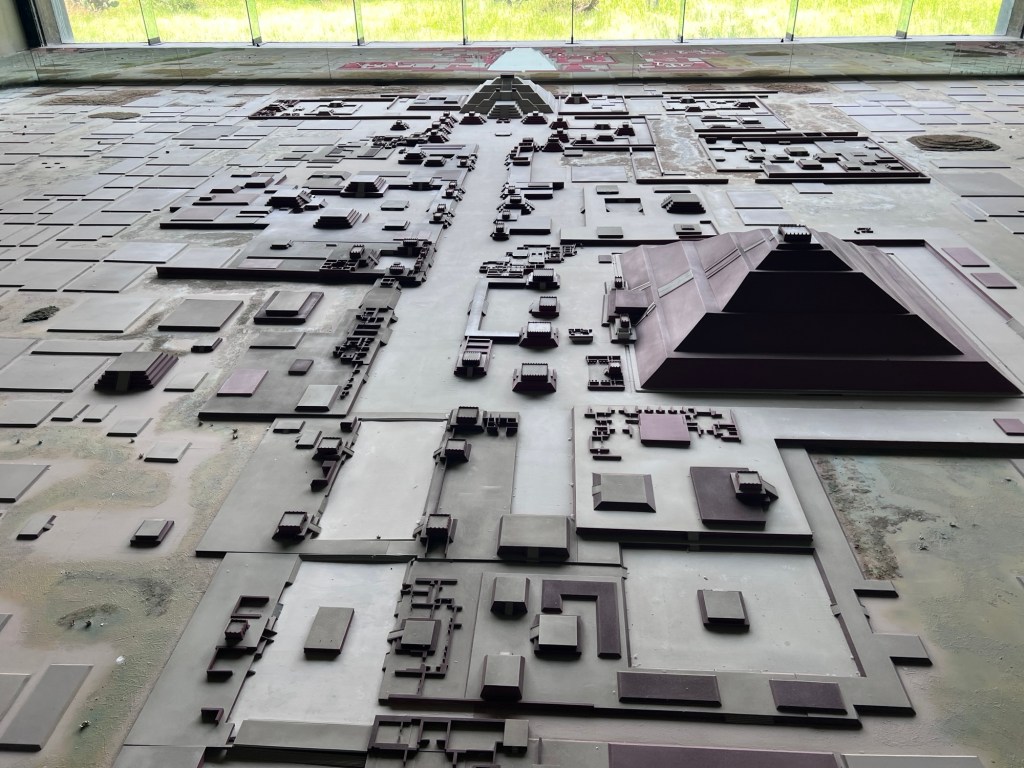
Overview of the pyramid complex located in the Museo de Sitio

Pyramid of the Moon

The Pyramid of the Moon was built between 100 and 450 CE. Its main purpose was as a stage for performing ritual sacrifices of humans and animals. It also served as a burial ground for sacrificial victims. Ceremonies were conducted on a platform atop the pyramid in honor of the Great Goddess of Teotihuacan — the goddess of water, fertility, earth and creation itself.

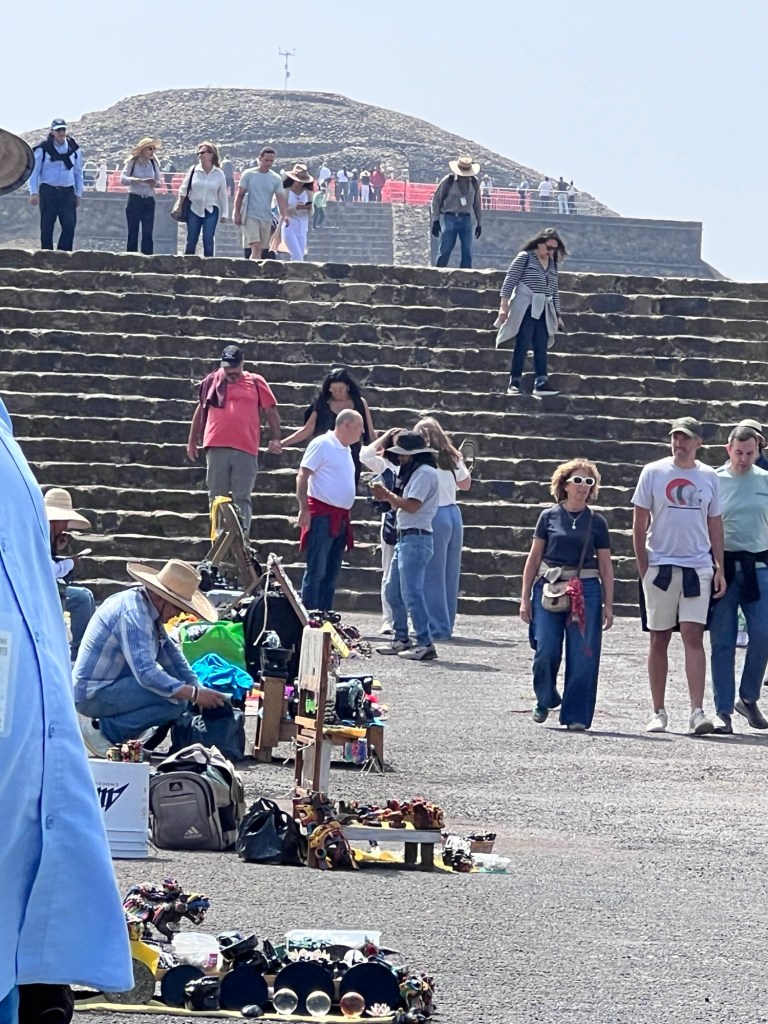
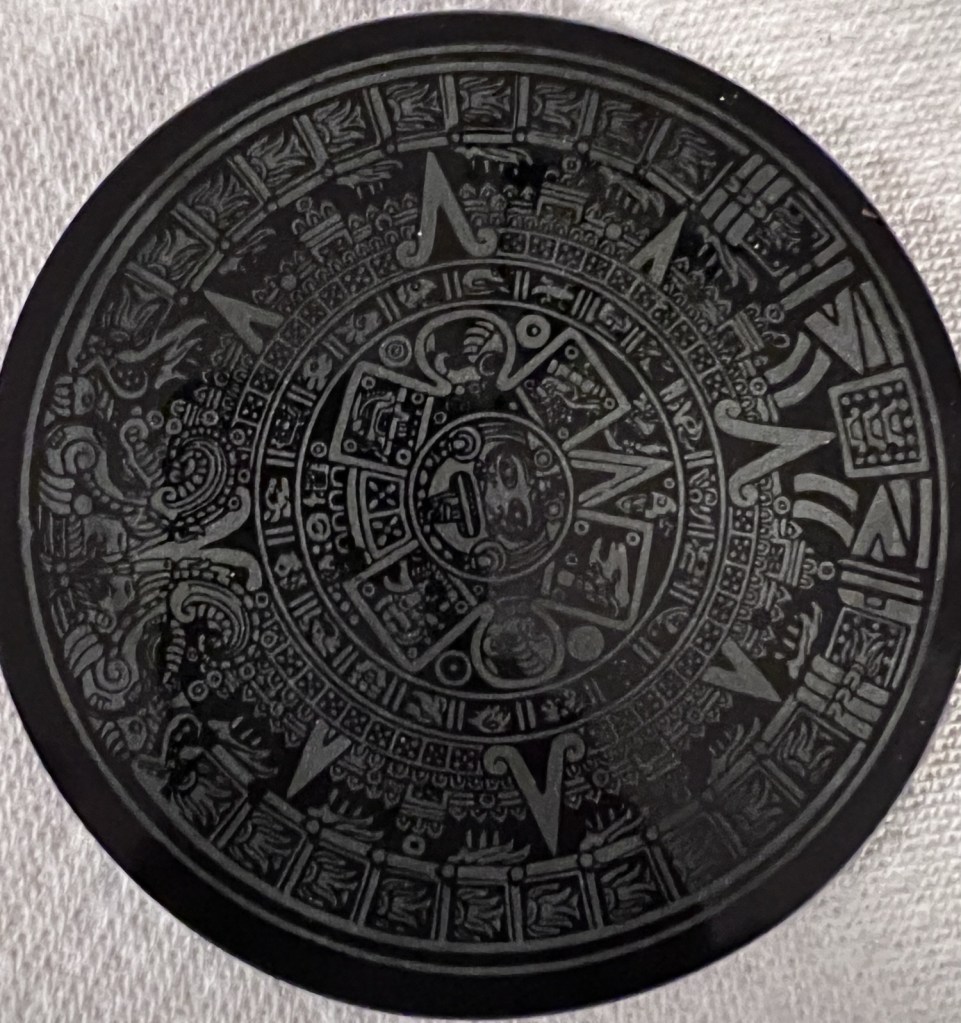
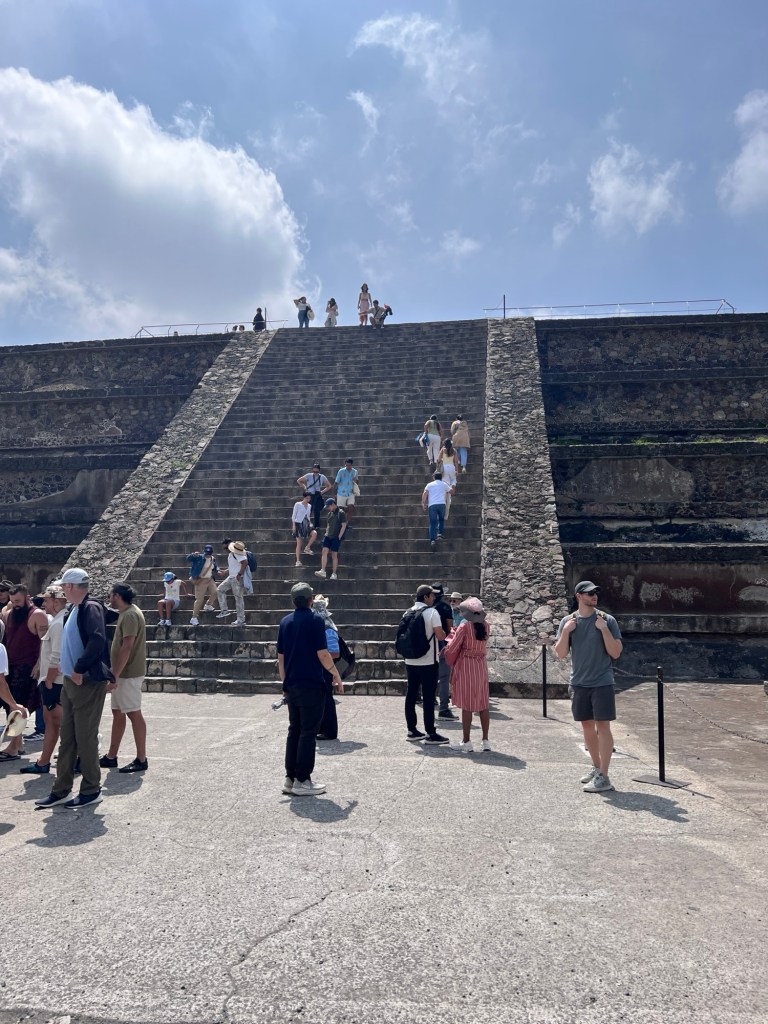
As of May 2025, tourists have been allowed to climb the 47 steps to the top of the first section of the Pyramid of the Moon, as well as to the top of five additional platforms. While there were vendors located throughout Teotihuacan, knowing that tourists would spend the most time in this particular area made it a popular spot for vendors selling a wide variety of local handicrafts. Far too many of them were selling a whistle-like toy that made very irritating high pitched screeching sounds meant to imitate an eagle or a puma. We definitely would have gotten into serious trouble if we had brought any of those whistles home for the grandchildren. Others sold lovely woven rugs, typical Mexican styled clothing, silver jewelry, pieces of shiny onyx through which you could view the sun, and countless other goods.

Our guide Ulysses
Pyramid of the Moon
Plaza area in front of the Pyramid of the Moon
Dan and Steven at top of platform
In front of Pyramid of the Moon. Vendors could be seen throughout Teotihuacan
Onyx disc that is transparent when held up to the sun.
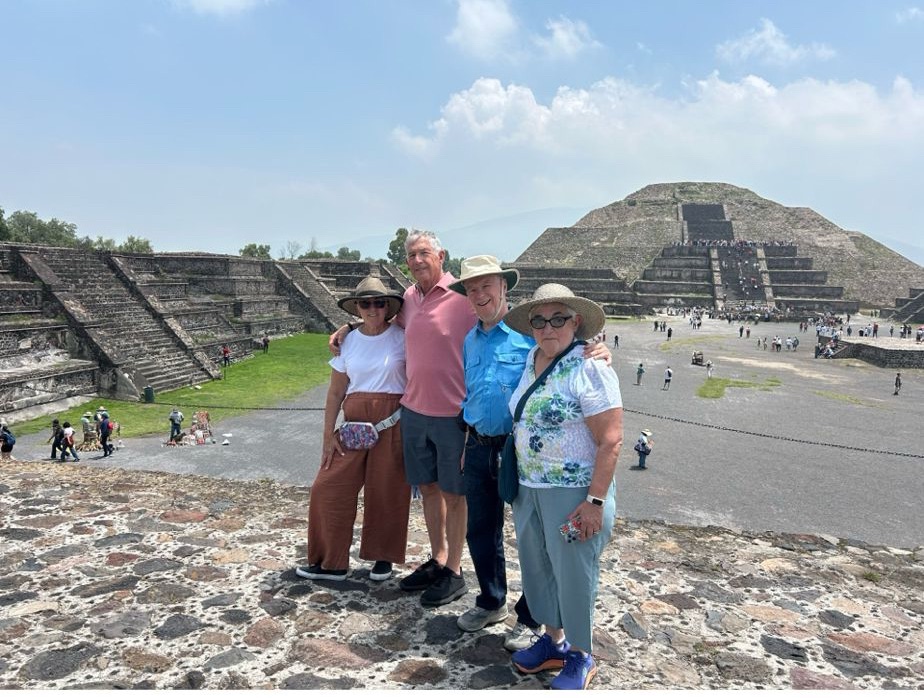
All of us near Pyramid of the Moon
Platform near the Pyramid of the Moon
Area where over 2,000 apartments once stood

Pyramid of the Sun

The Pyramid of the Sun was constructed about 100 – 200 CE and is one of the largest structures of its type in the Western Hemisphere. You can see how huge it is by looking at the tiny people standing in the lower right hand corner of the photo below. Its purpose is unknown, but it is thought to have been built to honor a deity or celestial body. Archeologists believe there was once a temple built on top. A large natural cave was found beneath its base with evidence of ritual offerings having taken place there. Its astronomical alignments also suggests it was used for important religious and ceremonial functions.

Pyramid of the Sun. People were not allowed to climb any portion of this pyramid.
Another view of the massive Pyramid of the Sun
One last view of the Pyramid of the Sun
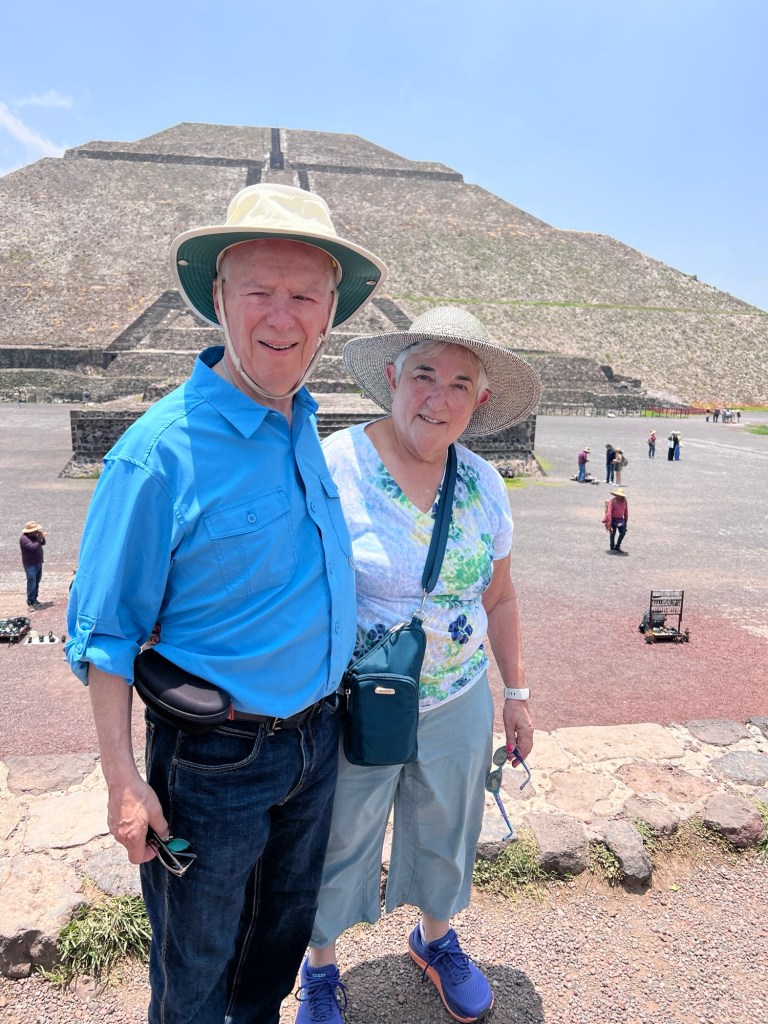
Posing in front of the Pyramid of the Sun

Temple of the Feathered Serpent

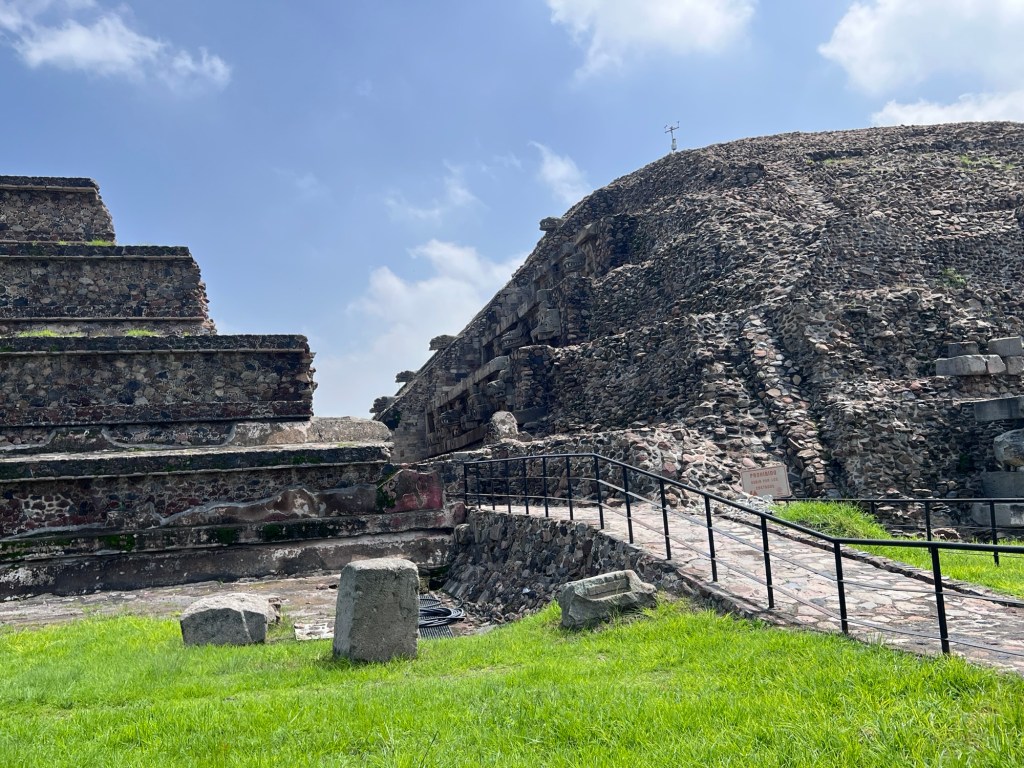
The third largest pyramid in Teotihuacan was the Temple of the Feathered Serpent. It is also the most ornate. Built between 150 and 200 CE, the facade is adorned with amazing carvings. Imagine them being painted in bright blue, red, green, and yellow, with the eyes of these mythical creatures filled with obsidian glass. Archeologists think it may have been built to venerate the “sacred” calendar cycle.
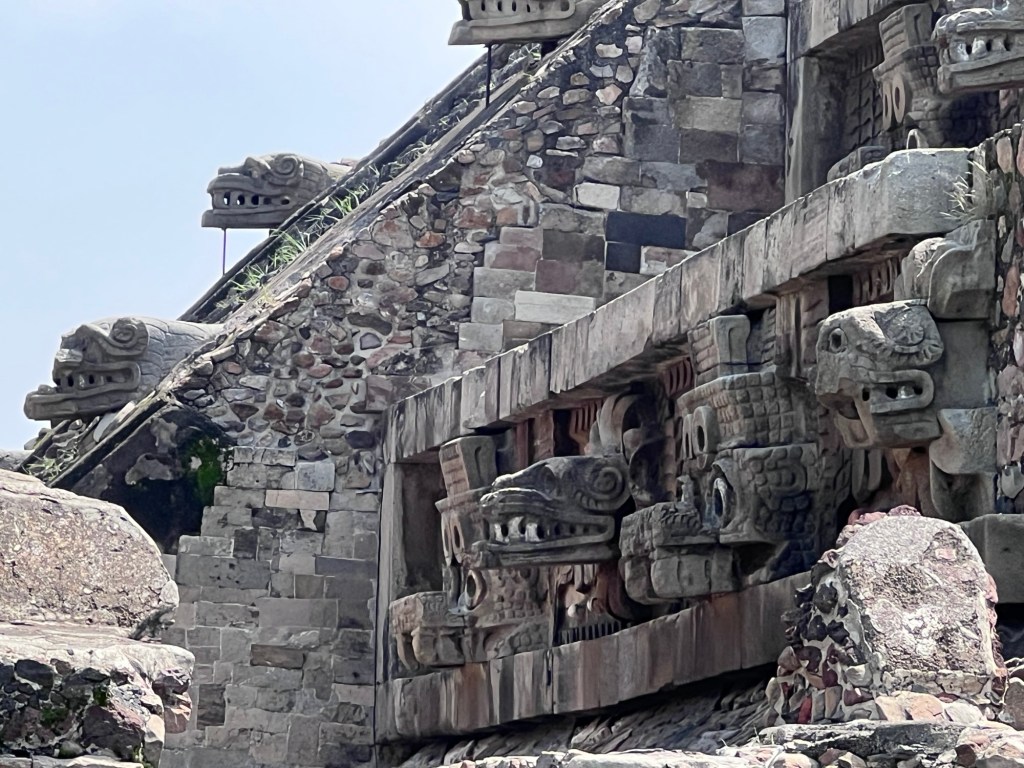
Amazing carvings at Temple of the Feathered Serpent
More amazing stonework
A view of the Temple of the Feathered Serpent
Amy and me in front of the Temple of the Feathered Serpent

Puma Complex

Complete rooms and many wall murals could be found in some of the smaller temples and residential apartment compounds along the Avenue of the Dead. One example was the Puma Complex where we saw wall carvings and murals still intact.

Wall carvings
The Puma — this mural was discovered in 1963 in part of the complex now called the Puma Complex. The scene shows a large wild cat with open jaws and large claws protruding from its paws. The round green circles represented precious stones.

Palace of the Jaguars

Located near the Plaza of the Moon is the Palace of the Jaguars. Within its rooms are more well-preserved murals, most of which are of jaguars. One example shows a jaguar blowing into a conch shell from which water or blood drips. The palace was a complex for elite warriors and priests with the murals representing themes of war, the cosmos, and the water deity, Tlaloc. The mural shown below is presumed to be a symbol of war because conch shells were blown before a battle. The bleeding shell could also symbolize an extracted heart, or symbol of conquest.
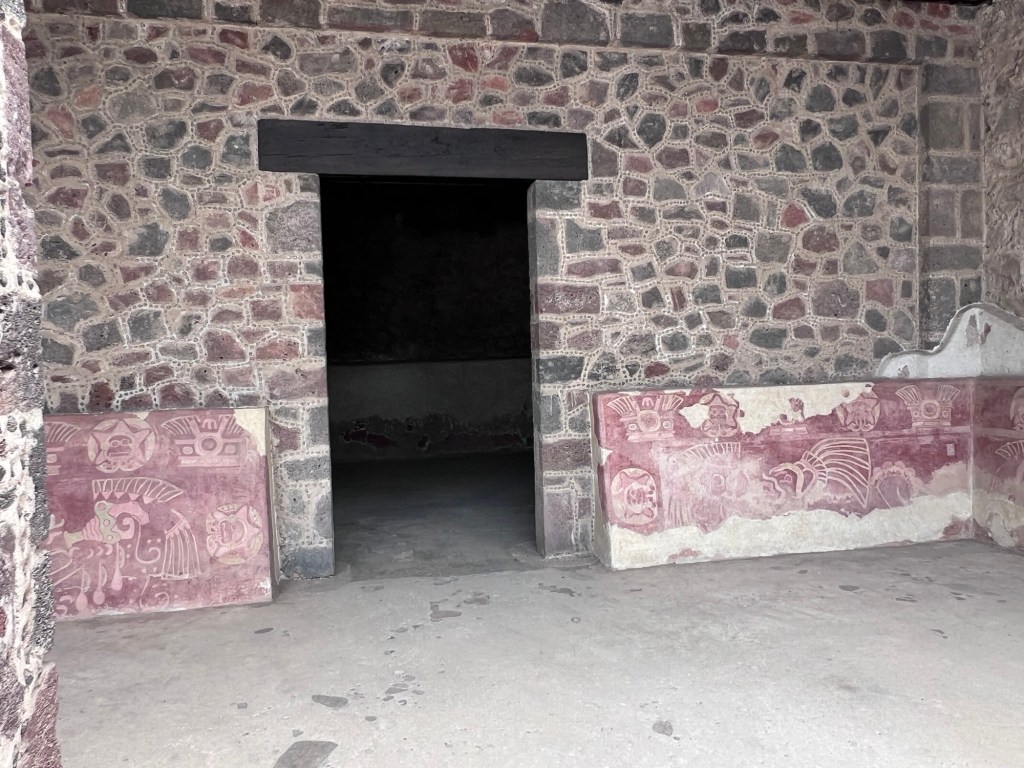
Doorway in Palace of the Jaguars with murals
Closeup of a jaguar blowing a conch shell dripping with blood. The curvy line below the shell represents sound.

Museo del Sitio (Site Museum)

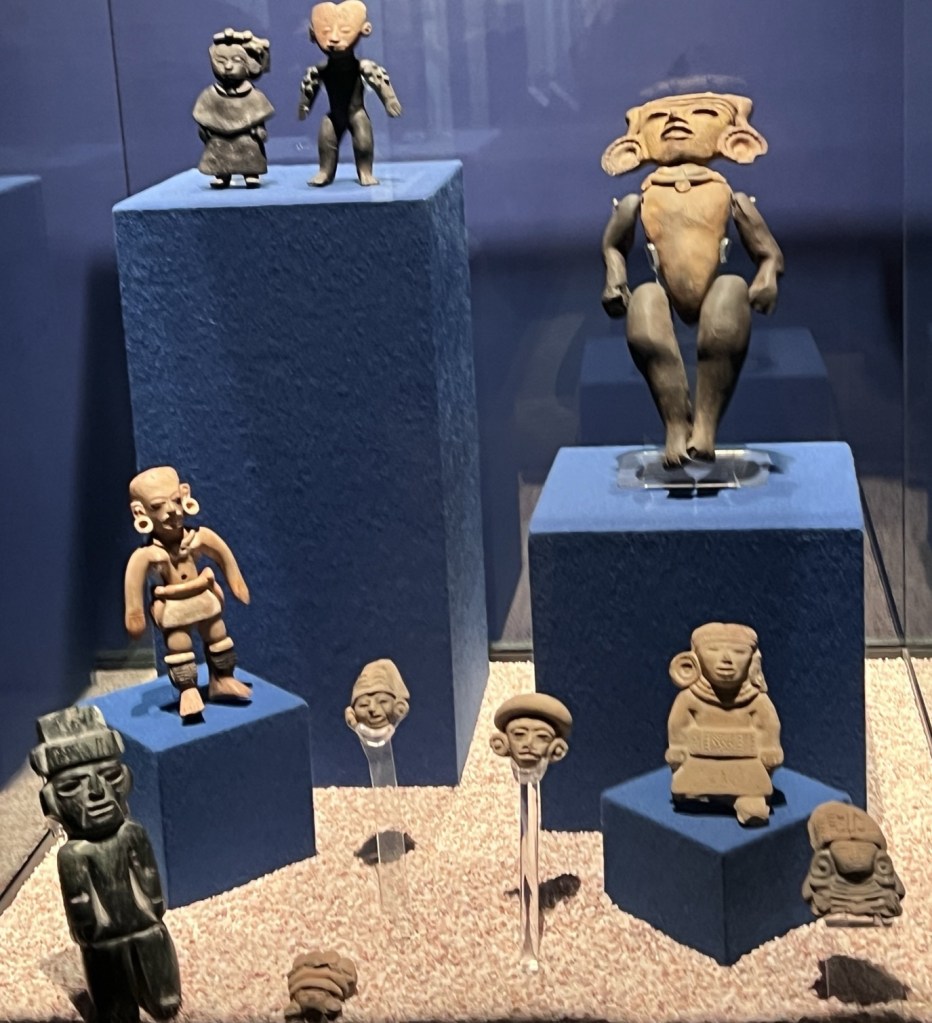
The main museum within Teotihuacan is the Museo del Sitio. It offered marvelous displays of artifacts found within the ruins and helped give us a comprehensive look at the ancient city’s history and culture.
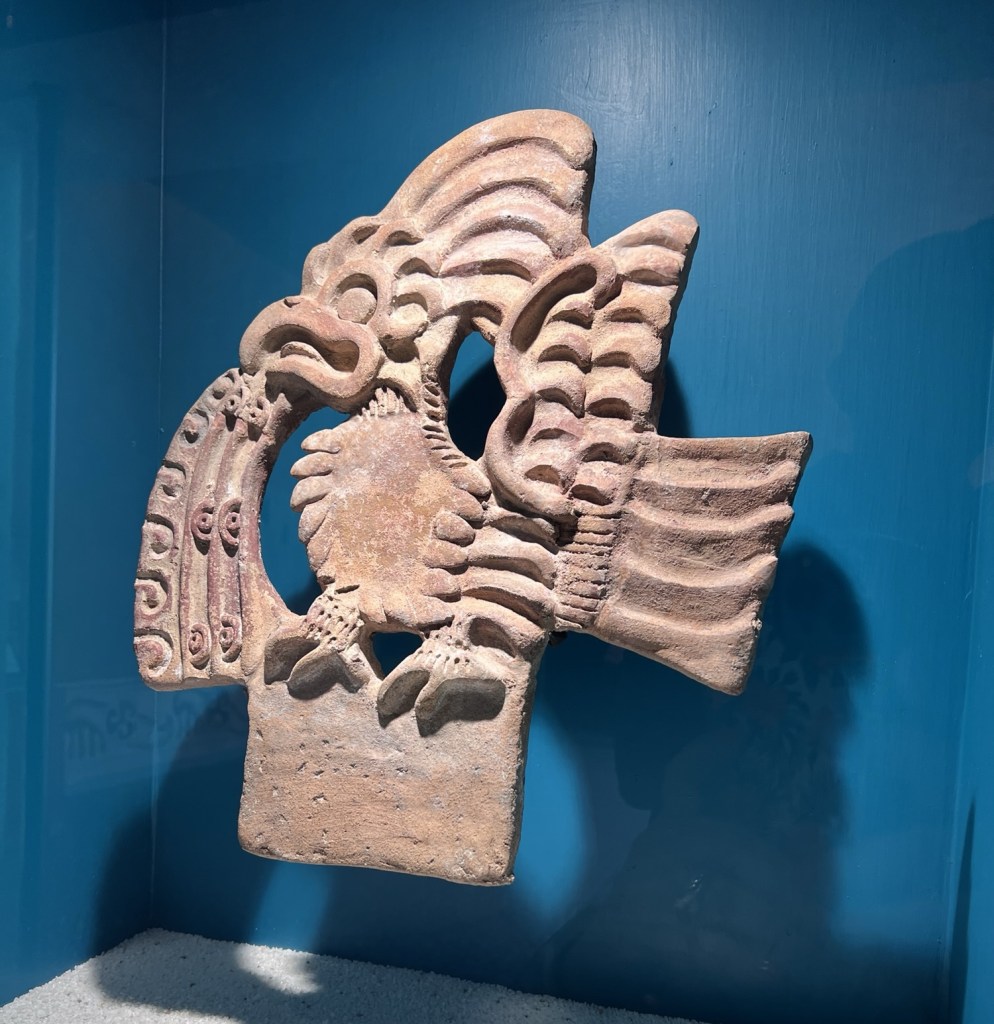
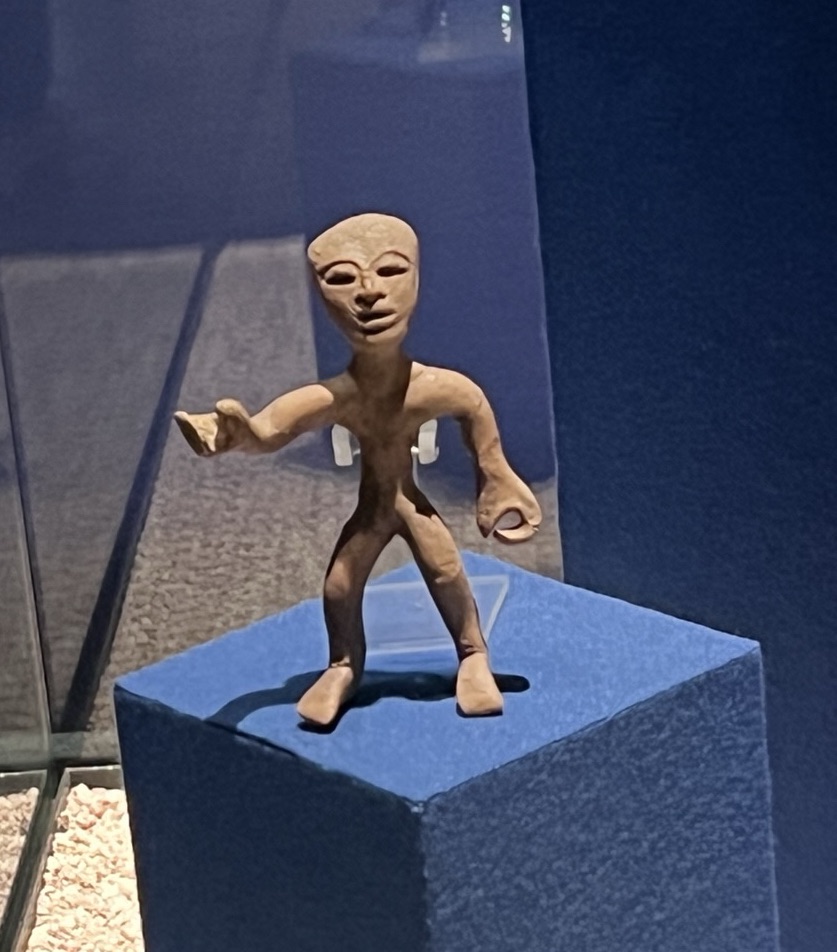
Architectural crest with representation of a bird pouring water from its beak.
Little person found in burial site
Contemplative little man found in tomb
Lots of little people from burial sites.
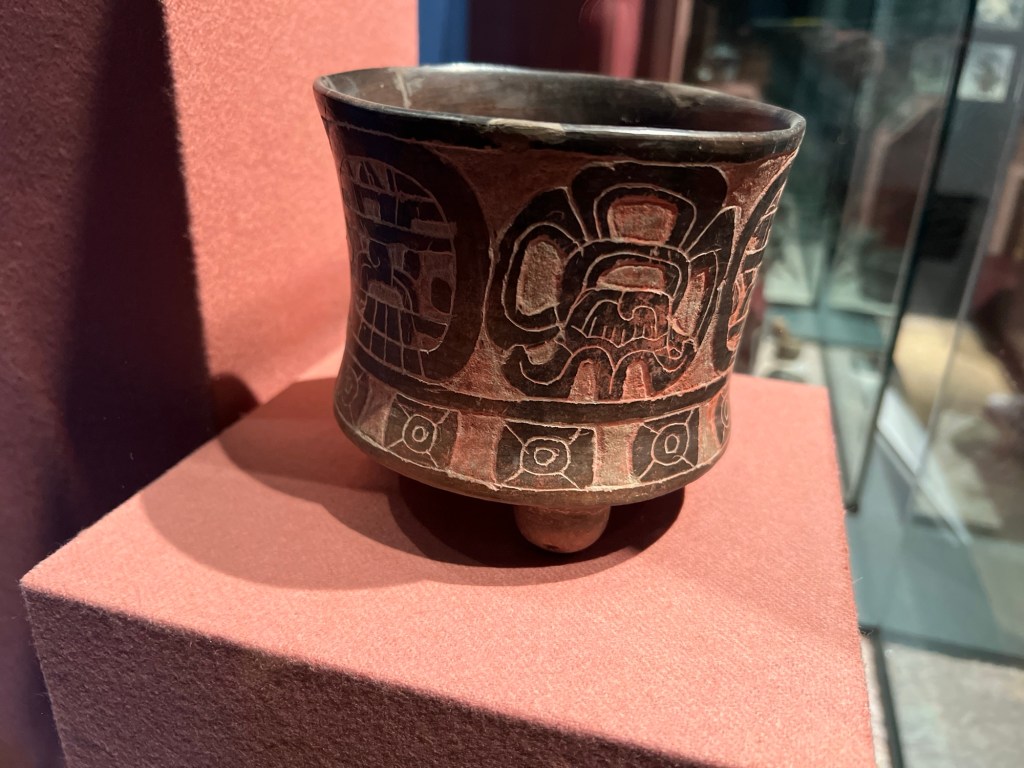
Ceramic cup
One of the individuals “offered” to the gods. The number of victims found so far totals 260. Necklaces, conch beads, and pendants that simulated human jawbones, pieces of obsidian and pottery were all found buried along with the dead.
Doesn’t the sculpture on the right look a little like Sponge Bob?
Sponge Bob
Beautiful jade piece. Jade was highly valued and symbolized life, fertility and power.

The last stop on our tour was the Restaurante La Greta set inside a volcanic cave. It was “unapologetically gimmicky”, but so much fun to visit. The cave was huge, and after a day in the sun, comfortably cool. The food was typical Mexican fare, and quite good. There was even a Mariachi band to entertain us over lunch.
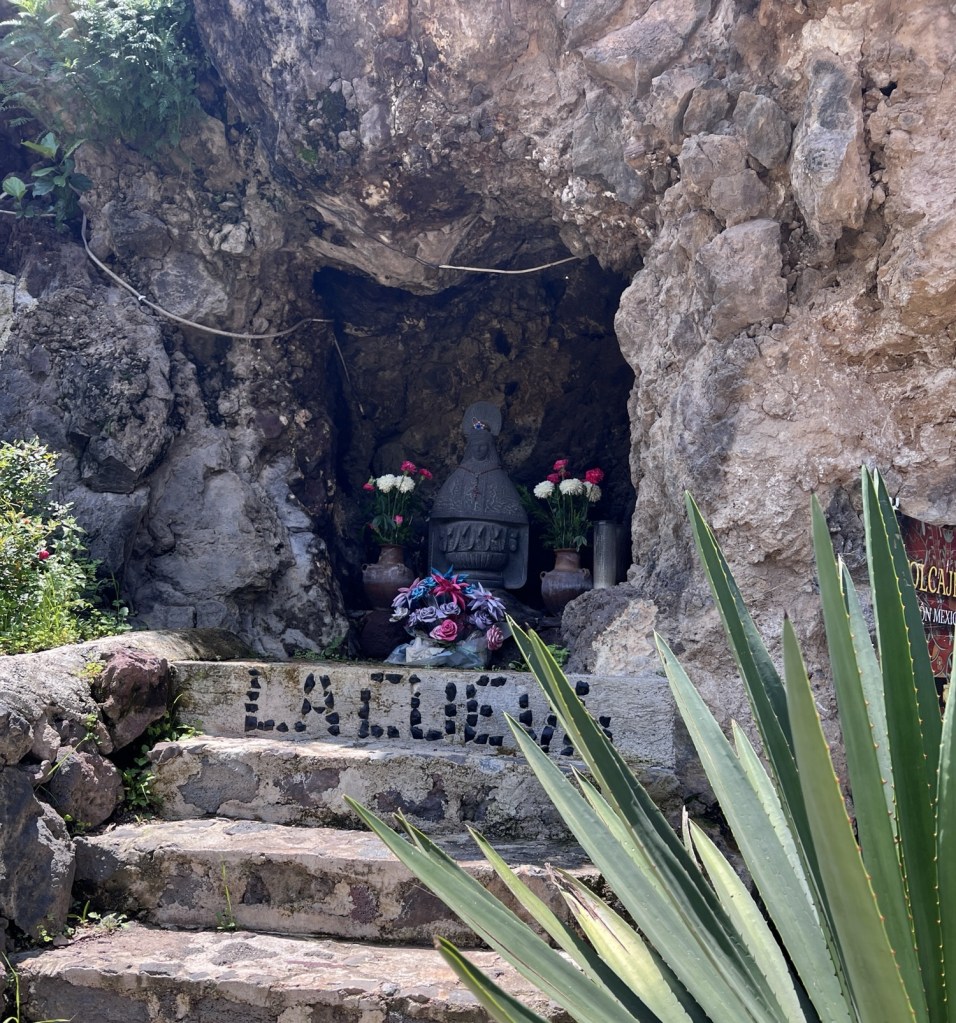
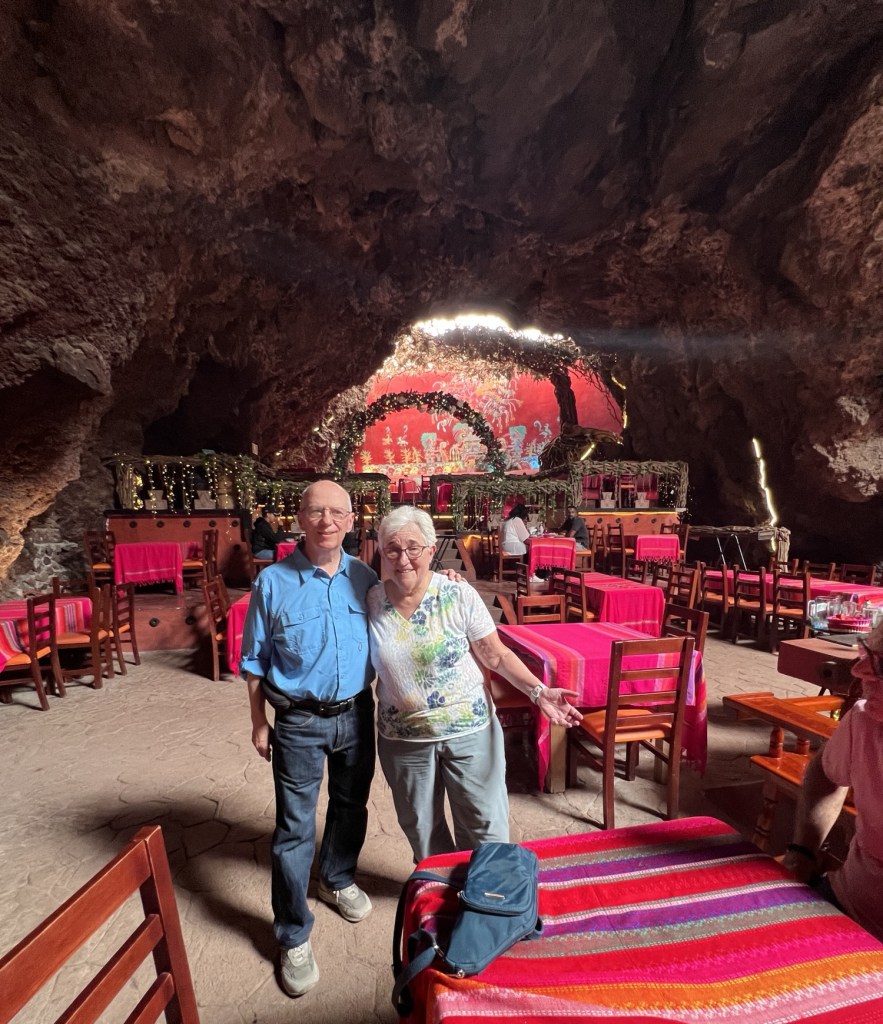
Restaurante La Greta
Posing in the colorful Restaurante La Greta

Ulysses was a wonderful tour guide and took excellent care of us. Teotihuacan is an amazing place. We could have spent hours more there, but to be honest it was a lot to take in and I think we all had seen enough for one day. It sure was nice to sit back and relax on our ride back to Mexico City.

The day was still young and Amy said that she really liked castles and would like to see the Castillo de Chapultepec. So instead of taking us back to our hotel, Ulysses dropped us off at Bosque de Chapultepec, which translates to Chapultepec Park. It is one of the largest parks in the Western Hemisphere and contains a multitude of attractions including museums, lakes, Castillo de Chapultepec and a zoo. Unfortunately, many of these attractions, including the castle, were closing in 30 minutes.

The Castillo’s construction began in 1785, but it wasn’t completed until Mexico’s independence in 1821. For a few years Mexico reverted to an independent monarchy, and that is when Emperor Maximillian and Empress Carlotta arrived from Austria in 1864. They refurbished the Castillo de Chapultepec as their residence. To say all did not go well for them is an understatement. Maximillian was the younger brother of Emperor Franz Joseph I of Austria, but his reign in Mexico lasted only 3 years. It ended when forces of the restored Republic executed him by firing squad. Empress Carlotta was not executed, but she suffered a mental breakdown. She spent the rest of her life in seclusion, dying in Belgium in 1927.
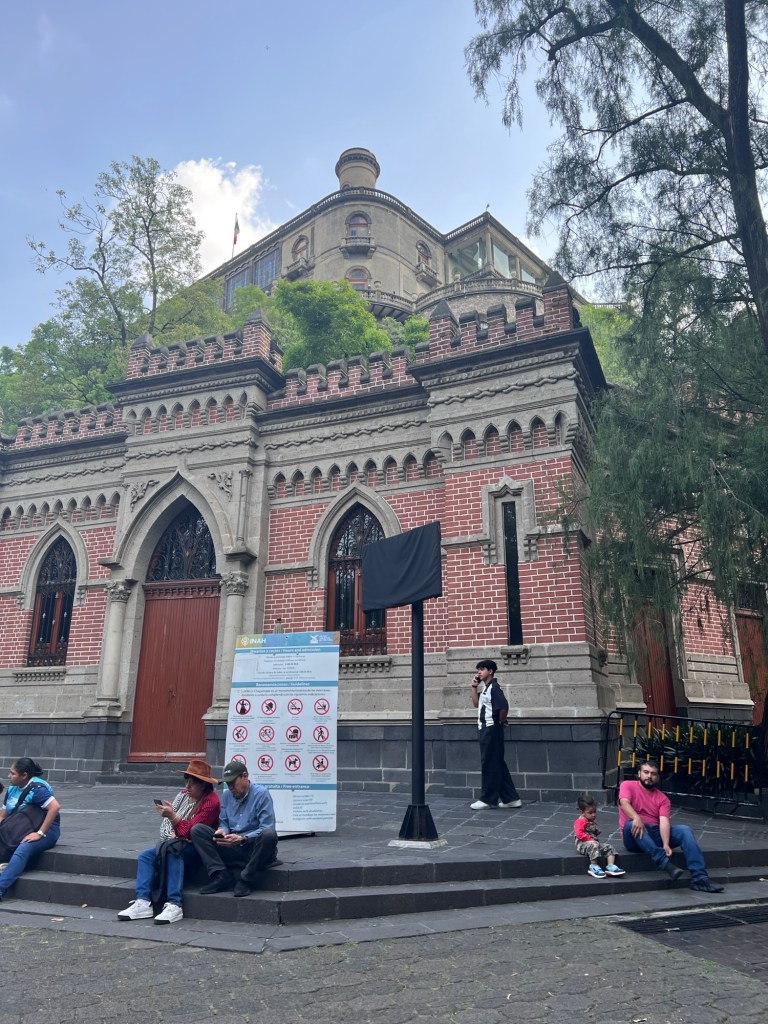
Entrance to Chapultepec Castle. The castle is up the hill.

It was late afternoon, so it wasn’t surprising that things were closing for the day. However, we managed to purchase a few monkey like creatures (Dan and I called them Squirting Monkeys) that we had seen adults wearing on their heads. A small container could be filled with water, and by squeezing a bulb, you could squirt people out of the the monkey’s head. Odd looking, but cute in its own way. I just had to buy a few for our grandkids.

Girls modeling Squirting Monkeys

Although the Museo de Arte Moderno was closing soon, the security guards were kind enough to let us roam the museum at no cost. It was a magnificent space and exhibited some extraordinary pieces of art.
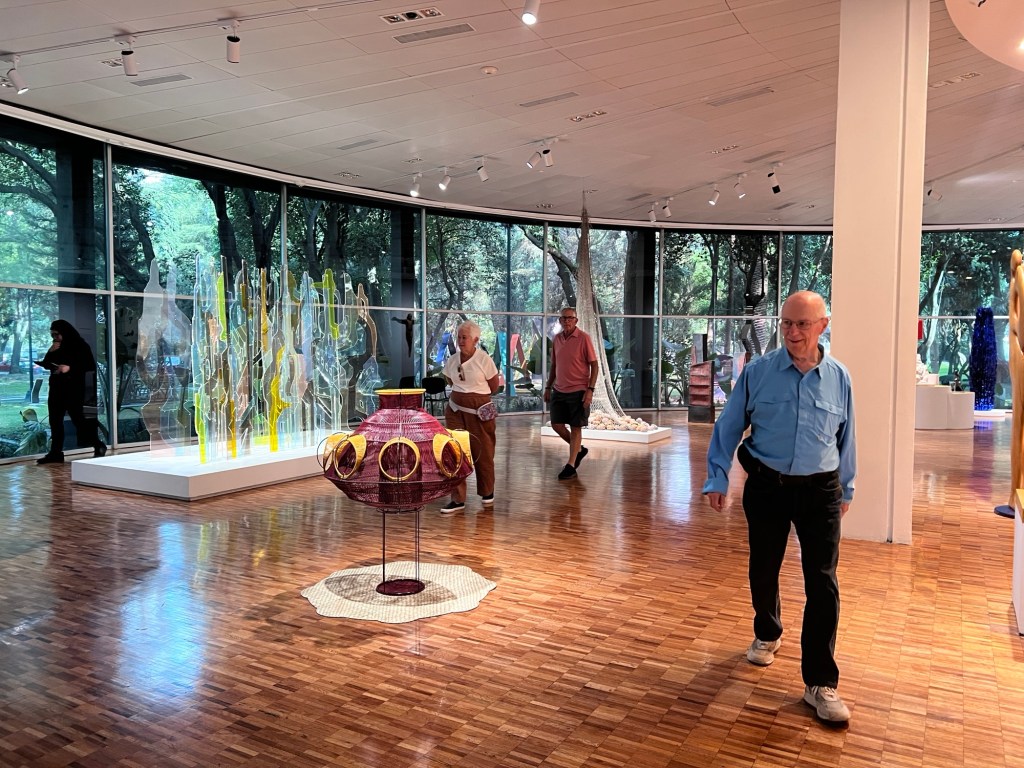
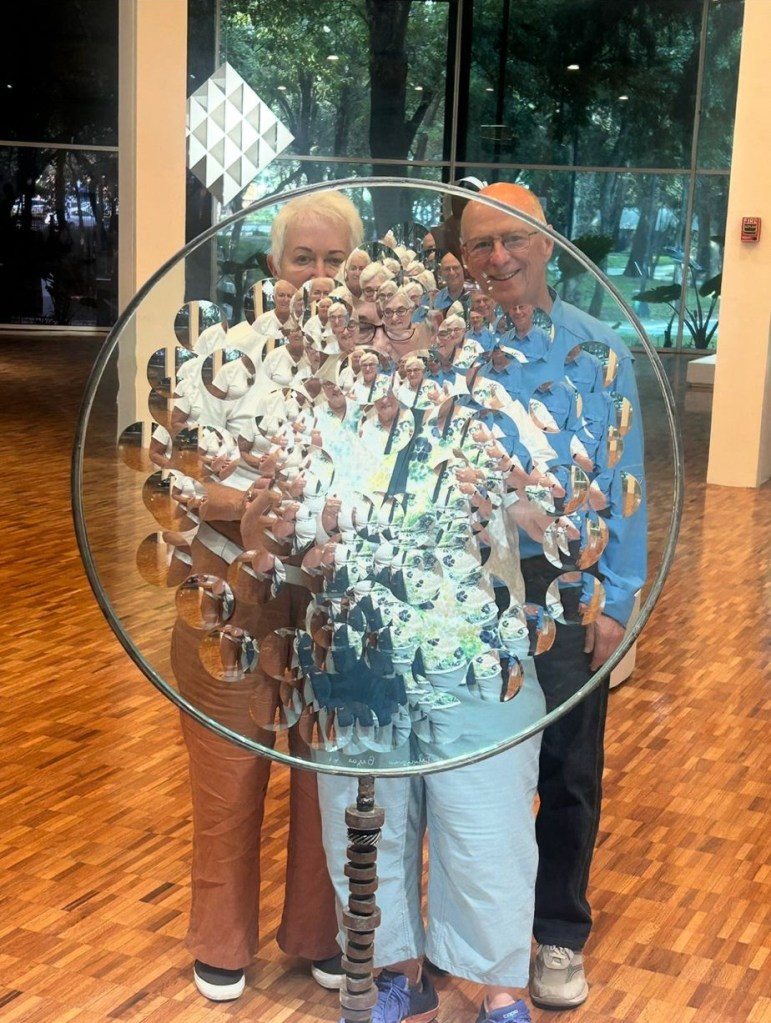
Just one of the many beautiful galleries
The exhibit halls were filled with fun and interesting pieces of art
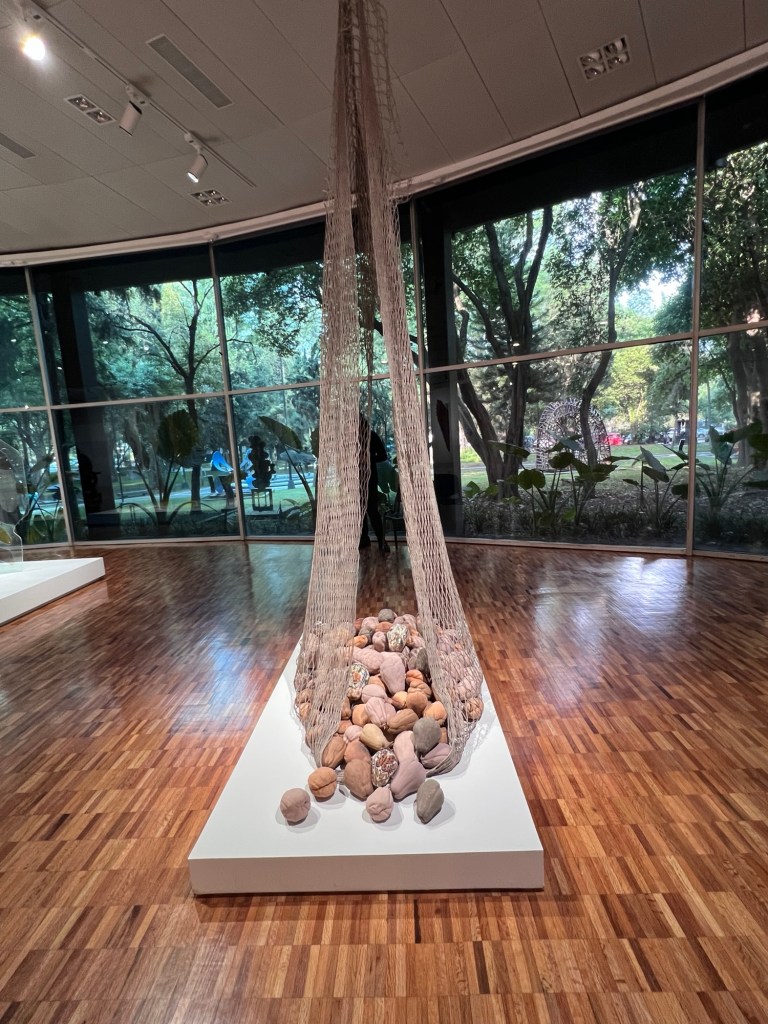
Not rocks, but cute fabric pillows
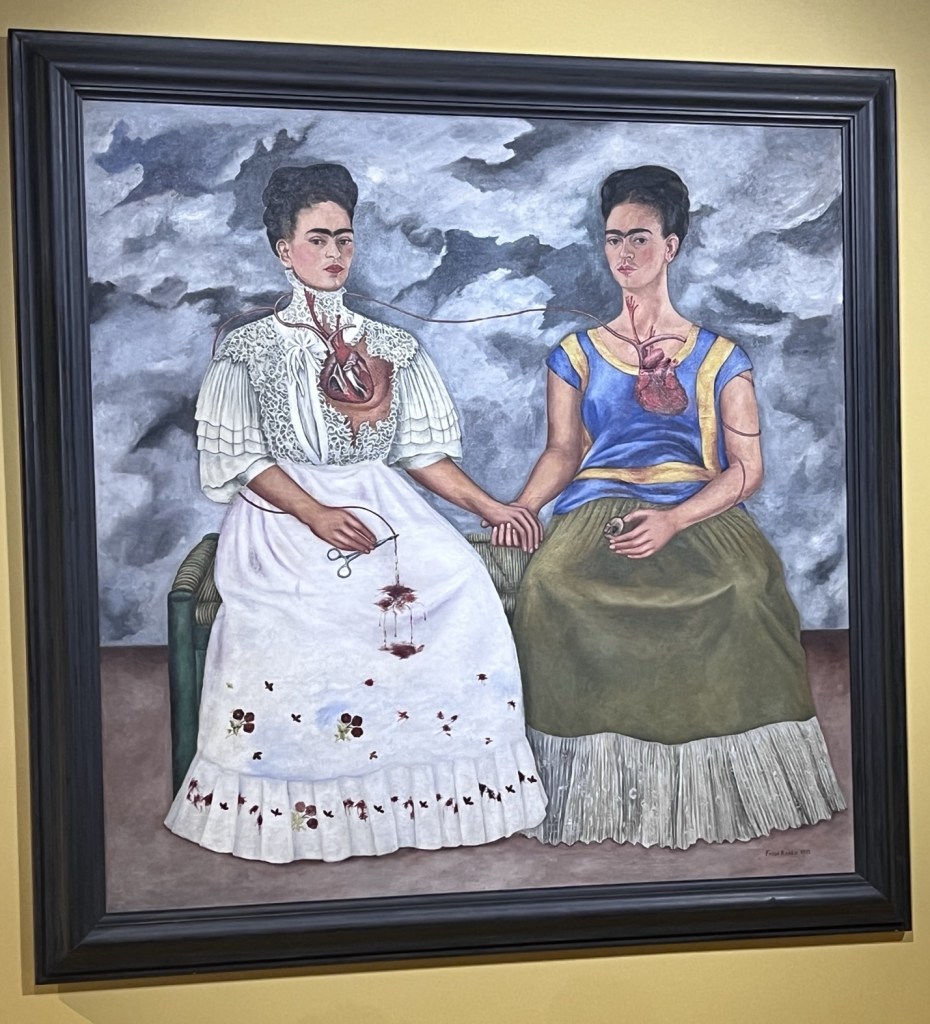
The Two Fridas

The remarkable painting, The Two Fridas, was painted by Frida Khalo in 1939, the year she and Diego Rivera divorced. The painting featured two seated figures holding hands and sharing a bench in front of a stormy sky. The two Fridas are identical except in their dress. The healthy heart of the Mexican-dressed Frida, on the right, represents the Frida that was loved by Diego Rivera. The broken, bleeding heart of the European-dressed Frida, on the left, symbolizes Rivera’s rejection of her. The vein connecting the two hearts shows their link, while the surgical forceps in the European Frida’s hand, as well as the blood stains on her dress, illustrate her efforts to stop the bleeding from their broken relationship.

Our visit to the Museo de Arte Moderno was short but sweet, and at exactly 5:30 the museum closed and we went on another search for an Uber. Fortunately, it has been incredibly easy to use Uber throughout our trip even at the busiest times of the day, and they have always been reasonably priced.

Selecting a place for dinner was a challenge since every block had several intriguing places to choose from. We ended up at El Zorzol Condesa, a “classic Argentine” restaurant. It had a quiet and lovely dining area and a great selection of steaks and seafood. I shared a gigantic, delicious steak with Amy and Steven, and Dan had seafood.

One last stop before heading back to pack, was a visit to the large bookstore we had passed numerous times during our visit. I had seen a display of children’s books in the window and thought it would be fun to purchase a few for our granddaughter, Maya. It turns out that Liberia Rosario Castellanos was a famous bookstore and cultural center named after the renowned Mexican poet and author, Rosario Castellanos.

The number of children’s books was enormous. I ended up asking a 4 year old boy, and his father, what they would recommend for an almost 3 year old. The boy was adorable and had no problem recommending some of his favorite reads. Since one of them was a Bluey book, I’m almost certain Maya will be happy with our selection. Of course all of the books were in Spanish, but I thought Maya might enjoy taking them to preschool where many of her teachers are Hispanic. I planned on translating them into English once I got home.
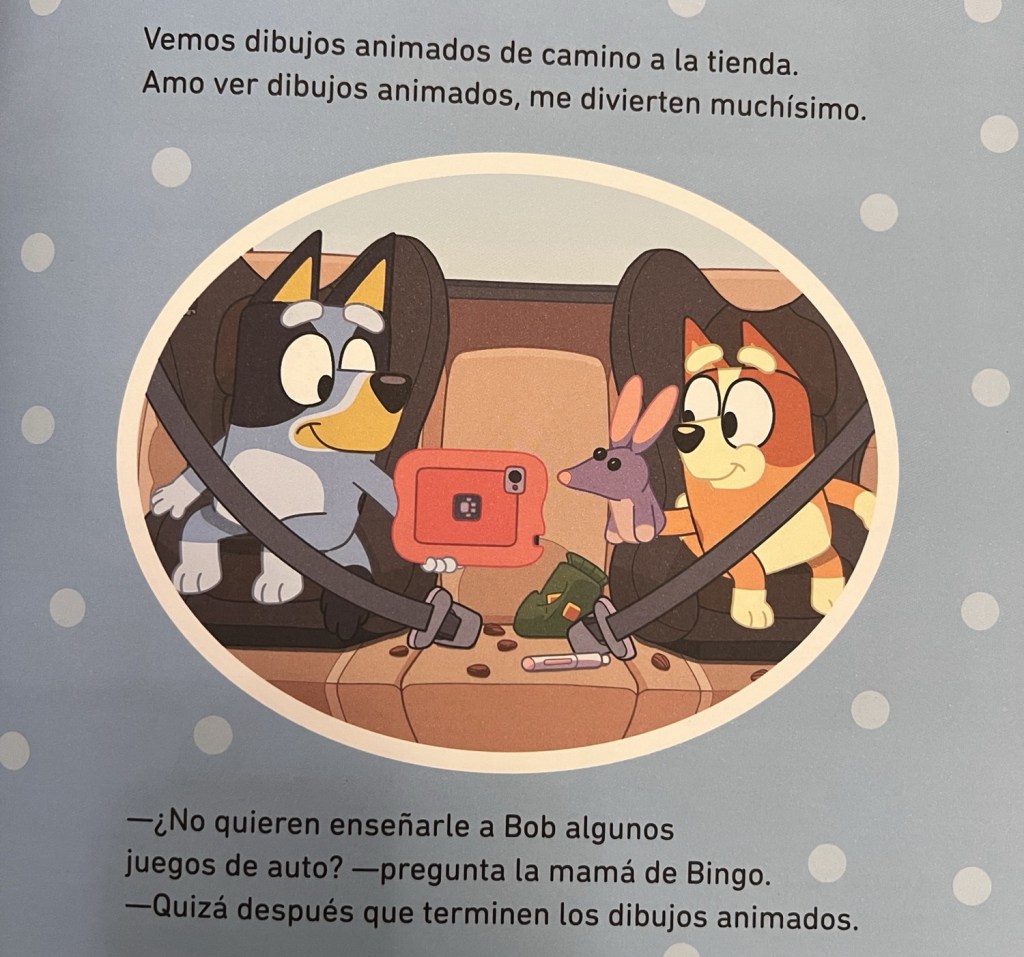
Page in Bluey book

It was time now to finish packing and get ready for tomorrow’s departure.

July 5, 2025

On the morning of our departure we made one last visit to “our” bakery and then ordered an Uber to take us to the airport. Having left plenty of time getting to the airport, it wasn’t stressful for us to figure out where to check-in and how to locate our gate. We were flying American Airlines with a stop in Charlotte, NC. For some unknown reason (I was not going to ask why), we had first class tickets. This allowed us to relax in the American lounge and left me with plenty of time to check out the duty free shops. We made it to Charlotte on schedule, caught our flight home to Cleveland on time, and were picked up by our limo driver as expected.

CONCLUSION

What a wonderful trip. It was a perfect balance of family, beach and city. However, we barely scratched the surface of Mexico City. It is an amazing city, and one of the more interesting places we’ve been. Below is a short list of some of the things that we would definitely want to see should we be fortunate enough to return:

  1. Diego Rivera murals and those of other artists such as Japanese-American muralist, Eitaro Ishigaki.
  2. Palacio de Bellas Artes, Mexico City’s cultural center. I would like to see a performance there, perhaps the Ballet Folklorica.
  3. Castillo de Chapultepec and more of the Bosque de Chapultepec.
  4. Xochimilco, ancient Aztec canals that are explored on flat bottomed boats.
  5. Food — There are so many foods and restaurants we didn’t try.
  6. There are a large number of museums we never had a chance to visit.
  7. It would be fun to explore more Mexico City neighborhoods

VIVA MEXICO!

Another Day Exploring Mexico City

JULY 3, 2025

Finally a relaxing morning allowing me the perfect opportunity to segue into the subject of breakfasts. The Condesa neighborhood is known for having some of the best bakeries in Mexico City. In our search for breakfast a day or two ago, we discovered a small bakery. There was a line of people waiting to order their pastries and coffee, and then having a seat at one of the outside tables to enjoy their goodies. We took the line as a good sign and joined everyone in line waiting for our turn. When we first walked inside our immediate reaction was to turn around and run out the door. The place was swarming with bees. (At least it wasn’t flies.) Evidently the bees wanted their pastries too. It wasn’t an easy thing for the four of us to do, but we put our gringo attitudes on hold and gave the place a try. Are we ever glad we did. The pastries were fantastic and the coffee perfect.

As much as we loved our little bakery, we were headed somewhere else today so we could get a small taste of Jewish life in Mexico City. We had heard of the famous New York style delicatessen, Mendl’s, and made our way there.

Mexico has a prominent Jewish community of about 67,000 people, about 95% of which live in Mexico City. Most are Sephardic and Mizrahi Jews who came from Southern Europe, the Middle East and North Africa. Mendl’s, however, serves Eastern European Jewish foods.

Conversos, Jews forcibly converted to Catholicism, first arrived in Mexico in 1519. Some truly converted, however, others practiced Judaism in secret and were called Crypto-Jews. The persecution of Jews had followed them from Spain to “New Spain,” although it was never as severe. It wasn’t until 1821, when Mexico gained its independence, that religious tolerance evolved. In the late 19th to early 20th centuries there was an influx of Jews from around the world settling in Mexico.

Mendl’s menu was similar to one you would find in New York City or at Cleveland’s Jack’s Deli. A bit of Mexican flavor intermingled with standard deli fare that you wouldn’t see on a menu at home. For example, house-made salsas were available to add to dishes like corned beef or pastrami sandwiches. I also thought I detected a hint of Mexican flavoring in their corned beef. We really hadn’t had a bad meal since arriving in Mexico, and Mendl’s was no exception. Everything was fresh and delectable.

Dan at Mendl’s

I was really looking forward to visiting today’s destination — the Museo Frida Khalo, located in the Coyoacan neighborhood of Mexico City. We had made reservations at noon for the four of us, as well as for our cousins.

The Kahlo house is also known as Casa Azulejo (Blue House) because it is painted in azul anil, a deep, vibrant blue typical of Mexico. Essentially you toured the house on your own simply by following a clearly marked path and reading explanations in English along the way. What was so nice was that you could take as much time as you wanted and were never rushed.

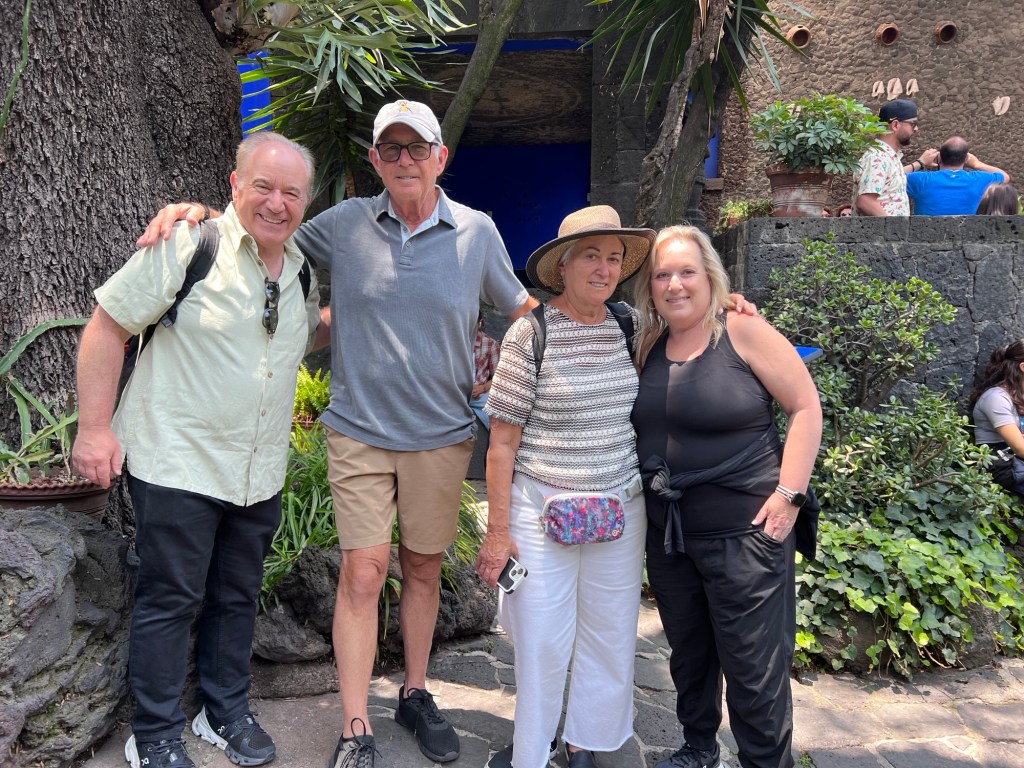
From left to right: Danny Rossen, Steven Berg, Amy Weisman Berg, and Lauren Hochberg Rossen
Cousins Marty Rosenthal and Debby Rossen Rosenthal

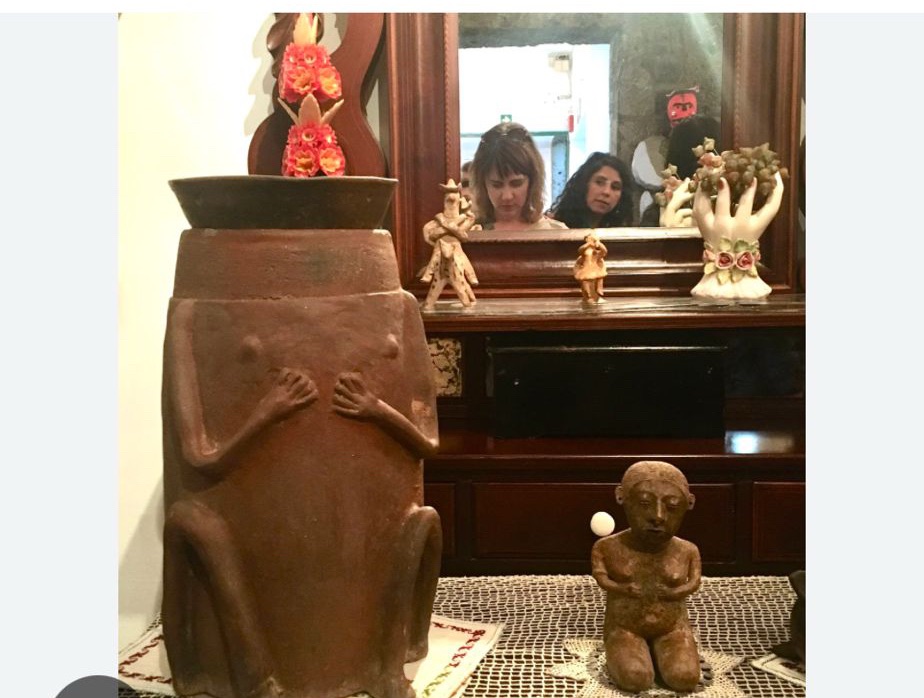
The house was built by Frida Khalo’s father, Guillermo in 1905. He was originally from Germany and made a living as a professional photographer. Her mother, Matilde Calderon y Gonzalez, was of indigenous and Spanish descent and a devout Catholic. Kahlo was born in the blue house in 1907. It was her lifelong residence, her creative sanctuary, and where she died in 1954 at the age of 47. Even in death she is still literally in the house. Her ashes are kept in a pre-Hispanic frog shaped urn which sits on a table in her bedroom. I found out later that the urn’s toad shape symbolized her affection for her husband, Diego Rivera. Her nickname for him was “el sapo” or the frog. If you’ve seen photos of him, you might understand why she called him that. He was an unlikely lady’s man, but his artistic talent, personality and fame must have been what drew women to him.

Photo of the urn holding Frida Kahlo’s ashes

Frida Khalo was one of the 20th century’s best known artists, and her life and artwork continues to fascinate people. The artwork of both Khalo and her husband Rivera, are displayed in the house along with their collection of Mexican folk art and pre-Hispanic artifacts. Khalo dealt with terrible illnesses and injuries throughout her life. She contracted polio as a child, and tried to cover up the fact that one leg was thinner and shorter than the other by wearing Tehuana dresses, (the traditional clothing worn by indigenous Zapotec women), as well as corrective shoes.

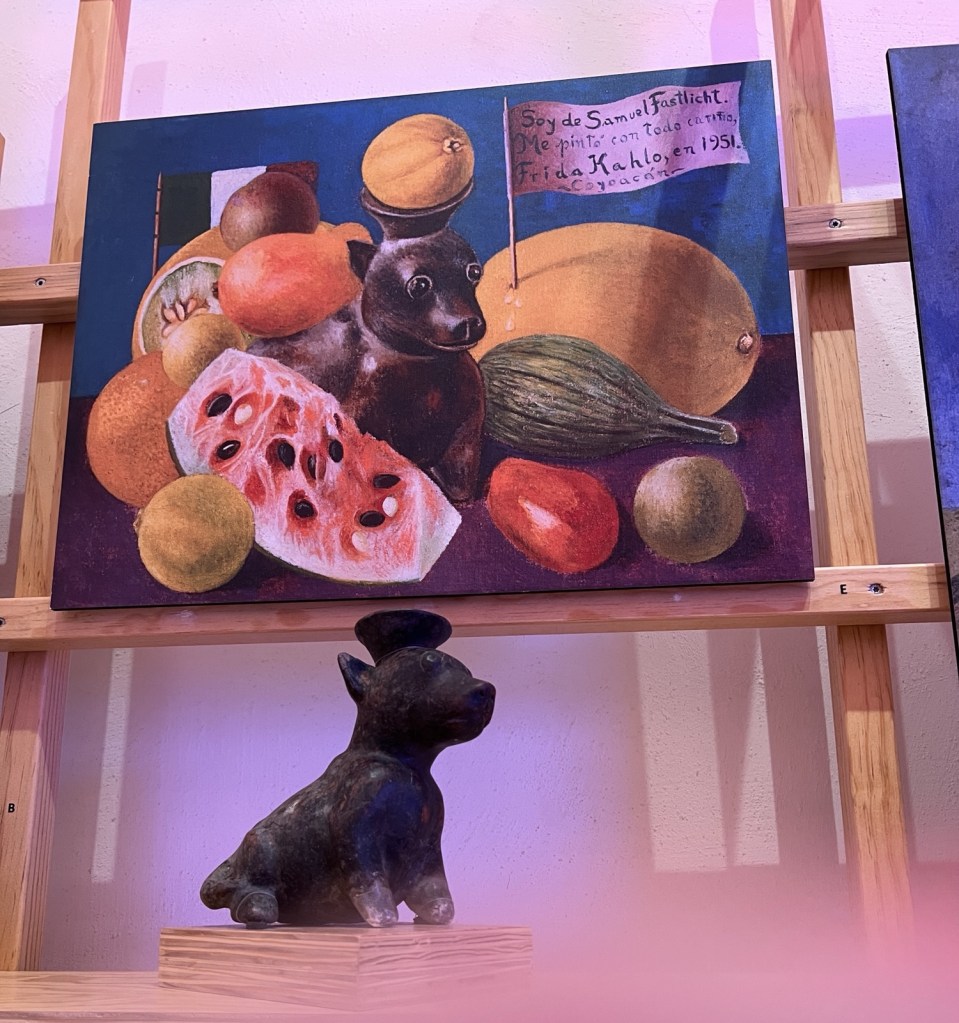
“Still Life,” painted by Frida Kahlo in 1951 for her friend and dentist, Samuel Fastlicht. It was painted when she was bedridden and pictured a collection of fruit, a ceramic dog, and a small flag reading “I belong to Samuel Fastlicht.” The ceramic pre-Hispanic dog she painted is seen below the painting.
Frida Kahlo’s kitchen. The papier-mache sculpture hanging on the wall is a work by Saulo Moreno known for his unconventional works.
Typical Frida Kahlo Tehuana dresses

At 18, Khalo sustained horrific injuries in a bus accident, and as a result she suffered from chronic pain the rest of her life. Internal injuries were most likely the reason she incurred multiple miscarriages. The sadness of never having a child weighed heavily on her and was often reflected in her art.

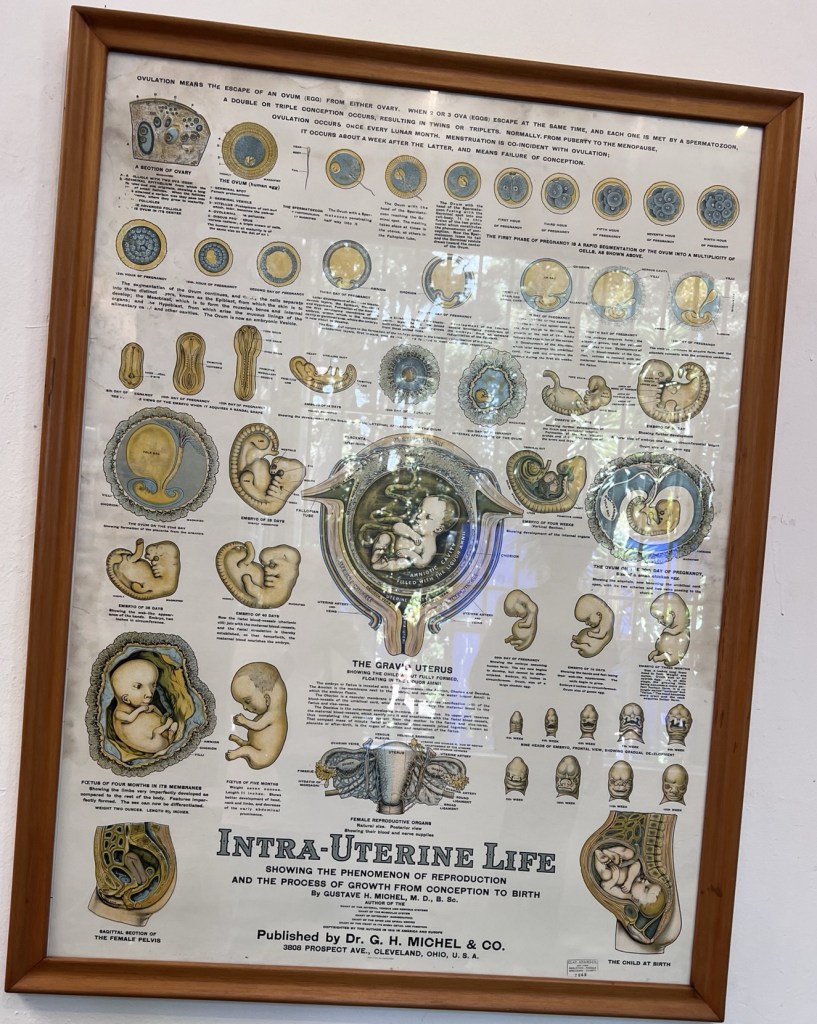
On one of the walls I found this poster of “Intra-Uterine Life” from Cleveland, Ohio

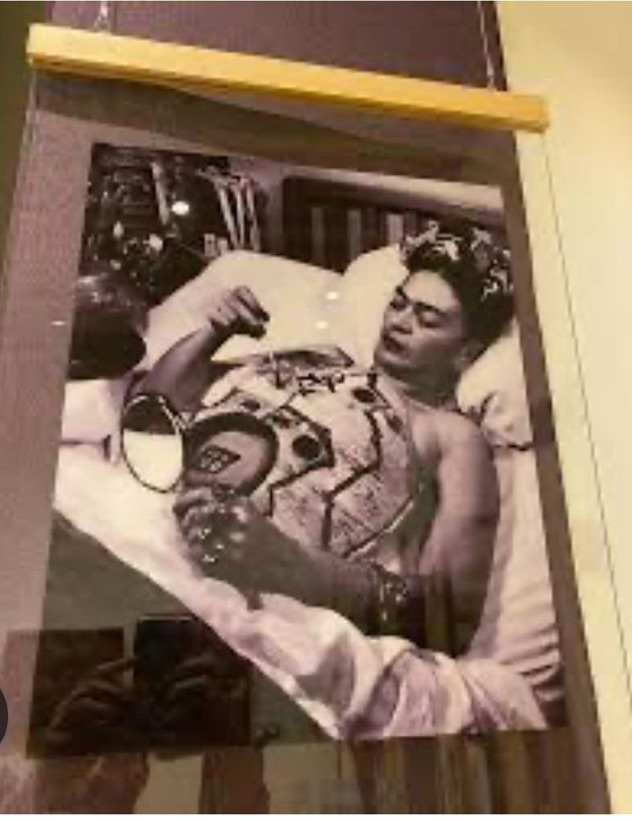
While bedridden, Kahlo began painting. To help her daughter through her convalescence, her mother placed a mirror above Frida’s bed so she could see herself and paint. Many of her paintings were self portraits. The pain in Kahlo’s life was not only physical. Her marriage to muralist Diego Rivera was passionate and destructive. It was marked by infidelities, separations, and eventually divorce in 1939, primarily due to his affair with her sister, Cristina. They remarried in 1940, and despite continued infidelities, their saga continued until her death.

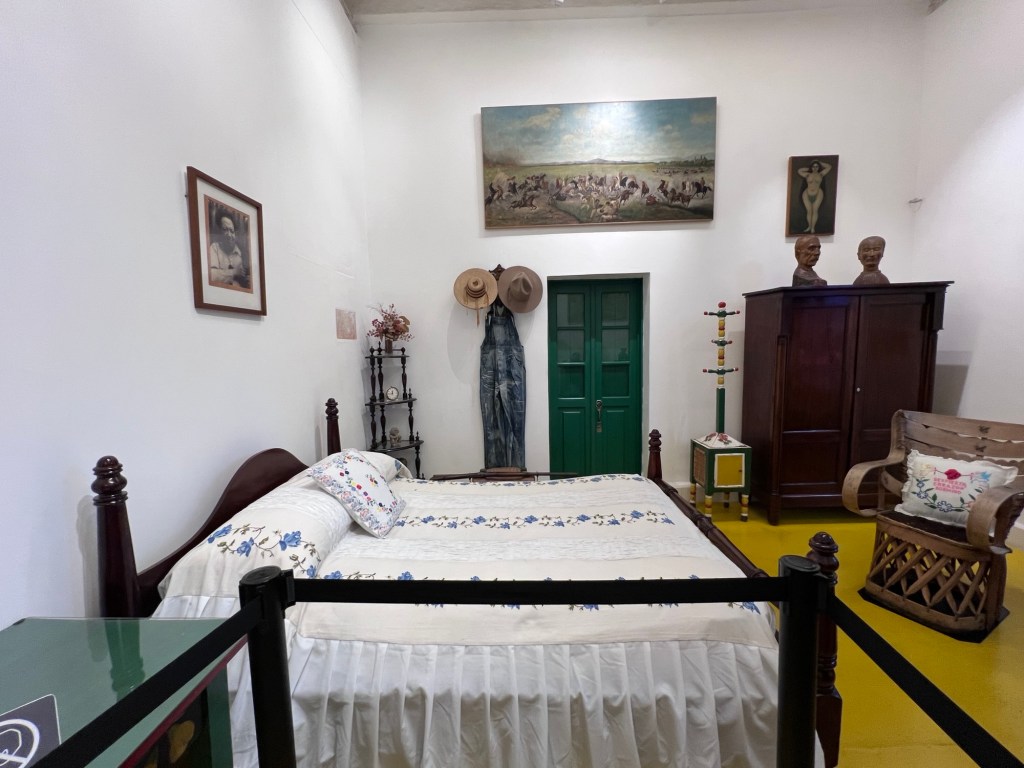
Kahlo’s bedroom
Frida Kahlo in her bed

Khalo joined the Communist Party in 1927 and was politically active her entire life. She embraced post-revolutionary nationalism, advocating for indigenous culture. This stance was reflected in her art, her Tehuana dresses, and even her garden filled with native plants. In 1937 Frida and Diego welcomed Leon Trotsky to live at their home. She had a short affair with Trotsky, but their relationship remained cordial. Despite that, she was falsely suspected of being involved in his assassination and was briefly jailed. While she continued to be supportive of Soviet ideals, she eventually became disillusioned with Stalinism.

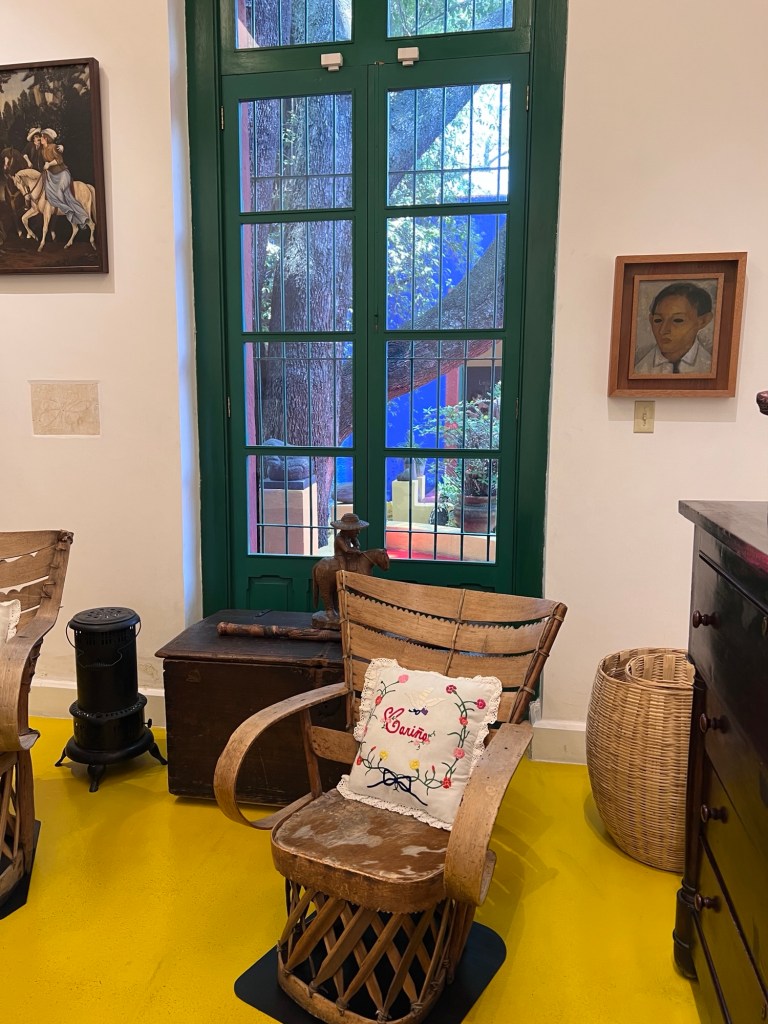
It was an all encompassing experience being surrounded by her art and belongings. You couldn’t help but come away with a better understanding of the woman, her world and her art. Seeing her bedroom was especially poignant since the mirror over her bed was still there, as were her ashes. It was a charming house. The courtyard garden was lovely, and you could imagine Frida Khalo enjoying the view outside her bedroom window.

Khalo’s bedroom window
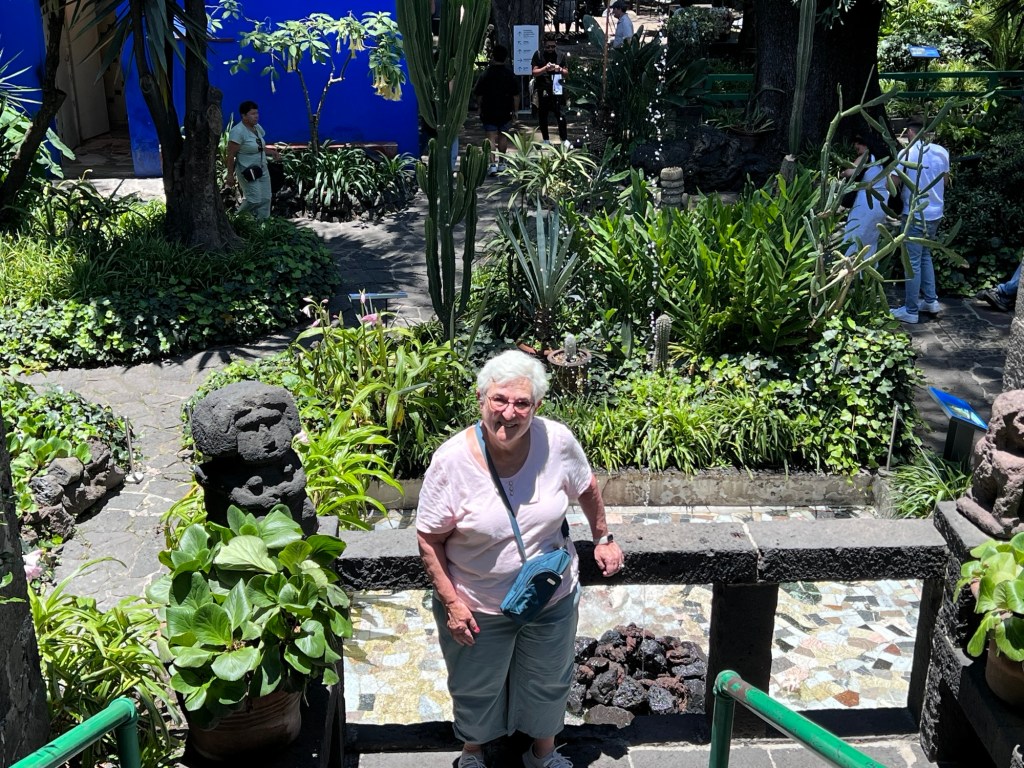
Courtyard garden and me
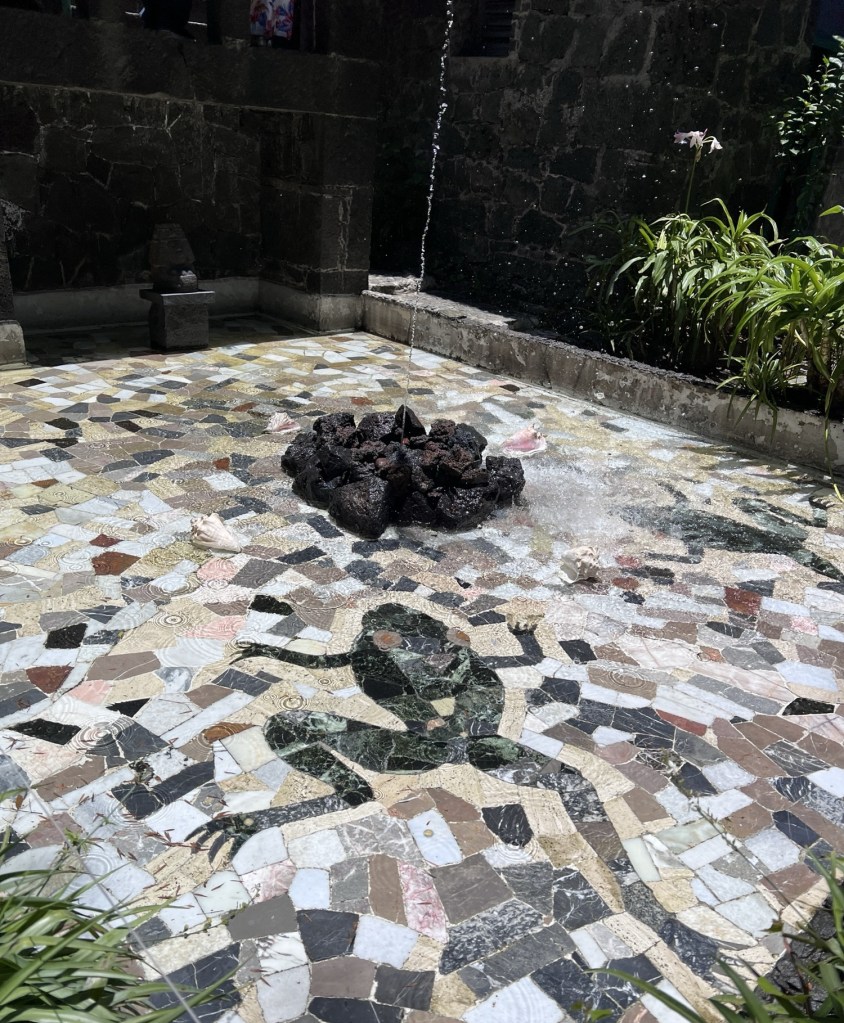
Frog mosaic fountain

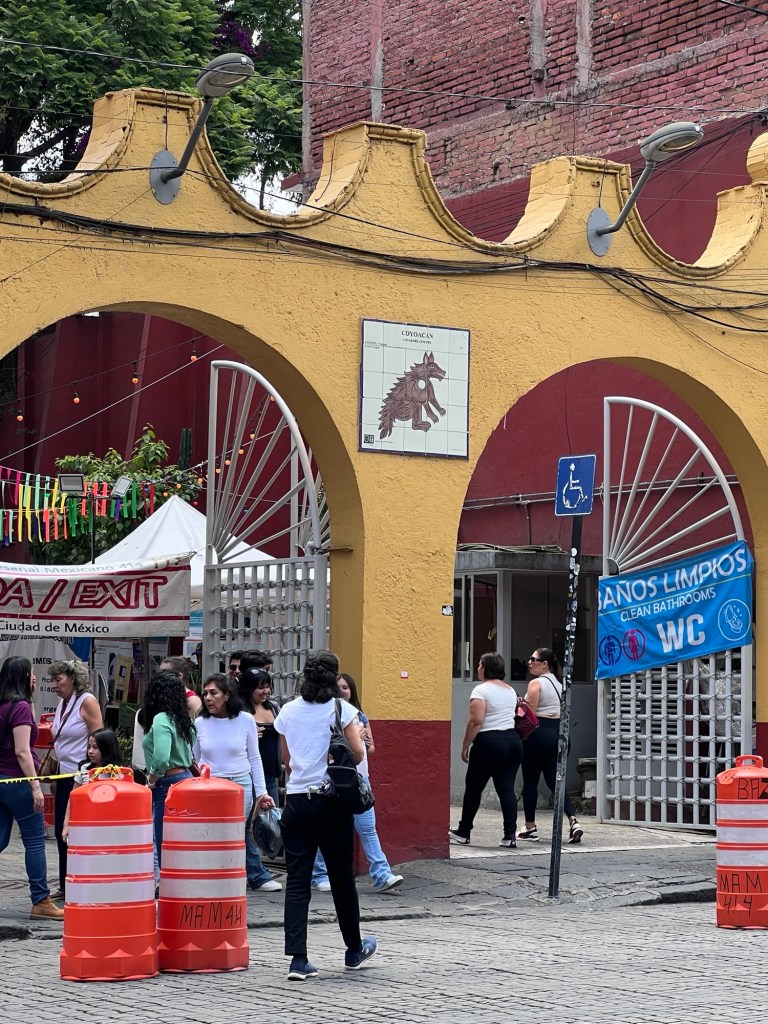
Cuyoacan (Place of Coyotes in the Nahuatl language) was where Hernan Cortez settled after defeating the Aztecs. At the time Kahlo lived there it was a village sitting about 7 miles outside Mexico City, and only in the past few decades has urban sprawl taken over. It is a fascinating place filled with narrow colonial-era streets, cafes, craft markets, parks, shops, and restaurants. Even on a Thursday afternoon the streets were filled with people.

Cuyoacan street

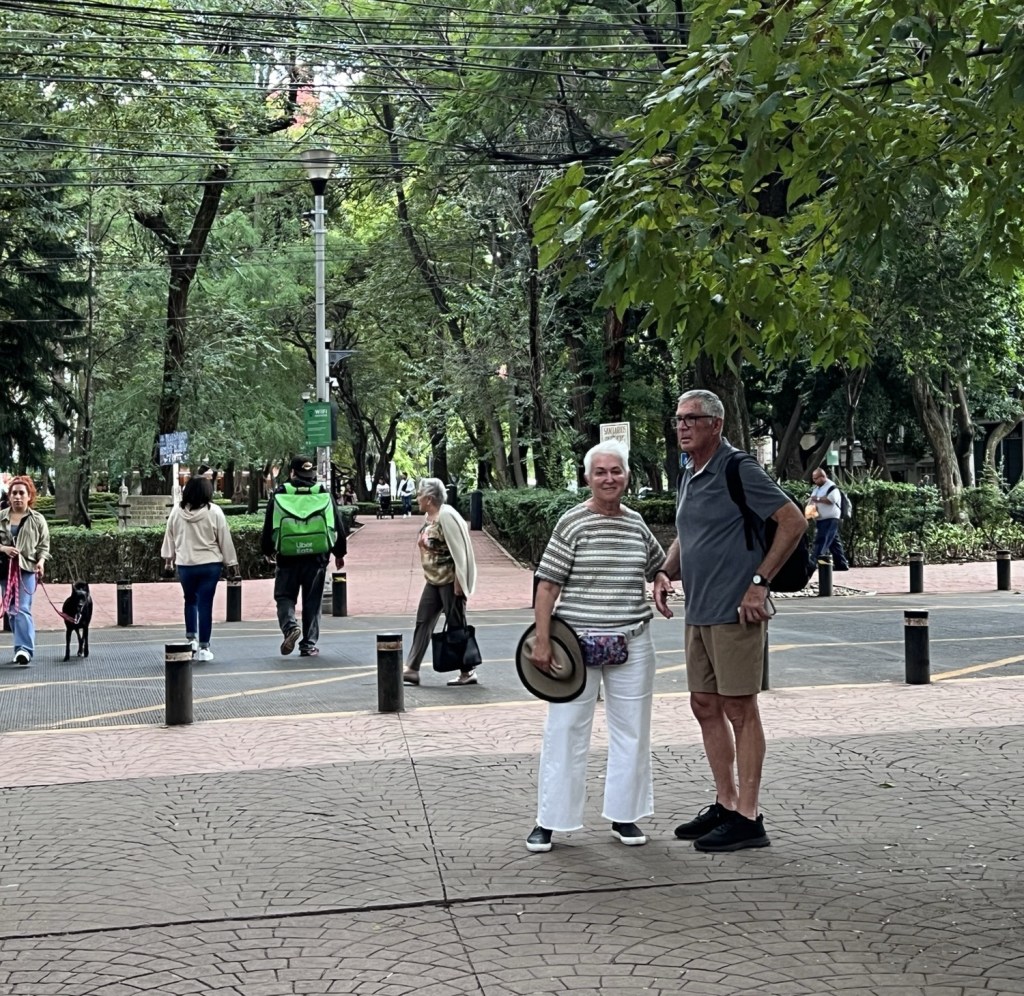
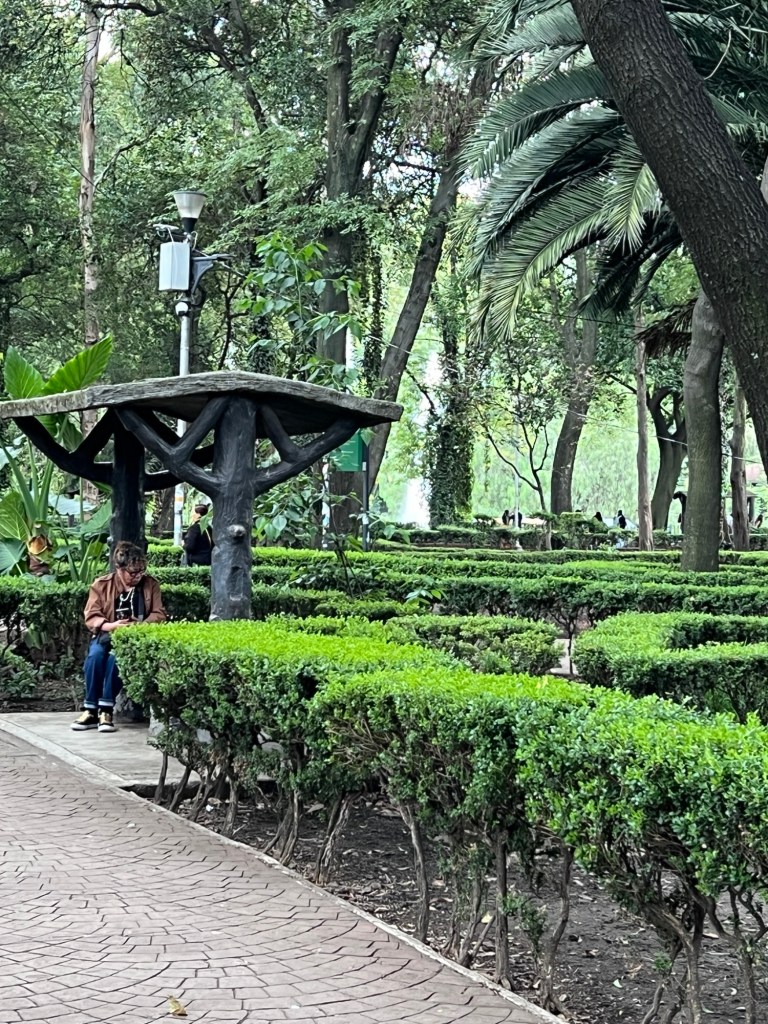
I wish we had more time to wander the charming streets of Cuyoacan, but we wanted to head back in the direction of our hotel. We had dinner reservations at a Michelin star restaurant, Esquina Comun, but first had our Uber driver drop us off in the center of Condesa. Amy and I wanted to do a little shopping and we managed to do some damage at a cute clothing store named Bout Rufina. In the heart of the neighborhood is Parque Mexico designed by Jose Luis Cuevas in 1925. The area was once a race track which accounts for the park’s oval shape. Parque Mexico was beautifully laid out with fountains, trees, and charming walking paths.

Parque Mexico in Condesa
Amy and Steven on our walk in the park

Tonight we were once again meeting up with our cousins, this time at Esquina Comun, Originally guests dined in chef Ana Dolores Gonzalez and her partner’s apartment. The restaurant is now located in a rooftop space reached by climbing several flights of steep stairs. The place was small, charming and had a very relaxed vibe. Oddly, only plastic sheeting protected us from the rain showers that started that evening. The restaurant offered a tasting menu, which was perfect for sharing. Dan and I ordered the amazing dishes below:

  1. Fish tostada, rice and seaweed, chintextle mayo (made from Oaxaca smoked chili paste made from dried chili peppers, avocado leaves and garlic), chile manzanita (Oaxacan chili paste fused with a fruit component and a creamy base), tangerine and cashew salsa, quelites (a generic term for edible plants or herbs native to Mexico), and radishes
  2. Shrimp crudo (an Italian inspired appetizer made from thinly sliced prepared or raw shrimp), passion fruit and lemongrass sauce, salt and vanilla oil, chochoyotas (small,round corn masa dumplings from Oaxaca), basil seeds, chalaca (a Peruvian sauce made with lime juice, onions, tomatoes, and Peruvian ahi amarillo. Ahi Amarillo is an orange Peruvian chile pepper) and elderflowers
  3. Wagyu cross (crossbred cattle), smoked bacon stock, baked on embers, sweet potato purée, chicatana mayo (condiment made with ground, toasted flying ants known as Chicatanas), pineapple pico de gallo, and pickled cabbage. Note: We had no idea we ate ants until I looked up the ingredients.
  4. Dessert: Tonka bean grenache (tonka beans are seeds from a South American tree prized for its complex aroma and flavor which is a mix of vanilla, almond, and cinnamon), mango, coconut foam, fresh lychee, tonka bean oil, and coconut powder

The dishes were extraordinary and delectable, and the service impeccable.

Wagyu Beef

We headed back to our hotel feeling very satisfied with how we had spent our day, and how it ended with a marvelous dinner.

MARKET DAY IN MEXICO CITY

July 2, 2025

Today we were embarking on an adventure. I had booked a guided food tour of the La Merced and Sonora markets through Get Your Guide. Just the day before we had been warned that this area was somewhat dicey. Via earlier texts, our guide for this tour, Gabriel, assured me of the safety of the area and of the food we were going to sample. So, at 10:00 AM we met him and the rest of our group at the Parque Francisco Primo de Verda’s y Ramos near the Zocalo.

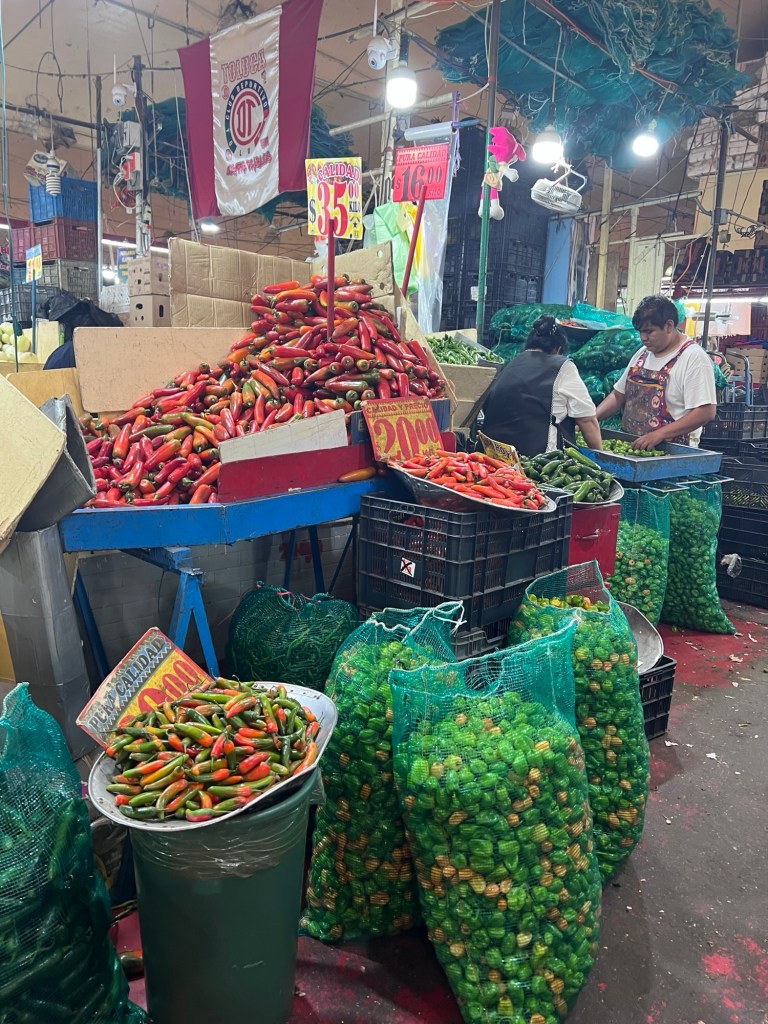
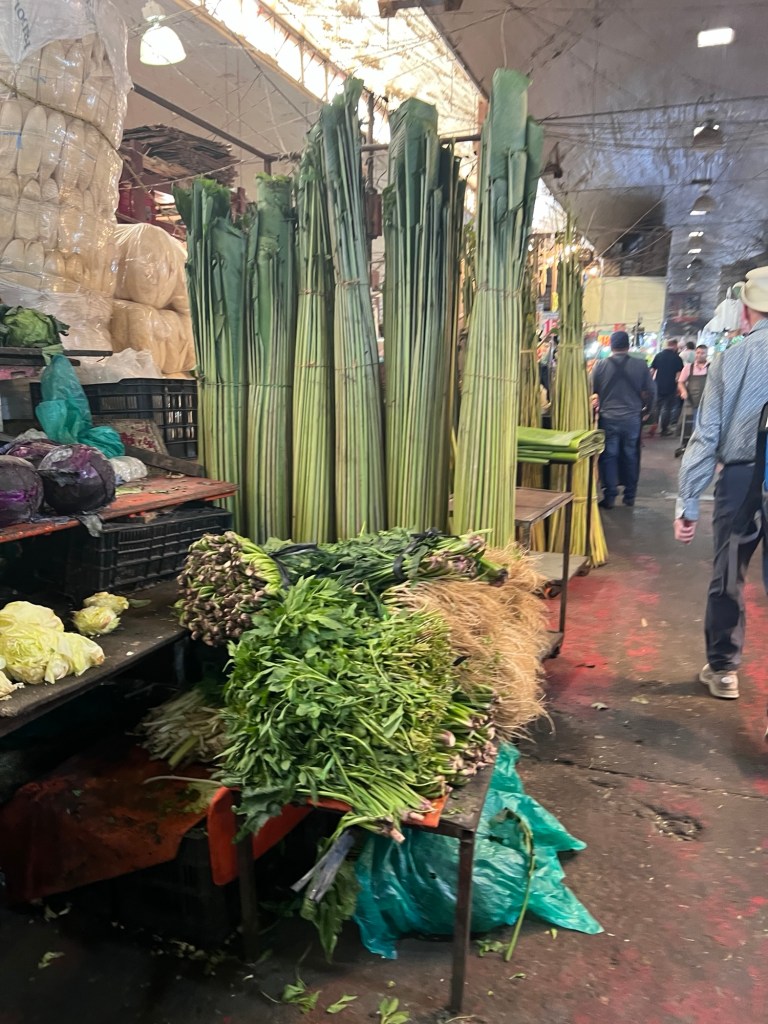
La Merced is the largest traditional retail purveyor of foodstuffs, toys, clothes, flowers, candy and much more in Mexico City. Most of our time was spent in the largest building primarily dedicated to the sale of fruits, vegetables, meats and spices. Other stalls were miniature fast food restaurants offering an incredible variety of Mexican dishes, non-alcoholic drinks, and sweets. Some even had small eating areas. One’s senses were overwhelmed by the colors, sounds, and unfamiliar aromas of the place.

The market was humming with activity, and was so crowded our group often found it difficult keeping up with Gabriel. Getting lost amidst the countless rows of stalls would have been extremely easy. Fortunately Gabriel had two young people working with him. They were being trained to become guides and did a remarkable job of keeping our group of 10 together. All three guides were wonderful, informative, and fluent in English.

The Barrio La Merced neighborhood has been a center for commerce since the Spanish conquest. At the end of the 18th century it was already a huge marketplace. By the 1860’s permanent buildings were constructed to house the ever growing marketplace. It wasn’t until the 1960’s that a competitor came on the scene, the La Central de Abasto market. However, La Merced continues to be the city’s largest “traditional” marketplace. Gabriel told us that the city wanted to shut the place down. I read, however, that while some sections would be closed, it was for renovation purposes only, and there were no plans to shut it down completely. Vendors, however, were concerned that their livelihoods might be greatly impacted if either scenario proved to be accurate.

Our eating frenzy began with Red Pozole, a traditional Mexican soup/stew made from hominy (corn kernels), tender chicken or pork, in a rich red chile broth. Dan and I tried the pozole with chicken and found it to be tasty, and not overly spicy despite the dried chiles. The corn kernels were enormous and came from a variety called cacahuazintle. It reminded us of what we had eaten in Peru. A second soup called Pancita was also offered. It was made from tripe (cow’s stomach)in a red chili broth served with hominy, onion, oregano and lime. We passed on that one.

Getting ready to enjoy Red Pozole

Aqua Fresca Horchata came next. It is a delicious creamy, sweet concoction made with cinnamon, milk, vanilla and rice. This was followed by a fruit vendor who gave us samples of a local fruit called Mamet. It comes from a native tree found in southern Mexico. Brown on the outside, the fruit looked like a papaya on the inside. Mamet has a rich, sweet flavor similar to something like pumpkin or sweet potato.

There are over 500 varieties of avocados in the world, with the Hass being the most popular. One of the vegetable vendors introduced us to the Aguacate Mantequilla, or butter avocado. What makes this avocado so unusual is that except for the pit you eat the entire fruit, skin and all. It was much more flavorful than the Hass, with an exceptionally creamy texture and rich buttery taste.

Peppers of all kinds and tomatillos
Produce and corn husks before they were dried

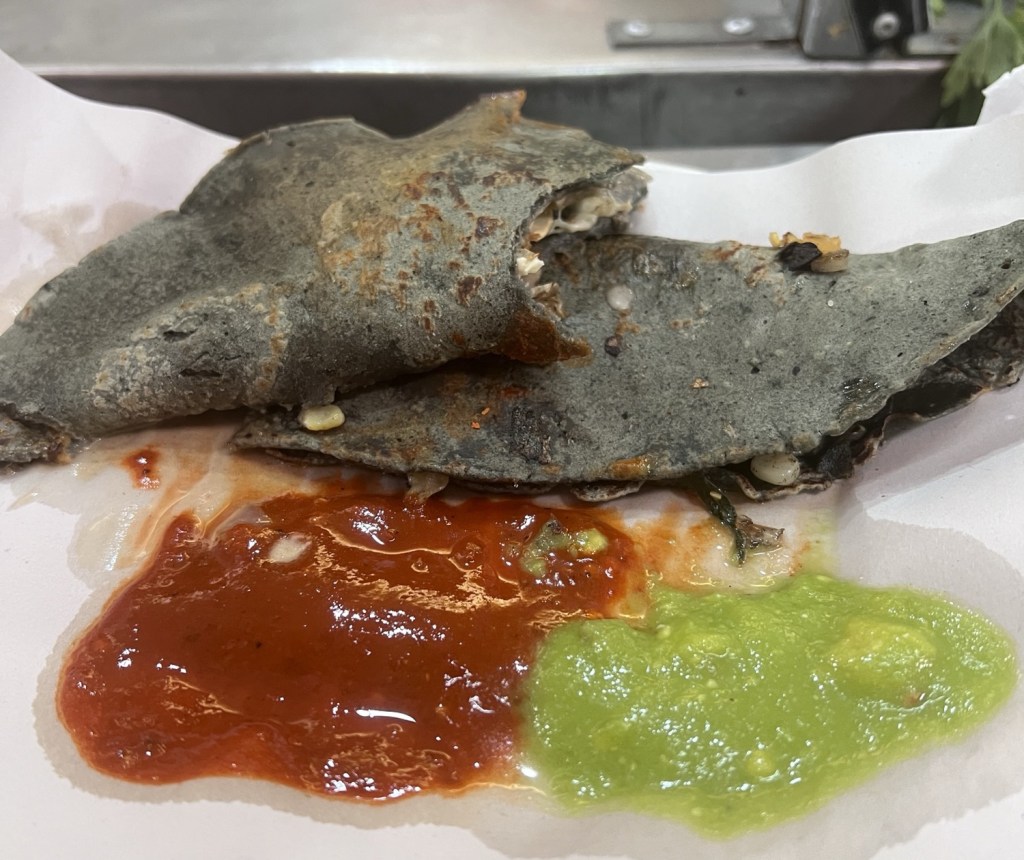
Mushrooms are a fungus that most of us eat, so eating quesadillas made from a fungus known as Huitlacoche that grows on corn should be ok to eat —right? This fungus also goes by the lovely name of “corn smut,” or the much more pleasant name of “truffle of corn”. Huitlacoche is actually a fungal disease forming tumor-like galls on the ears, stalks, leaves and tassels of corn. If collected before the galls dry out and rupture, they are considered a culinary delicacy. We watched as two women made us quesadillas from a pile of grey fungus. I had mine filled with chicken, cheese and grilled onions. Frankly, it didn’t taste much different than a quesadilla made from flour, but we felt rather courageous for trying it.

The grey pile is fungus from corn used to make our quesadillas
Women making our quesadillas
My quesadillas

We weren’t finished yet. Now we were trying two types of deep fried tamales. The first one was made with tomatillo and green chile. The second one was a rajas tamale. This dish consisted of corn dough filled with slices of roasted poblano peppers and cheese wrapped in a corn husk and steamed. Along with the tamales, we were served Atole, a hot Masa-based beverage made with cinnamon, milk and vanilla. Masa is corn flour, and created a drink similar in consistency to a milk shake. Lastly, another vendor treated us to freshly squeezed pineapple juice—it was soooo good.

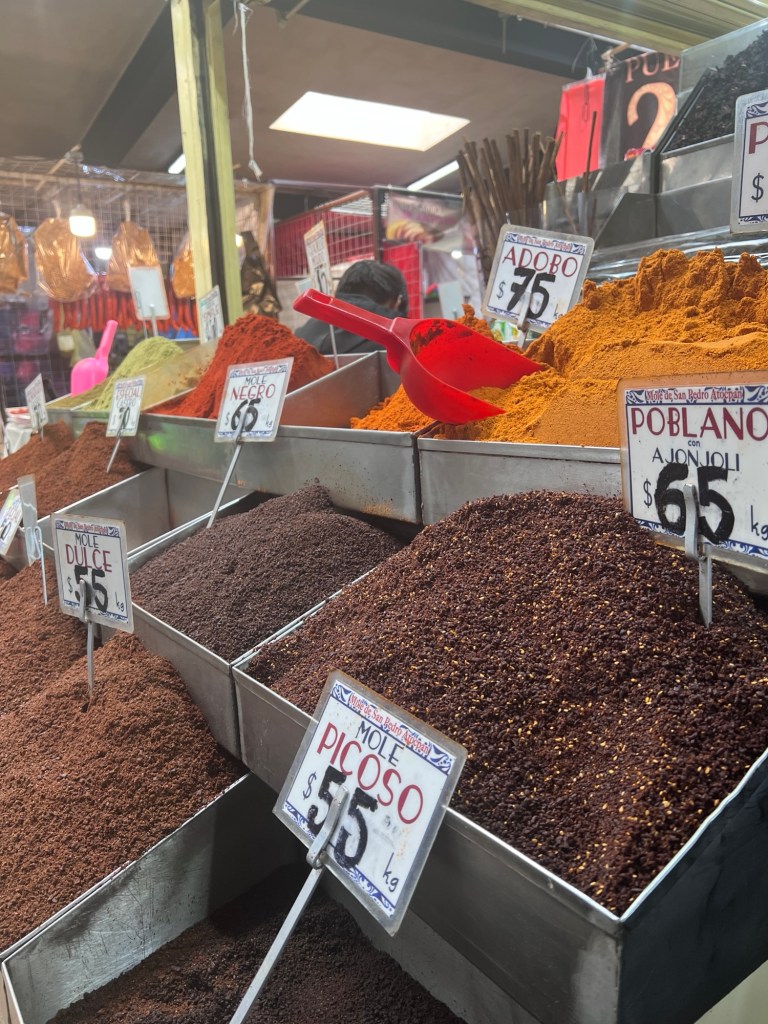
All of us were so full we were bursting at the seams. As for Dan and myself, there wasn’t anything we tried that we wouldn’t have eaten again. Before leaving La Merced we had the chance to purchase mole at a stall offering an amazing array of dry mole, each with its own combination of herbs, spices, chiles, etc. . Our choice was a mole that wasn’t too spicy, and had notes of chocolate. Now I’ll have to figure out what to do with it.

Mole Anyone?

On our way to the Sonora Market which is essentially adjacent to La Merced, we took a potty break. I would like to point out that everywhere in Mexico, even in a somewhat grungy market place, the bathrooms were clean. Much better than many bathrooms I’ve visited in U.S. gas stations. The bathrooms might have been old and dingy, but it was worth paying an attendant a few pesos knowing the place would be clean. It was important to bring your own Kleenex, however, because you were handed a few thin sheets of toilet paper. I was very grateful for the cleanliness. Due to my stomach issues I visited many a bathroom.

While the La Merced Market focused on food, the Sonora Market focused on mundane goods such as shoes and party supplies. However, it is best known for its sale of unique items for religious or mystical practices and is referred to as the Witchcraft Market.

Anyone need a pair of shoes?

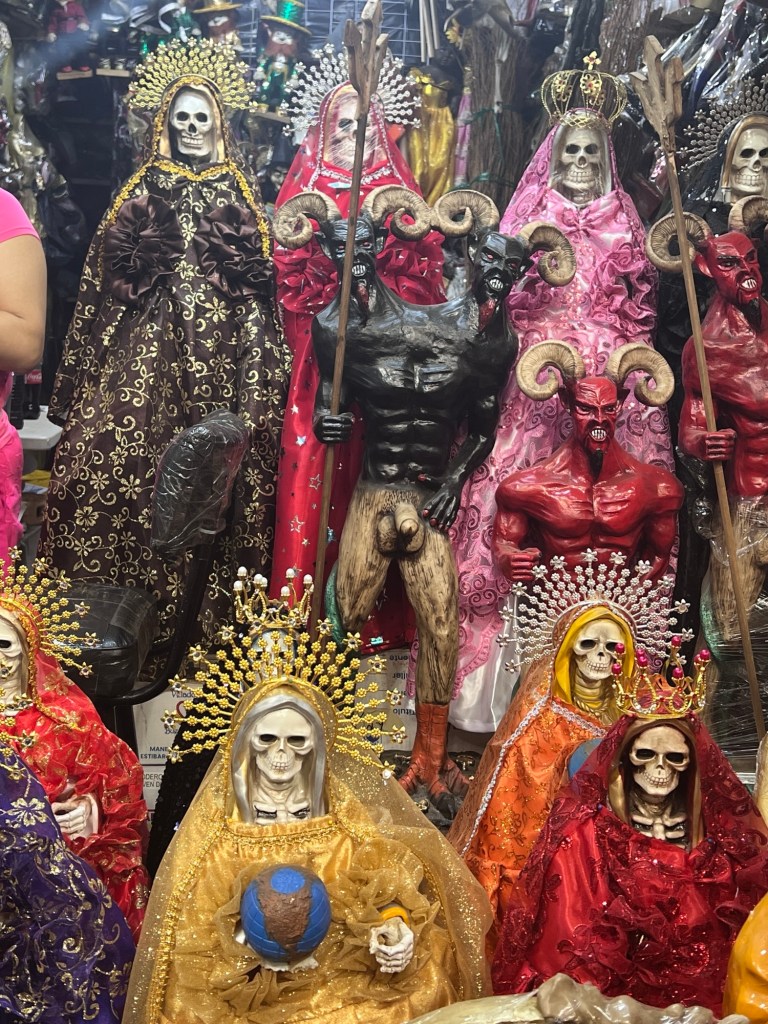
Buy a statue for good or evil purposes

If you want to force someone to fall in love with you, or wished to curse someone, you could find the ingredients needed to make that happen at the Sonora market. Advisors can tell you exactly what you need to purchase. There were soaps that if used could make you rich or improve your sex life. Plenty of creepy statues lined the aisles that could grant you your wishes, including wishing someone dead. You could even buy the statues different outfits that would change their supposed purpose. There was also a live animal market that we chose not to visit. This area has the reputation of keeping caged poultry, rabbits, dogs and cats in terrible sanitary conditions. Supposedly the animals are meant for farm or home use.

The Aztecs, along with other pre-Colombian civilizations, consumed fried insects to provide them with a significant amount of protein. They are still considered a delicacy today and are incorporated into dishes made by street vendors and gourmet chefs. We had the chance to try fried grasshoppers, ants (chictana), crawfish, beetles, scorpions and maguey worms (edible insect larvae). I took a bite of a beetle. It had no taste and was crunchy—yuck. Dan ate a variety of insects and confirmed that they had little flavor outside of the oil they were fried in and that they were crunchy.

Insects to go

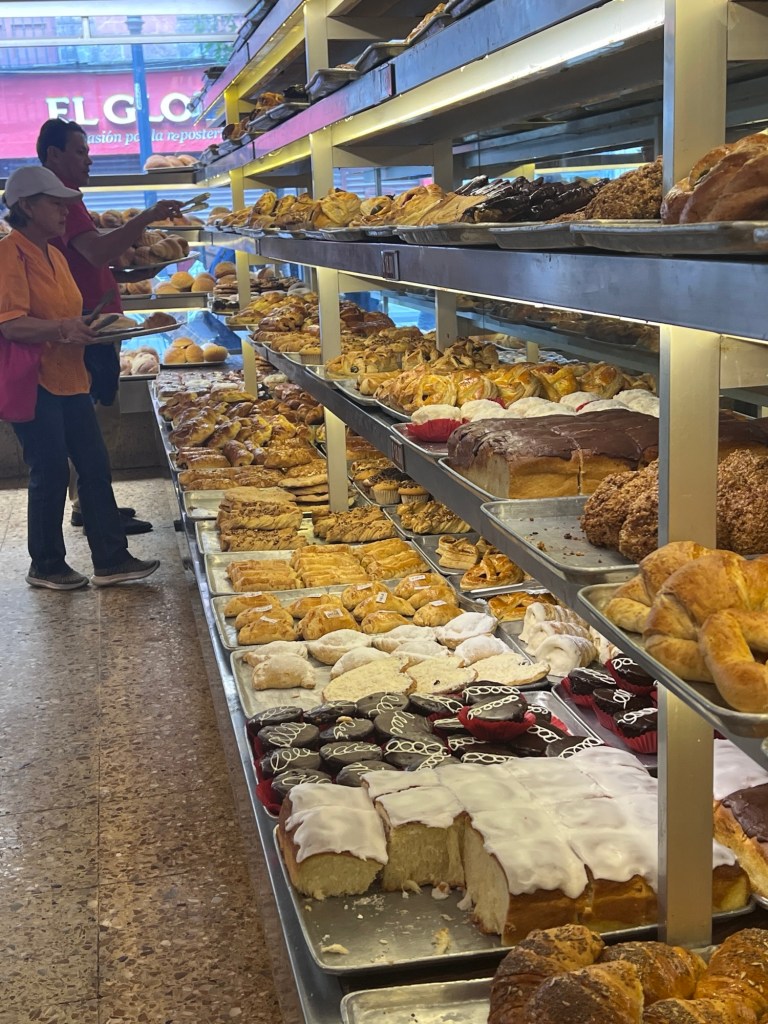
It was then back to the Zocalo for our last food tour stop, the incredible La Madrid bakery. We’ve never seen so many pastries in one place. Although we were too full to eat, Gabriel said we should pick out whatever we wanted and take it with us. We felt like kids in a candy shop. Between the four of us we had enough pastries for several breakfasts. After saying goodbye to Gabriel and his crew, we sat down in the bakery to enjoy drinks, relax and discuss where we would head to next.

La Madrid bakery

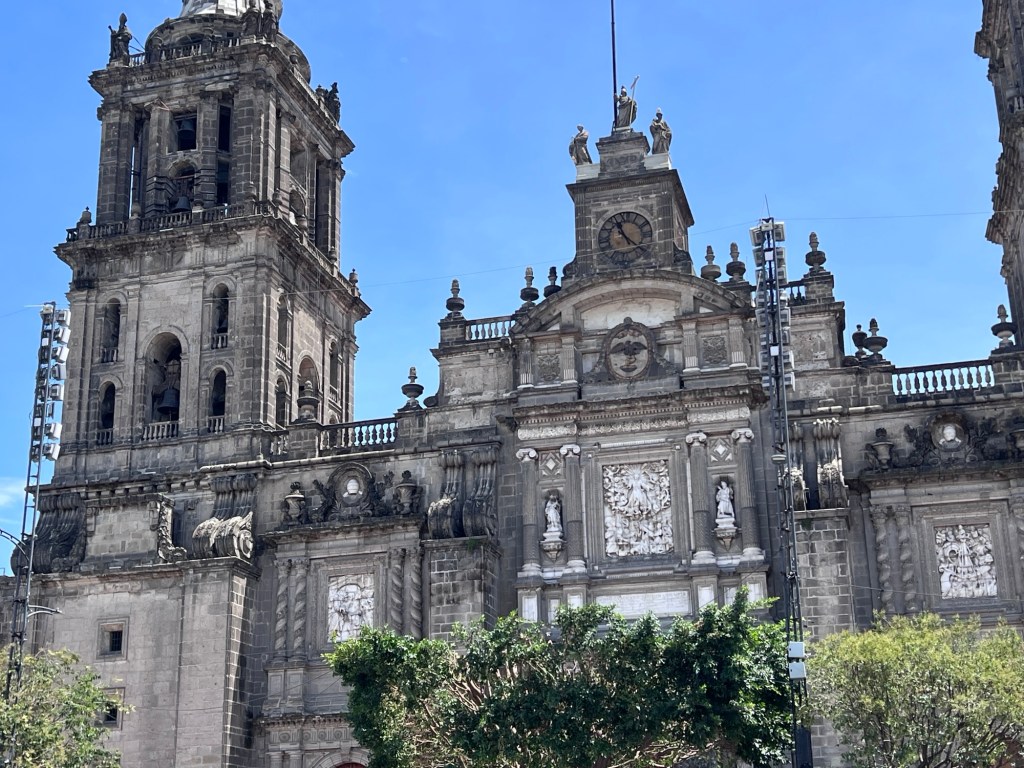
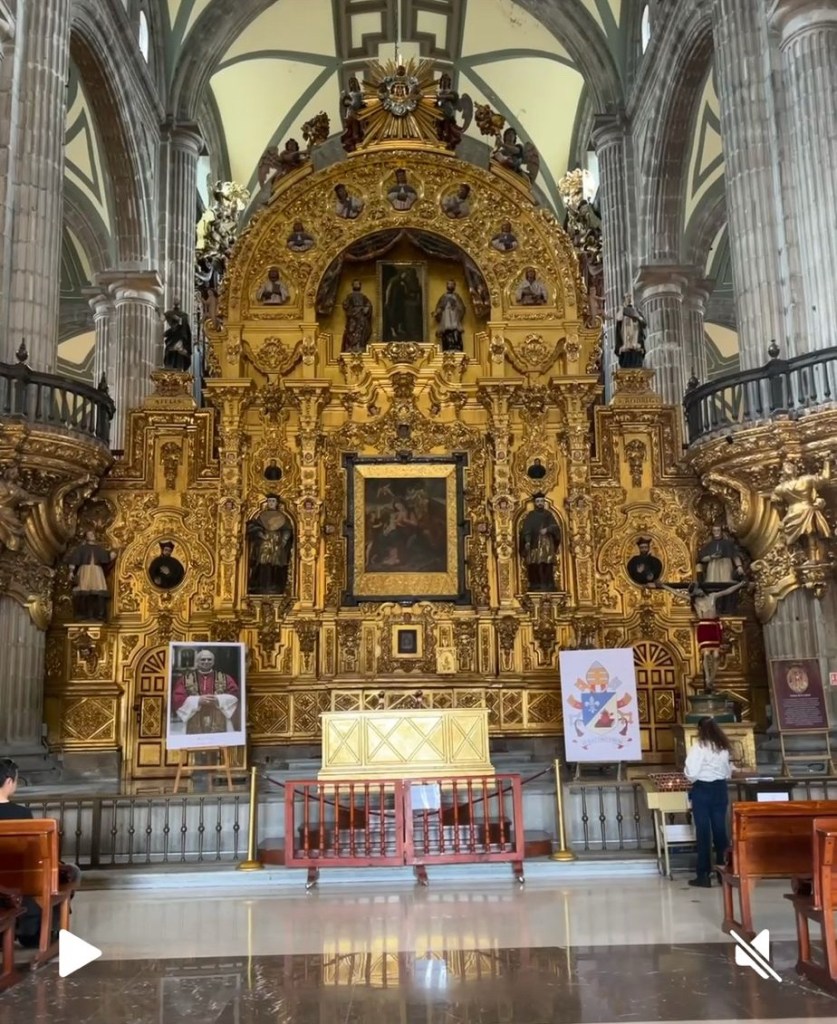
There were several places in the Zocalo that we hadn’t visited, including the Metropolitan Cathedral. We took a quick look inside the church and saw its opulent altar covered in gold, most likely stolen from the Aztecs. Construction took place in stages beginning in 1573 shortly after the Spanish conquest of Tenochtitlan. It was built on top of the Aztec temple. The church was completed in 1813. Because it took so long to build, it is comprised of many architectural styles, i.e. Gothic, Baroque, Churrigueresque (elaborate stucco decoration used until about 1750 in Spain) and Neoclassical.

Metropolitan Cathedral
Metropolitan Cathedral Altar

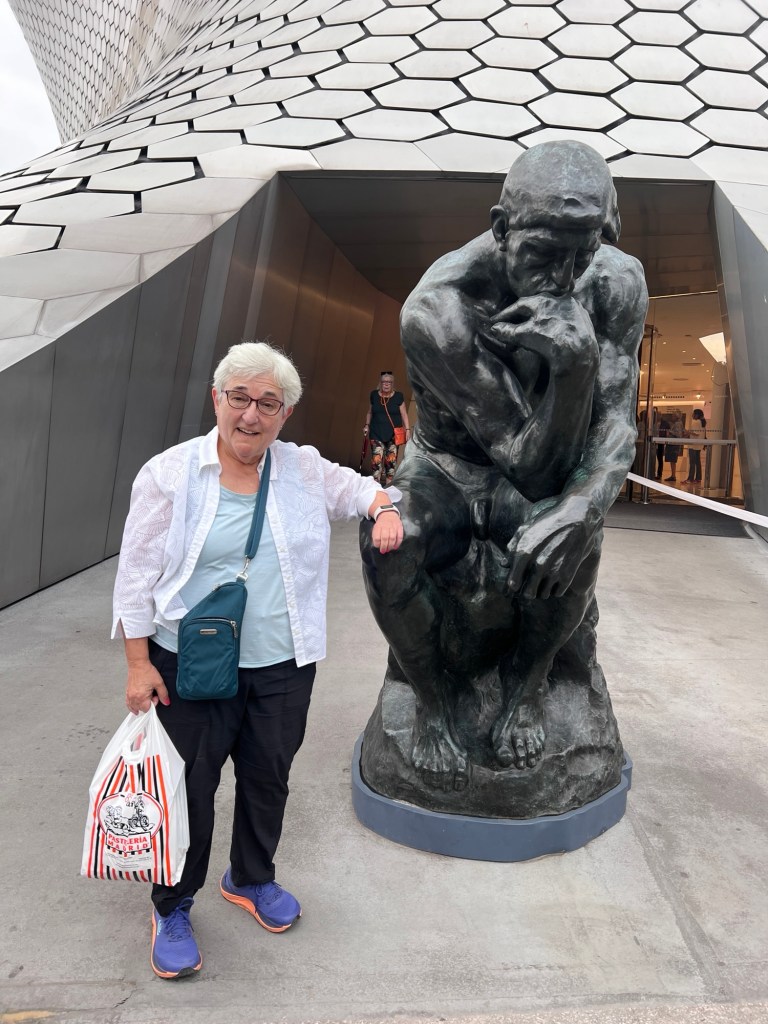
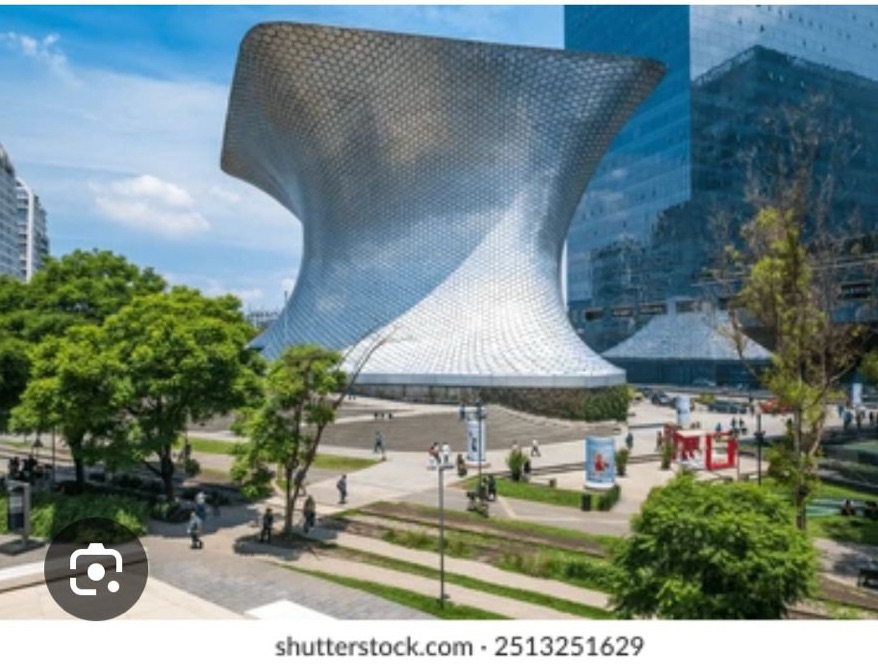
We then attempted to see some Diego Rivera murals, but once again we were thwarted. Since it was getting late it was time to head back. Instead of taking a 60 minute Uber ride, however, we decided to give the subway a try. On our walk to the station we passed the Museo Soumaya, an architectural wonder. The art museum just happened to have a copy of Rodin’s The Thinker at its front entrance, just like the Cleveland Museum of Art back home. However, this statue hadn’t been blown up and its base and legs were intact. The Cleveland bombing back in 1970, was thought to be politically motivated and carried out by the Weather Underground, but it remains an unsolved crime.

The Thinker outside the Soumaya Museum and me holding my bag of pastries from La Madrid
The Soumaya Museum

Taking the subway was easy, but the train was packed with people heading home from work. The Mexicans we‘ve met have all been exceedingly friendly, thoughtful and helpful. For example, a woman must have seen how exhausted I was and offered me her seat on the subway. We never felt unsafe, even in the so called dangerous La Merced market, riding on the subway, or walking back to our hotel at night. When we returned to the hotel Amy and Steven went out to dinner, while Dan and I ate pastries, did a quick laundry and went to bed. At least tomorrow we can sleep in a little.

EXPLORING MEXICO CITY (CDMX)

JULY 1, 2025

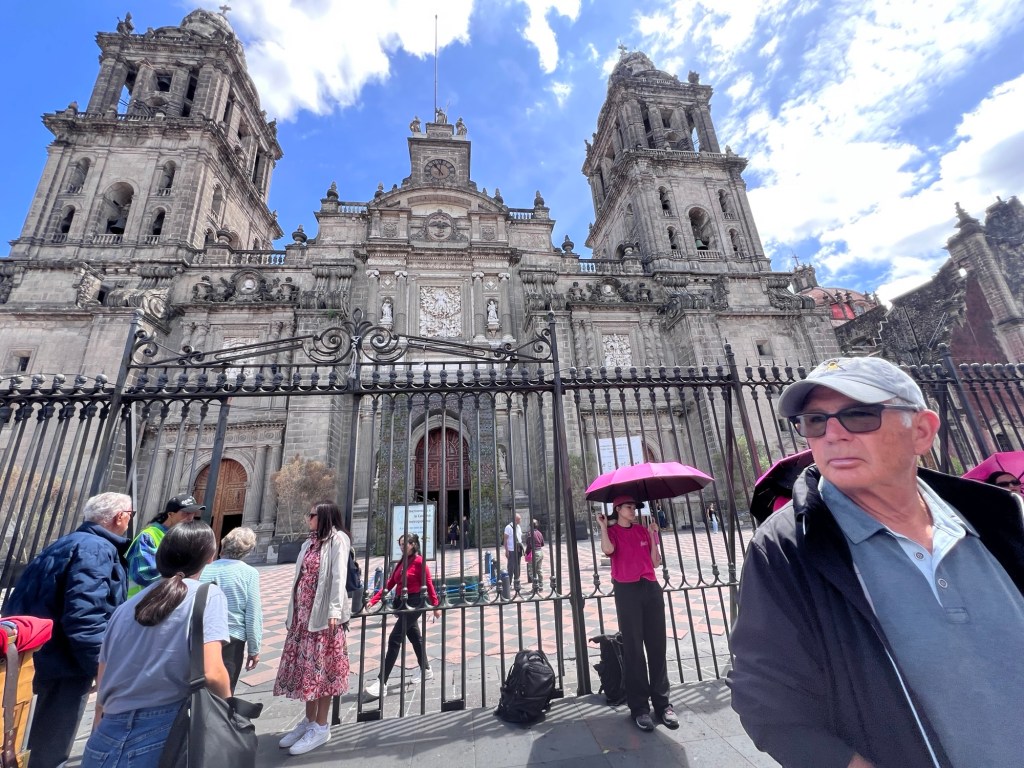
After enjoying a pastry and coffee in our hotel lobby, the four of us headed out to our “Free Tour of Mexico City” offered by Estacion Mexico Free Tours. We were meeting our cousins Danny and Lauren from Chicago, and Debby and Marty from Columbus. Their daughter Amanda and her boyfriend Yuri, who live in Minneapolis, also joined us. All we had to do was make our way to the Metropolitan Cathedral’s main entrance and hunt for people wearing pink t-shirts and umbrellas.

In front of the Cathedral finding pink t-shirts. Steven is in foreground

This 2-1/2 hour Free Walking Tour concentrated on the Historical City Centre of Mexico City (CDMX). Our guide was very informative and was a rock musician in his “real life.” He took us on a comprehensive tour of the major landmarks beginning with the heart of Centro Historico, the massive Zocalo, or main square (also known as the Plaza de la Constitucion). This is the place where people gather for cultural events, political protests and celebrations. In fact, shortly after we left Mexico there was a demonstration against increased housing costs due to the large influx of Americans moving into the city.

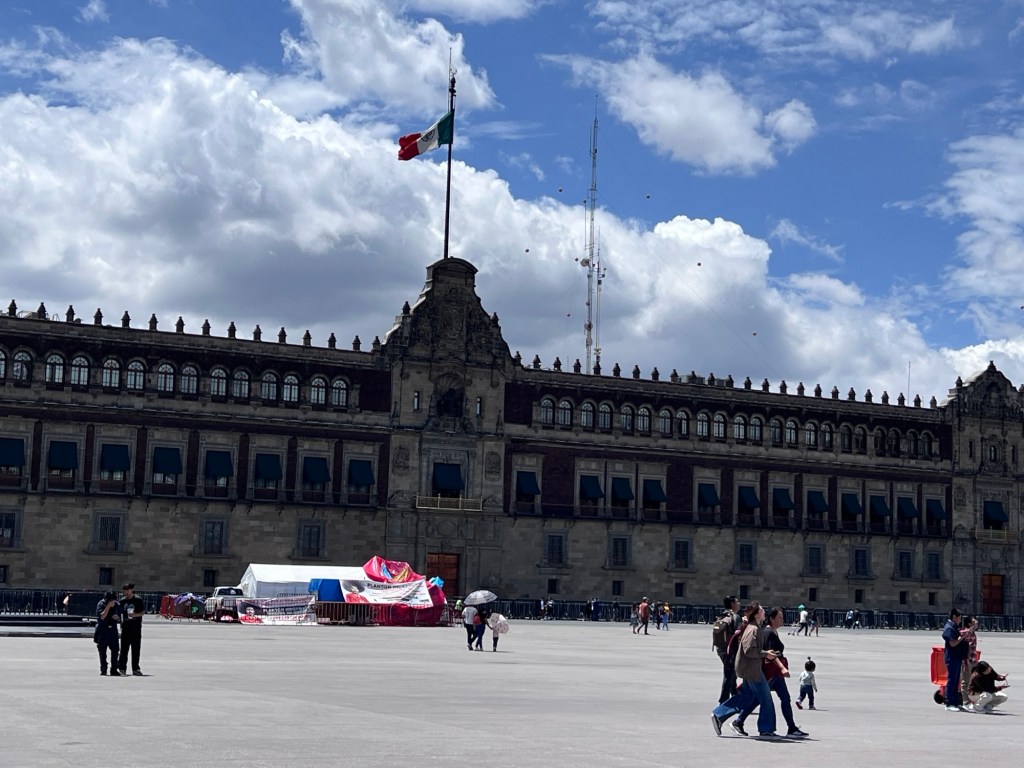
The Zocalo with a view of the Palacio National
Another view from the Zocalo with the Metropolitan Cathedral in the background
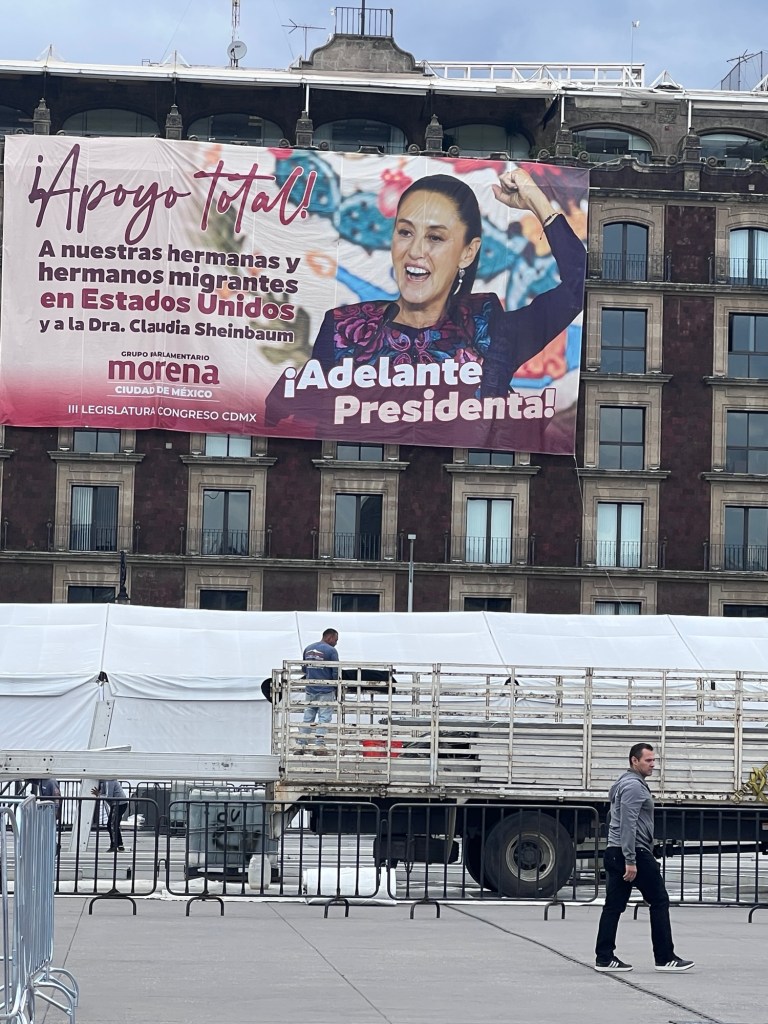
The sign hanging on a colonial building in the Zocalo reads: Total Support for our brothers and sisters in the United States. Carry on President Sheinbaum

Every Mexican city or town has a Zocalo, which usually features a church and government buildings. The Zocalo in CDMX is surrounded by impressive colonial era buildings including the National Palace on the east side and the Metropolitan Cathedral on the north side. The Palacio Nacional has been the seat of power and sovereignty for the Mexican people since the 16th century. Great figures in Mexican history have lived and worked within its walls, and it serves as the official residence and workplace for Mexican presidents. The current president, Claudia Sheinbaum Pardo was elected Mexico’s first woman president in 2024. In addition to being a politician, she is an energy and climate change scientist, and an academic.

The palace also houses one of the most famous Diego Rivera murals depicting Mexico’s history and cultural heritage. Unfortunately every time we tried to see a Diego Rivera mural there was some obstacle in our way i.e. the building was closing early, renovations were being made, or we simply ran out of time. (The closest we got to seeing one was in the Palacio de Bellas Arts where we caught a glimpse of a mural, but were prevented from seeing it in full.) It was very frustrating being unable to see Rivera’s work, especially since so much is written about him and other muralists in Mexican history books.

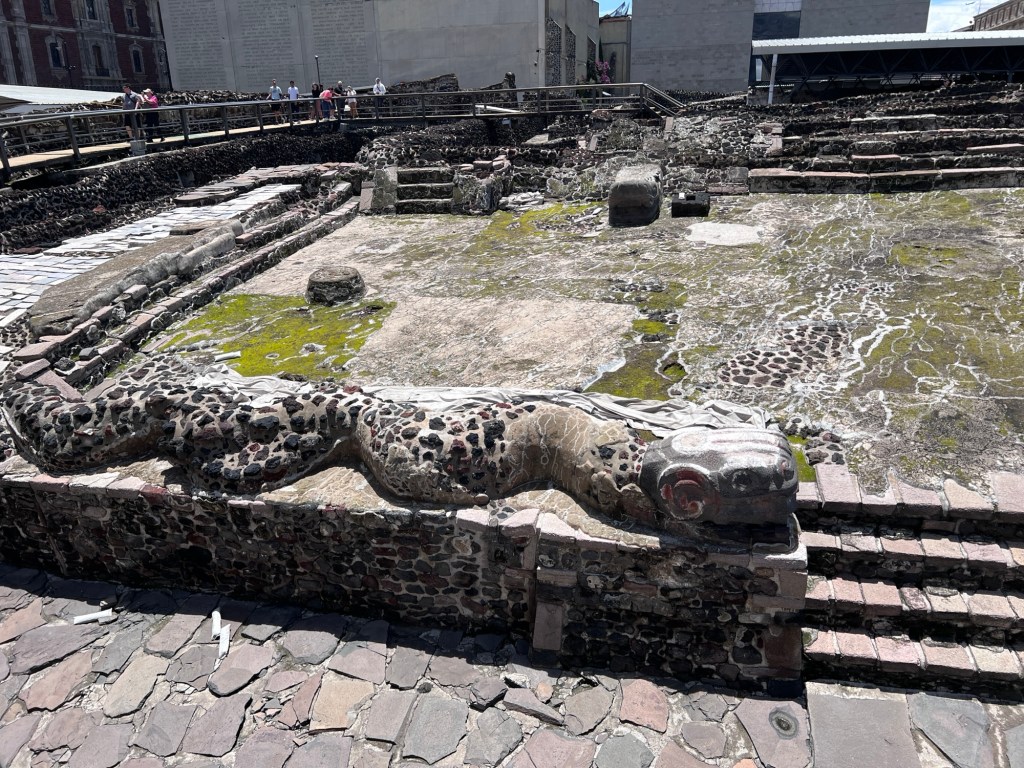
Our next stop was the Templo Mayor (Great Aztec Temple). It was the religious hub in the Aztec capital city of Tenochtitlan. The city was destroyed in 1521 by the Spanish, and the stones of its buildings used to build other structures including the Metropolitan Cathedral. The remains of this double pyramid complex were uncovered when in 1978 electrical workers happened upon an 8-ton stone-disc carving of the Aztec goddess Coyolxauhqui. Several colonial buildings were torn down in order to excavate the site.

Aztec scouts had been sent out to find the perfect location for a new city. Tenochtitlan was built on the very spot where these scouts saw an eagle perched on a cactus holding a snake in its beak. This was an important symbol for the Aztecs, and they literally believed that this spot was the center of the universe. The symbol still resonates with the Mexican people and appears on their flag. The temple was dedicated to the gods of sun and rain and at its center was a platform dating from about 1400.

View of Templo Mayor with a platform in the background
A serpent or snake
Mexican Flag

After walking through a local market, which sold utilitarian items, our guide pointed out an area we should avoid because it was considered unsafe, the La Merced Market. (Our tour the next day was scheduled to take us to this “dangerous” market.) CDMX is second only to London in the number of museums it hosts, and our guide pointed out an incredible number of them along with government offices and interesting shops.

Some stores were selling princess-like dresses for girls celebrating their 16th birthdays in a traditional ceremony called Quinceañera. The ceremony, includes a religious service and celebrates a girl’s transition into womanhood. A large party follows mass, and is often held at a banquet hall, featuring food, music, and dancing. Families spend years saving for this special event, and often fundraise asking friends and family for contributions to help finance the party.

A Quinceañera dress
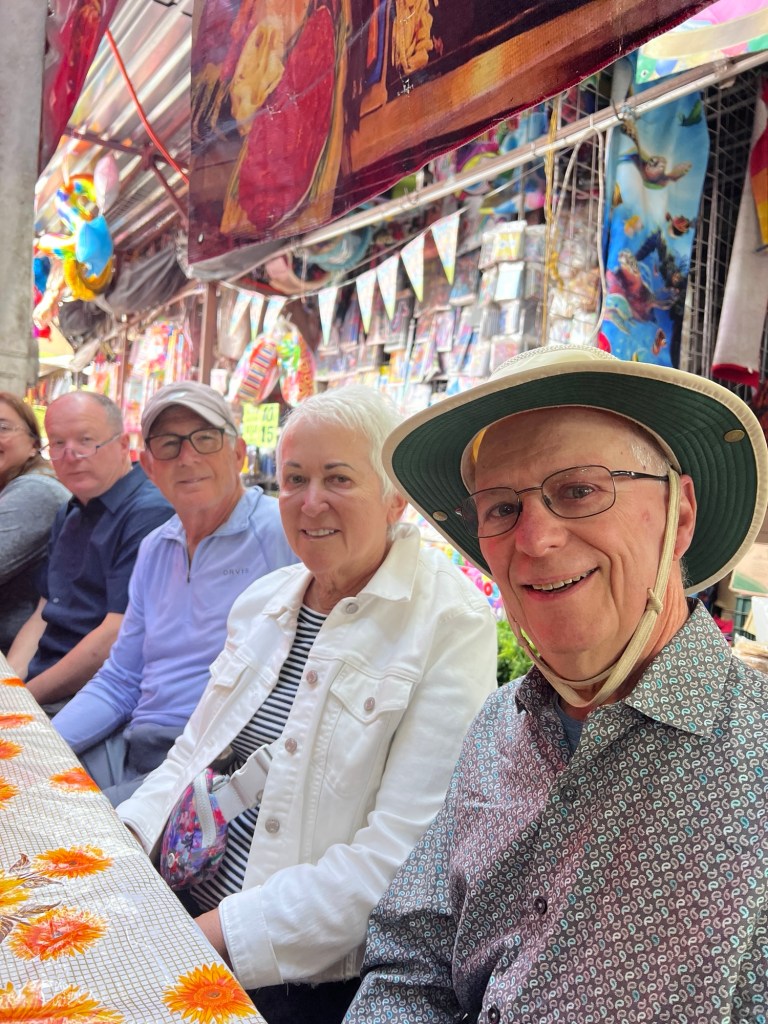
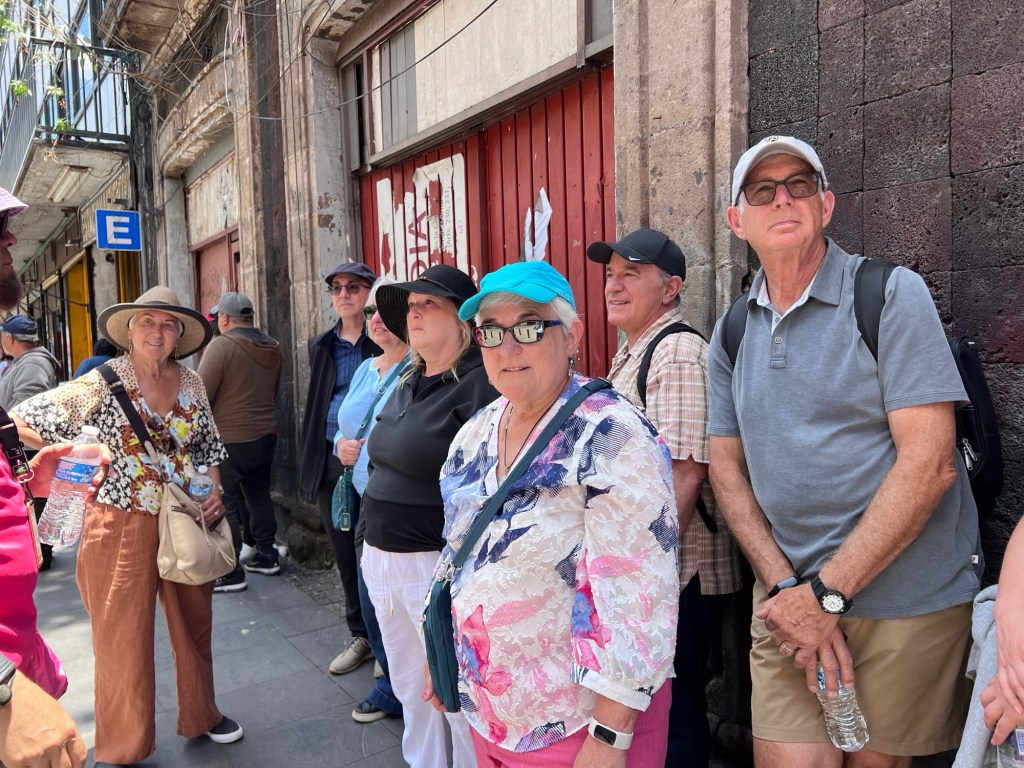
All of us listening to our tour guide (or half listening)

Dan and I were exhausted by the time our tour came to an end. There was so much more to see around the Zocalo, but we had a private tour of the National Museum of Anthropology in less than an hour. We were to meet our guide, Pepe in front of a mural near the museum entrance, but he was nowhere to be found. I tried texting him and then sought help from one of the museum’s security guards. My poor Spanish, and his poor English, made it difficult to explain our problem, but he managed to leave our guide a message. I gave up on Pepe when I saw our cousins arriving for their tour. We were fortunate in that we both had booked through Viator, and their guide allowed us to join their group.

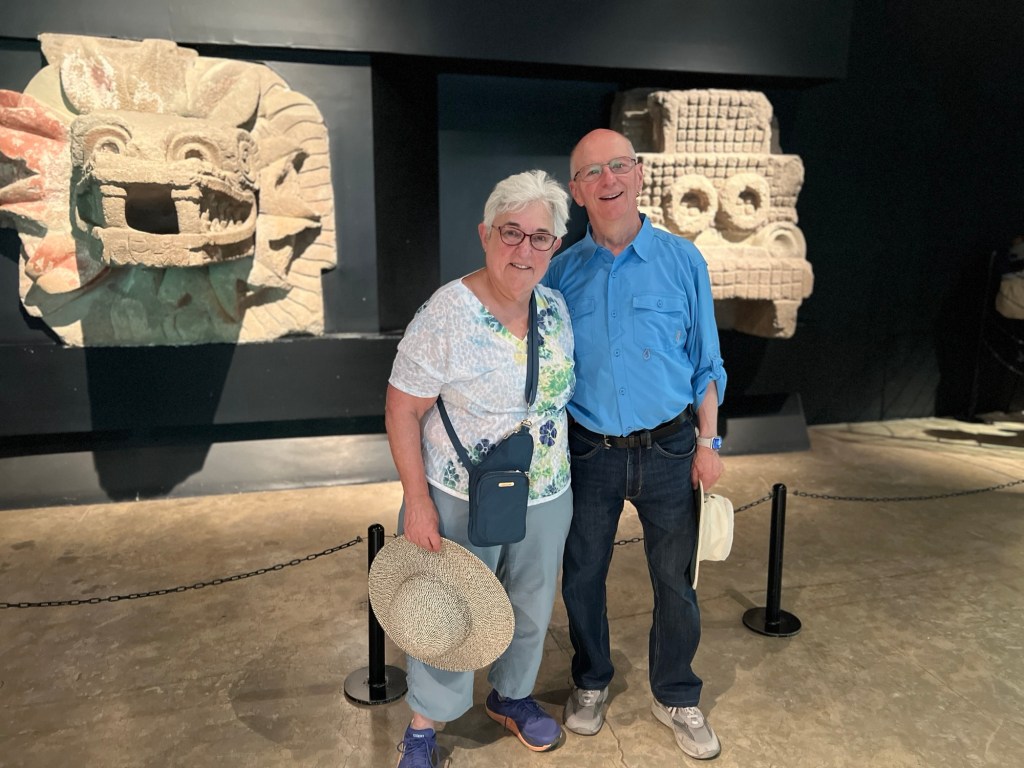
The museum is architecturally a beautiful place in and of itself. It is considered one of the most important museums in the Americas, especially regarding pre-Hispanic civilizations such as the Aztecs, Mayas, and Olmecss. Even if we had an entire day it would have been impossible to see everything in its vast collection. Our guide concentrated on some of the most important objects.

Dan and I at the Central Courtyard Umbrella at the National Museum of Anthropology
Reproduction of a Templo Mayor wall
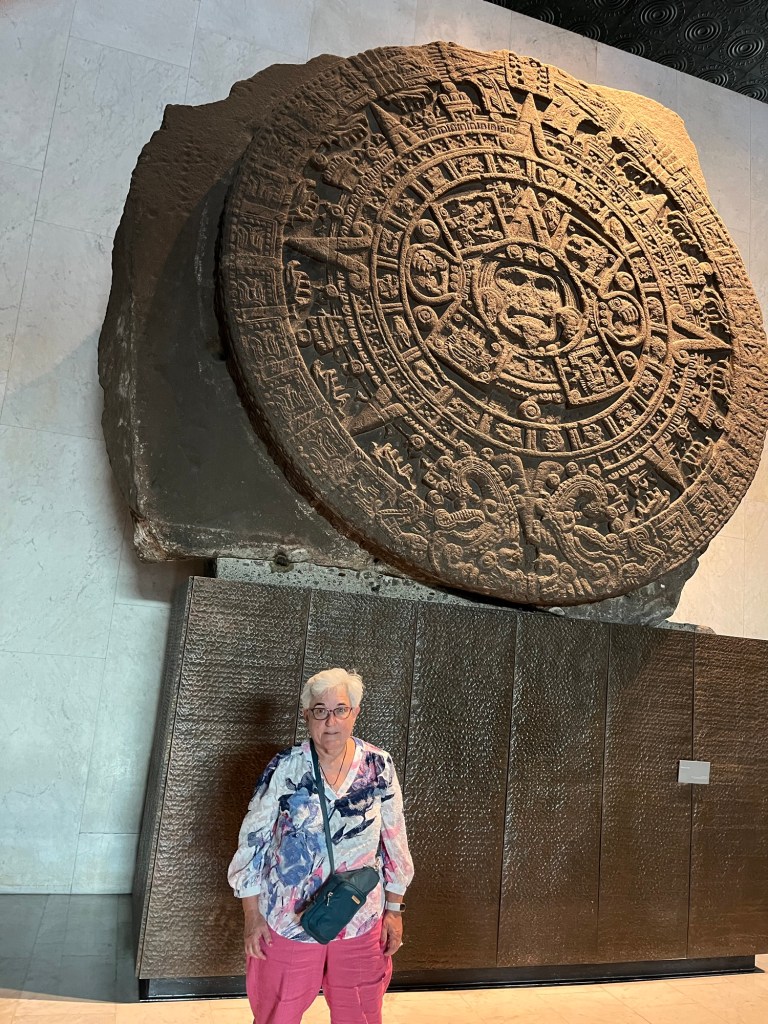
In front of the huge Stone of the Sun

The Stone of the Sun was found in 1790 in the Plaza Mayor. It was incorrectly identified as the Aztec Calendar because it showed the names of the days and the cosmogonic suns. Instead, it is a gladiatorial sacrificial altar. It must have been used to stage the fights between warriors in the tlacaxipehualizli ceremony. (That ceremony is so gruesome I don’t want to describe its depravity.). The face of Xiuhtecuhtli, the god of fire, heat, and the cycle of time is shown as emerging from a hole in the earth holding a pair of human hearts and showing his tongue transformed into a sacrificial knife.
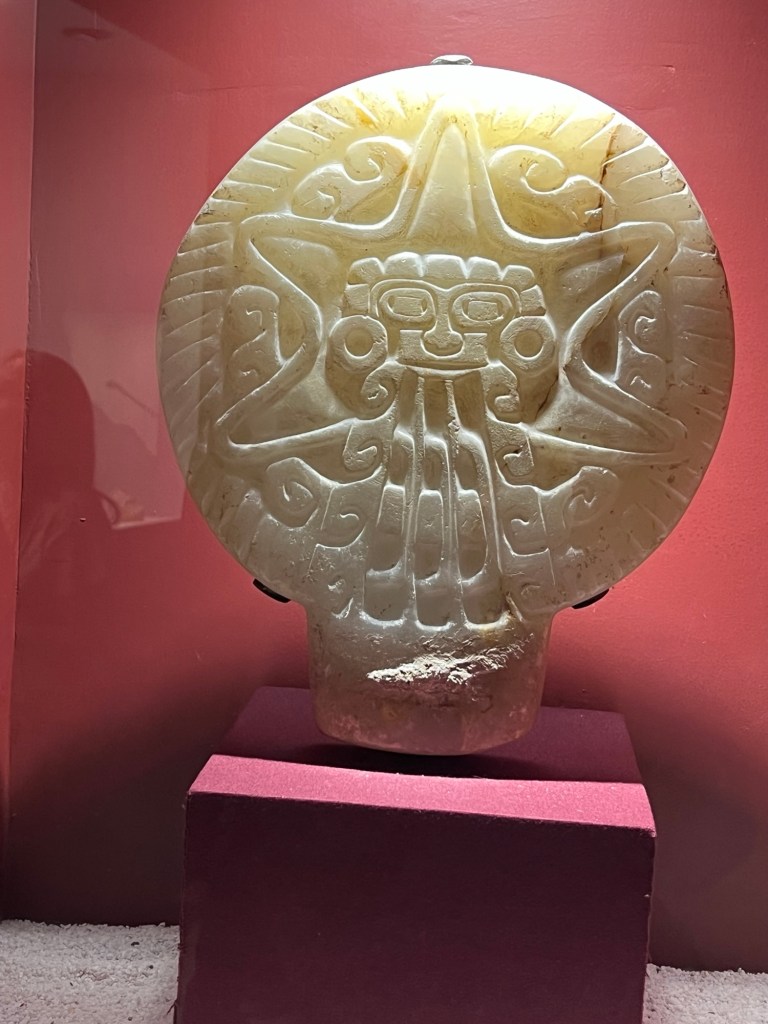
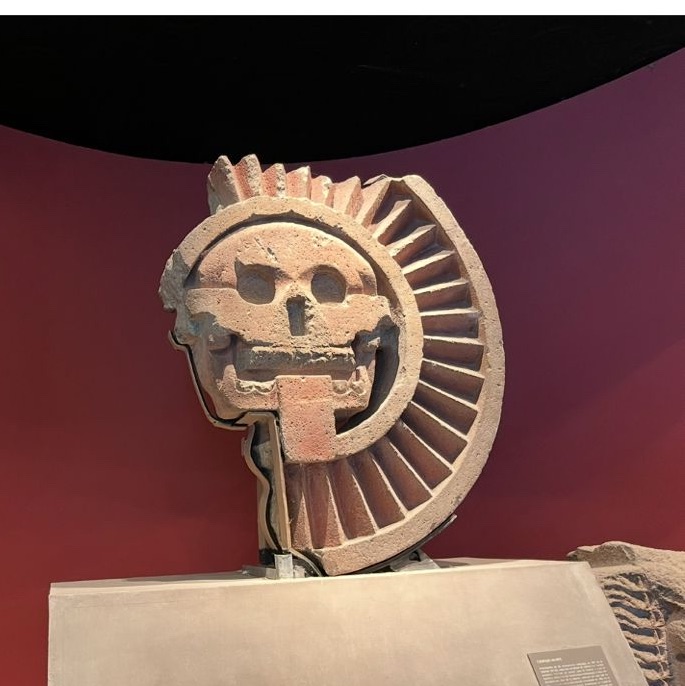
Disc of Mictlantecutli – the Aztec god of death, ruler of the underworld

Our guide was an academic and researcher and tended to talk about the fine details of every exhibit. At some point, Dan and I wandered away from the group and looked at the exhibits at our own pace. Most of the descriptions were in Spanish, so we made the best of it. We were surprised to find that many of the exhibits featured replicas rather than original pieces. Before we left, we reconnected with everyone and relaxed a bit in the museum restaurant, but not for too long. It was at least a 60 minute ride back to our hotel and the four of us had dinner reservations at one of the premier restaurants in CDMX, Entramar.

Entramar serves only the freshest of seafood and is located in the upscale Polanco neighborhood. It is the sister restaurant to the famous Contramar, offering the same dishes—but in a more relaxed atmosphere. While listed in the Michelin Guide, it does not have a star. We tried their tuna tostados as an appetizer—delicious. I wish I had kept track of what we all ordered. I think I had halibut and Dan a shrimp dish, but the bottom line is that all of us enjoyed our dinners and would highly recommend dining there.

After dinner we headed straight back to our hotel. I had been feeling a bit off. Perhaps that is why I found the day so exhausting. (Motezuma’s revenge stayed with me throughout the rest of the trip. Luckily for me it wasn’t a severe case). We were all tired and went straight to bed. We had another busy day planned for tomorrow.

MEXICO CITY HERE WE COME

JUNE 30, 2025

Now I was about to find out whether or not the time I spent using Duolingo to help refresh my Spanish skills would be of any help to us on this trip. Until today everyone spoke English. We arrived at the Cabo San Lucas airport without anyone holding our hands. We were clueless in terms of checking our luggage and finding our gate. When I asked a question in my broken Spanish, the answer would be given to me in Spanish traveling at the speed of light. Only when the person slowed down to a glacial pace could I even grasp a sense of what they were telling me. Fortunately my reading skills were much stronger (ok, really only a little bit stronger). However, I am glad to report that we were able to check our luggage and find our gate in plenty of time to catch our Volaris flight to Mexico City.

We were lucky that some of Mara and David’s friends were on our flight. With their help we located the area in the airport where one could call an Uber or catch a cab. Rather than experiment with Uber (it would have been my first time using the app) we ended up taking a taxi to our hotel/apartment, The Frida Boutique by Viadora.

The 30 minute ride to our hotel was in bumper to bumper traffic. We couldn’t help but notice how green the city was with parks and playgrounds to be seen along the way. We had expected smog, but the skies were clear and we could see that the city was surrounded by mountains. Mexico City sits at an altitude of about 7,400 feet and is located within the Trans-Mexican Volcanic Belt, also known as the Sierra Nevada. Other mountain ranges include the Sierra de Guadalupe to the north and the Sierra de las Cruces to the southwest. Several of the mountain peaks are inactive volcanoes that are part of the Pacific Ring of Fire.

Mexico City is the most populous city in North America with a population of close to 22 million people. It is one of the most important cultural and financial centers in the world. Mexico City was founded by the Aztecs around 1325 on a group of islands in Lake Texcoco. It is the oldest capital city in the Americas. Originally named Tenochtiitlan, it was almost completely destroyed by the Spanish in 1521. Using the stones and foundations built by the Aztecs, the Spanish redesigned and rebuilt the city in accordance with their own standards. In 1585 it became known as Ciudad de Mexico (Mexico City) and was an important player in the Spanish colonial empire.

Mexico’s journey from being a Spanish territory to independence is too complex to cover in this blog. It took place from 1910 to 1920 and involved some colorful characters such as Pancho Villa. It will suffice to say that it culminated with the drafting and signing of the Act of Independence of the Mexican Empire on September 28, 1821.  This document formalized Mexico’s declaration of independence from Spain ending 300 years of colonial rule.  

Our apartment/hotel, the Frida Boutique, was located in the charming Condesa neighborhood on a quiet gated side street. From the very start the staff couldn’t do enough for us. Our spacious suite was perfect for two couples. We each had our own bedroom and bathroom, plus there was a kitchen, laundry room, living room and patio on the roof. Now we just had to wait for Amy and Steven’s arrival.

In the meantime, Dan and I went out to explore our neighborhood. Condesa takes its name from the title of the Countess of Miravalle, Doña María Magdalena Catarina Dávalos de Bracamonte y Orozco. I just wanted to write down her name — impressive isn’t it? There were tree lined medians and beautiful art deco and “California-colonial-style buildings.” The impressive Parque Mexico was just a short walk from our hotel. Plenty of shops, restaurants, small grocers, bakeries, bars, and a huge bookstore were located close by. You did, however, have to watch your step. Unlike in the U.S. where trees are often cut down if their roots lift a sidewalk; here trees came first, not sidewalks.

PARQUE MEXICO
CHIHUAHUAS GOING FOR A WALK

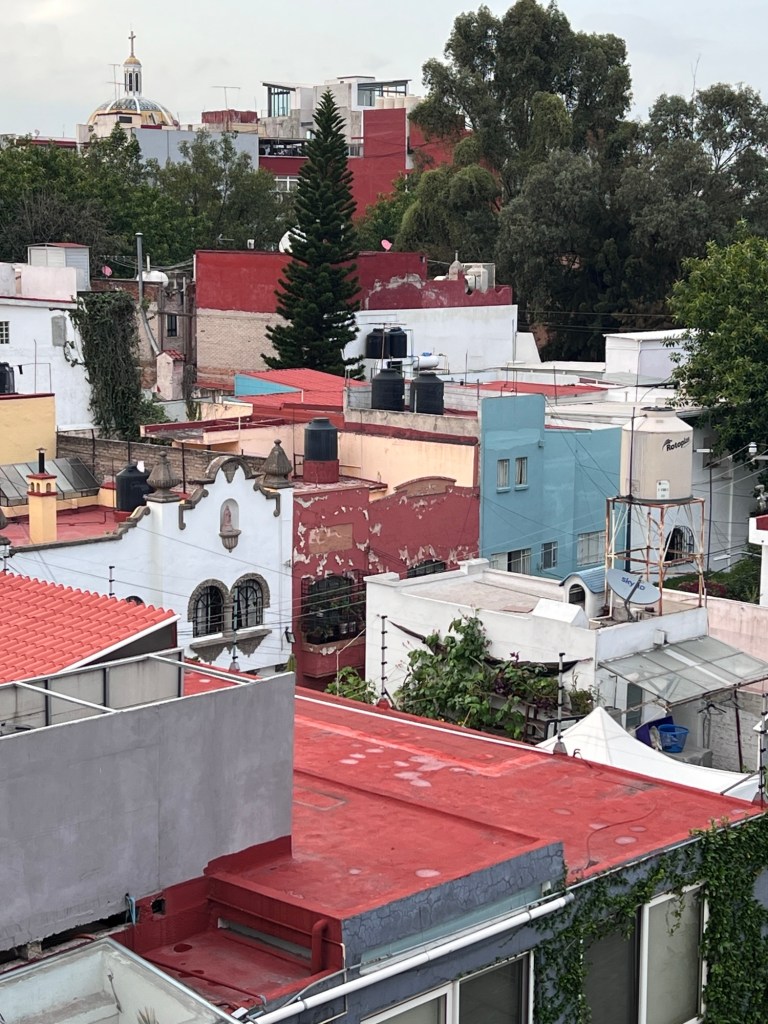
OUT OF OUR BEDROOM WINDOW

Amy and Steven arrived just in time for us to walk to Azul Condesa for dinner. The chef, Ricardo Munoz Zurita, is known as the “Prophet and Custodian” of traditional Mexican cuisine. We all enjoyed a Magarita, and shared guacamole with onion, serrano chile, coriander and tomato. We opted not to have grasshoppers on top. Most of us ordered the “legendary” Qaxacan black mole with chicken, which was delicious.

On our way back to our hotel we had to be very careful navigating the uneven sidewalks, but we made it back without any injuries.

VIVA MEXICO WEDDING DAY

JUNE 28, 2025

Before I begin writing about the wedding day, I neglected to tell you about the fantastic “Taco & Margarita“ dinner last night. Anything you could think of that could go into a taco was on that buffet table. In addition to the typical pulled pork, chicken and beef, there was also the unexpected, such as ceviche. Ceviche is a delicious mix of raw fish, tomatoes, avocado, red onion, cilantro and lime. To top off your taco there was also guacamole, and so many sauces and salsas that there was no way you could try them all. We also enjoyed our first margaritas of the trip — a perfect blend of guava juice and tequila.

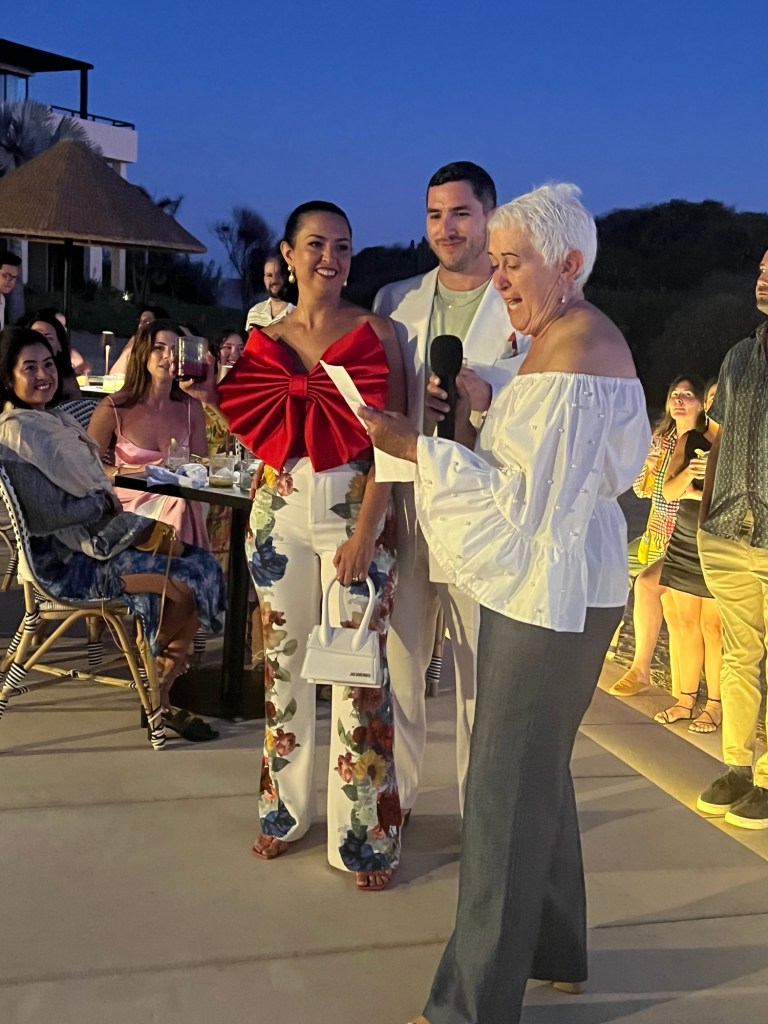
Heartwarming speeches were delivered by my sister Amy, David’s mother Mayra, Mara’s brothers Eli and Gregory, and David. Mayra gave her speech in Spanish and it was translated into English by her niece Isabel. Isabel went on to give a speech of her own. Between the beautiful sentiments expressed, fantastic food, and stylish crowd the evening could not have been more pulchritudinous, which means beautiful.

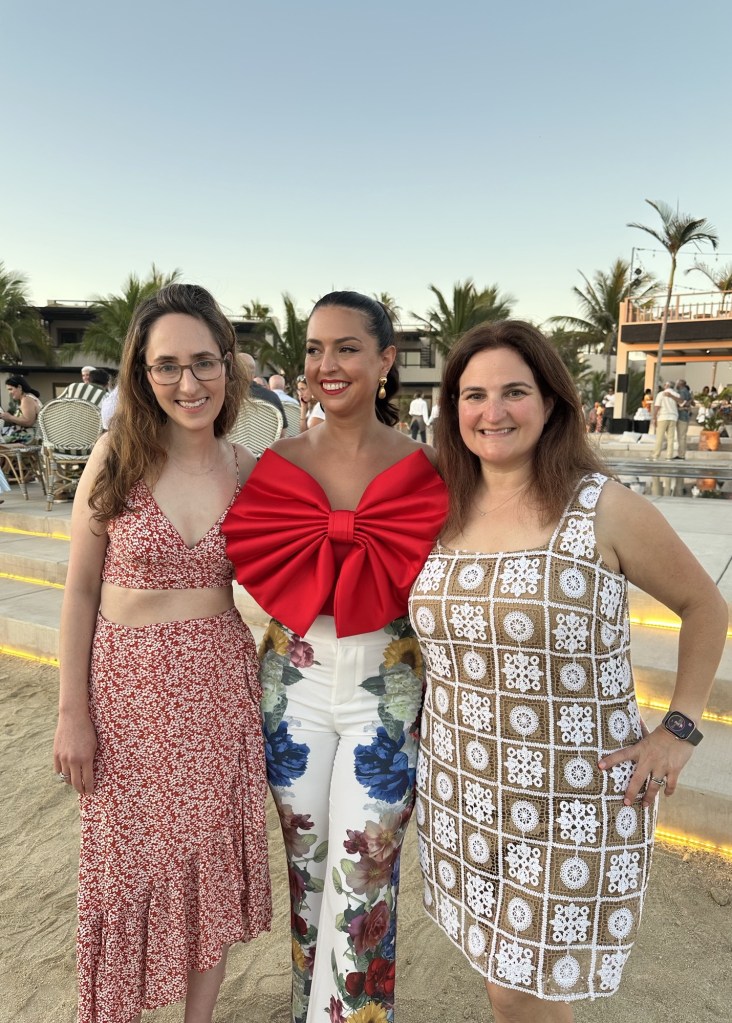
On the left is our niece Adria, in the middle is the bride, Mara, and on the right is our daughter Jessica.
Amy giving her speech alongside the bride and groom.

NOW MOVING ON TO THE WEDDING DAY

A beautiful day greeted us as we headed to breakfast. By the time we reached the restaurant the place was bustling with wedding guests.

I thought I would give a typical Mexican breakfast a try and ordered chilaquiles. Chilaquiles consist of fried tortilla chips simmered in salsa (in my case both red and green) topped with cheese, and a fried egg. It was tasty, but very heavy, and there was way too much of it. Dan had a more sensible breakfast of eggs, toast and fruit.

Now it was time to jump into one of the resort’s many pools and relax. We headed to the infinity pool, but it was too crowded. The second and third pools were quiet, but there was little shade and the water felt like a hot bath. The lap pool, located by the spa, was just right. The water was cool and there were plenty of comfortable lounge chairs in the shade. Oddly enough the only people joining us at this pool were family members. I was able to get my swimming in and catch up with my cousins.

The ceremony was scheduled for 5:00 PM, so it was time to head back to the room and change. However, on the way, I snuck into the bridal suite where my sister Amy, Mara and her bridesmaids were getting their hair and makeup done. The room was amazing and had the potential for being very romantic with its indoor and outdoor showers, and its own pool. However, at the moment, it looked like a fancy beauty shop.

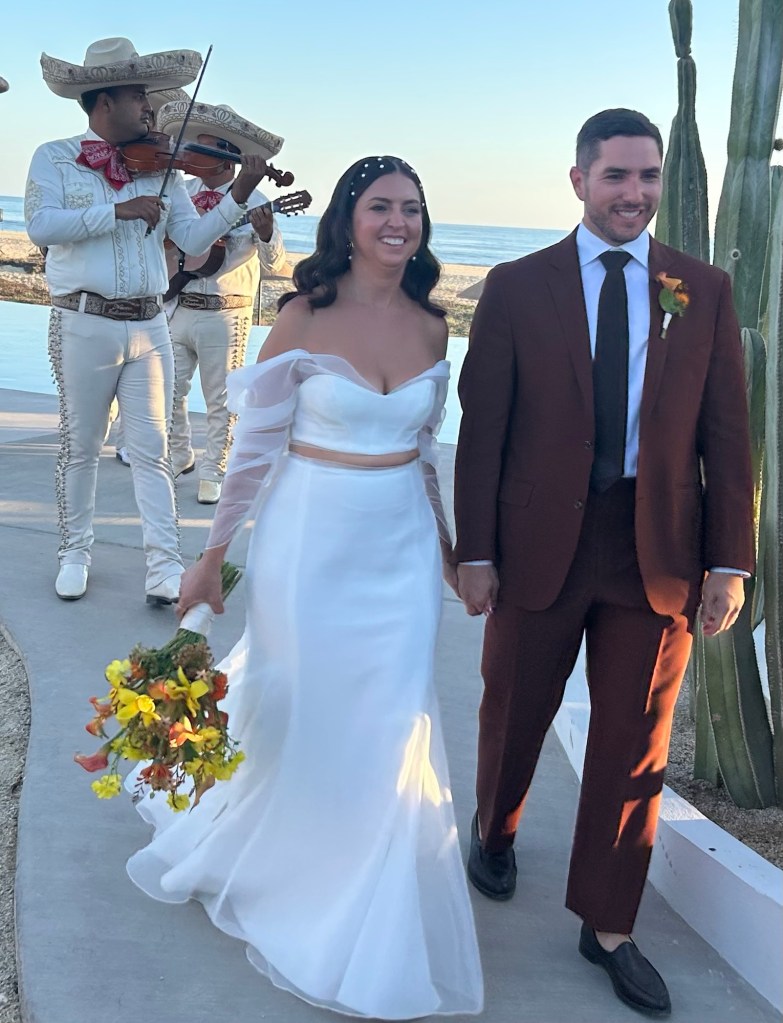
Greeting the guests as they took their seats for the wedding was a chuppah made up of beautiful orange flowers and a Mariachi band. For the processional the Mariachis played music befitting a wedding.

Dan and I in our wedding attire
My sister Amy on her way to the ceremony with her two sons, Eli on the left and Gregory on the right.
The chuppah being readied for the ceremony
From left to right: our niece Adria’s husband Andy, then Adria, our son-in-law Joey and daughter Jessica, and Dan. Note the Mariachi band in the background and the hand fans meant to help keep the guests comfortable.

Mara and David’s friends Gaby Grossman and Alejandro Stein served as the officiants. Gaby’s portion of the service was in English, while Alejandro’s was in Spanish. Within the service there were elements representing both the bride and groom’s heritage. For example, a lovely verse from the New Testament selected by David’s mother was read. Making the ceremony even more meaningful, the bride and groom wrote their own wedding vows. Then David performed the Jewish tradition of breaking the glass, and with that, Mara and David were declared husband and wife.

The happy couple.

Now the Mariachi band broke out playing traditional Mexican music and marched all of us to the botanical garden where the cocktail hour was to be held. The happiness of friends, and family was so powerful the feeling was almost palpable. All of those feelings became even more intense as the abundant and delicious hor d’oeuvres and drinks were served.

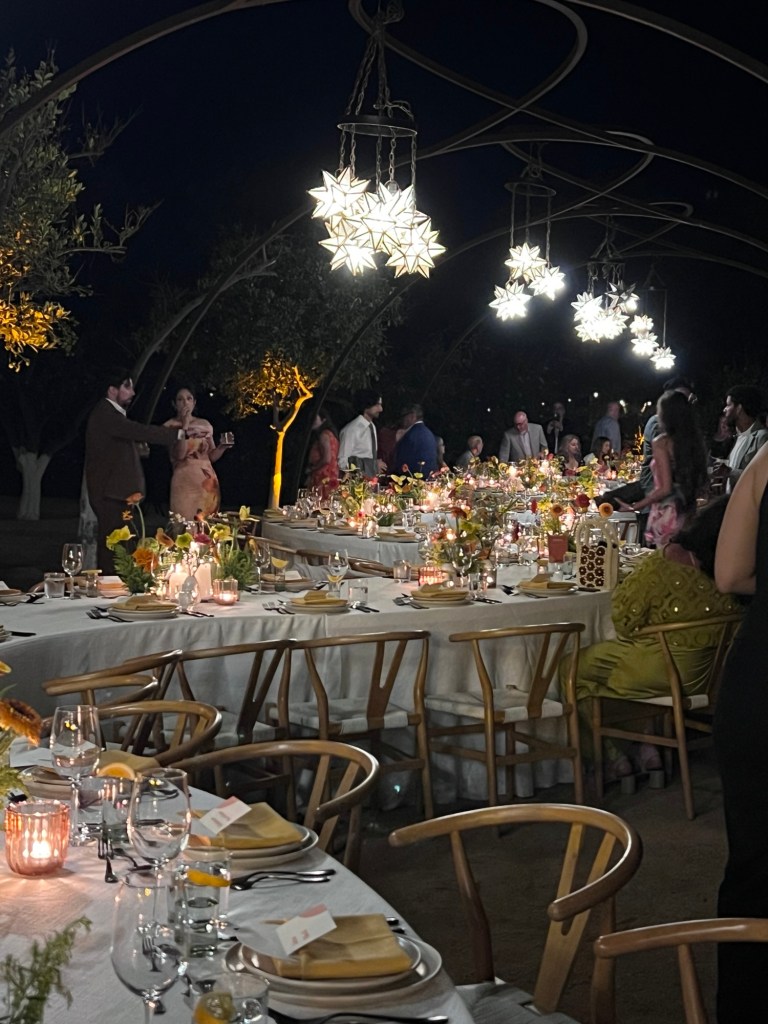
As dusk set-in all of us were directed to the outdoor dining area. A serpentine table was set with flowers, candles and lights and was so gorgeous it took your breath away. It’s funny, but I hardly remember the food that was served except for the largest prawns I’ve ever seen, risotto, and slices of beef cooked to perfection. The desserts looked like gems with each one more beautiful than the next.

Amazing serpentine table
Steven, the father of the bride, dancing with Mara

This time the fathers were the ones giving the toasts. Steven’s speech was heartfelt and welcoming. I’m certain Hermes, David’s father, also gave a beautiful speech, but it was all in Spanish. It was clear, however, that he was very happy to welcome Mara into his family.

Wedding guests danced the evening away. Mara and David were lifted on chairs with the Hora playing as is customary at a Jewish wedding. There was plenty of Latino music played as well. It was a special celebration.

At 11:00 PM the official celebration ended and was immediately followed by an after party. While Dan and I could hear partying going on until about 2 AM, we were just too tired to attend. I’m sorry we missed it because we heard the bride and groom gave a performance that will live on forever in the partygoers memories.

.

VIVA MEXICO

Note: This blog is being written after Dan and I returned from our travels. I will be trying my best to follow what actually transpired day to day and will publish as I go along.

June 27, 2025

One of the best parts about traveling, at least for me, is the anticipation. For months we had been thinking and planning for our trip to Mexico for our niece Mara’s destination wedding. Mara and David, her fiancée, are avid travelers, so we knew if they selected Más Olas Resort in El Pescadero, it was going to be a very special place.

Our limo driver picked us up at the ungodly hour of 3:00 AM. We arrived at the airport even before the Southwest customer service people were at their posts. Surprisingly the airport was bustling with travelers. Fortunately we had no problem catching our flights, first to Denver and then to Cabo San Lucas on the Baja Peninsula. The resort was located about 1 hour 15 minutes outside of Cabo.

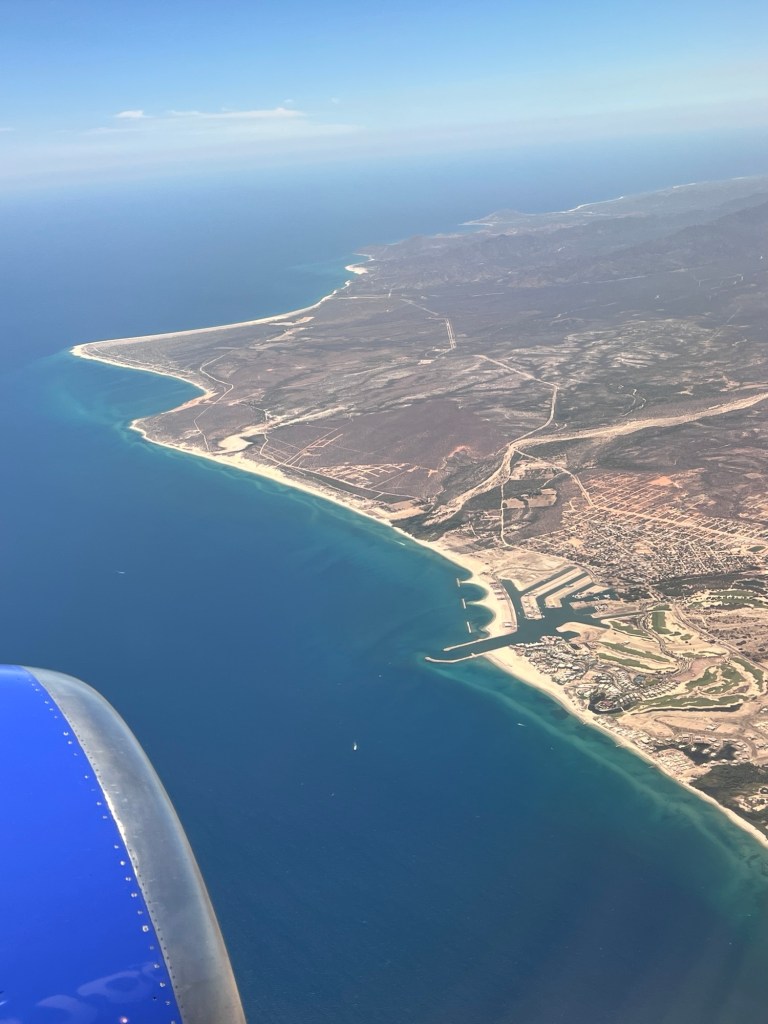
First glimpse of the Mexican coastline, heading into Cabo San Lucas

Our daughter Jessica and son-in-law Joey arrived shortly after we did so we shared a ride to the resort. We had toyed with the idea of renting a car, but I’m glad we didn’t for several reasons. First we were exhausted from getting up so early and it was nice being able to sit back and look out the window. Second, Mexican drivers are not the most polite — which is an understatement. Third, I don’t know if we would have ever found the dirt road leading to our destination. There were no signs of any kind. Lastly, it turned out to be more economical. Car rental companies neglected to tell people that they had to purchase insurance required by the Mexican government.

The ride to the resort was beautiful. Most of the way mountains were on one side of the road and the ocean on the other. The landscape was similar to Arizona with lots of Saguaro cactus. You couldn’t see much in the way of development from the car. Our driver was a young woman who grew up in the U.S., but had family in Mexico. She chose to make her home in the area and made most of her living as a realtor. She said that the area was going to transform over the coming years with new developments. We could see for ourselves all of the land with for sale signs along the way.

After what felt to be an hour of bouncing around on the dirt road (it was probably only 15 minutes) the gates to Más Olas opened and we entered a little piece of paradise. The staff greeted us with a cold drink of guava juice with rosemary, which was very much appreciated. A golf cart then dropped all of us off at our respective rooms.

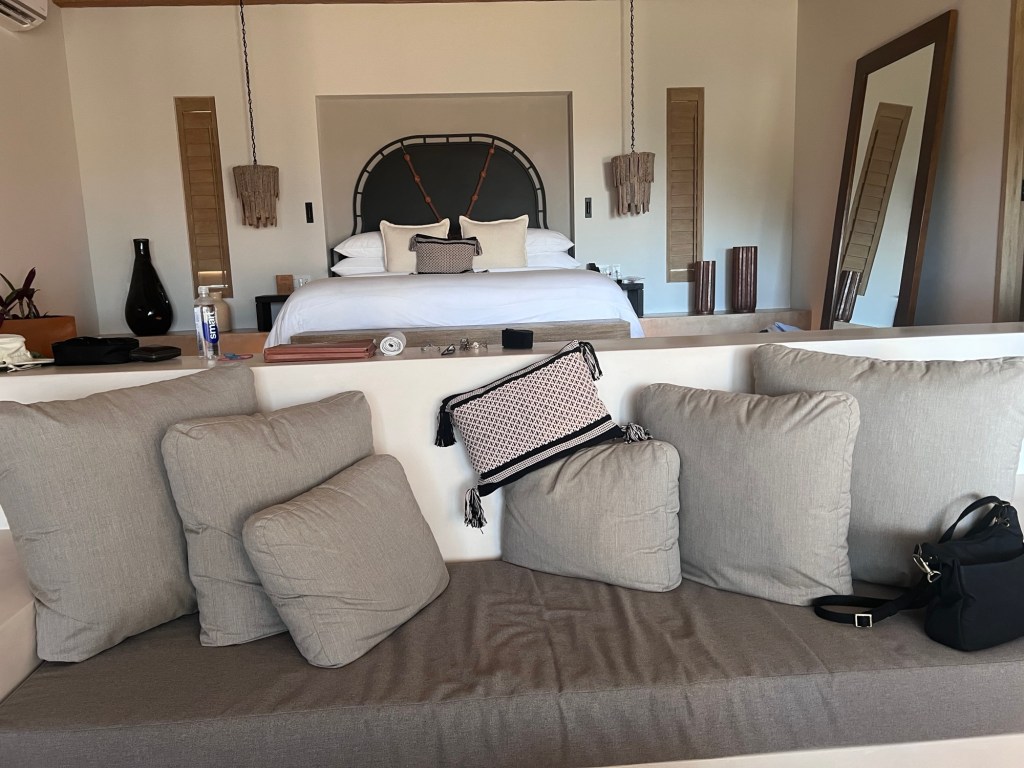
Our room was spacious and beautiful. The porch had a large comfy futon like bed. Outside we were surrounded by birdsong and beautiful plantings. In the background we could hear the ocean crashing onto the shore.

Our room

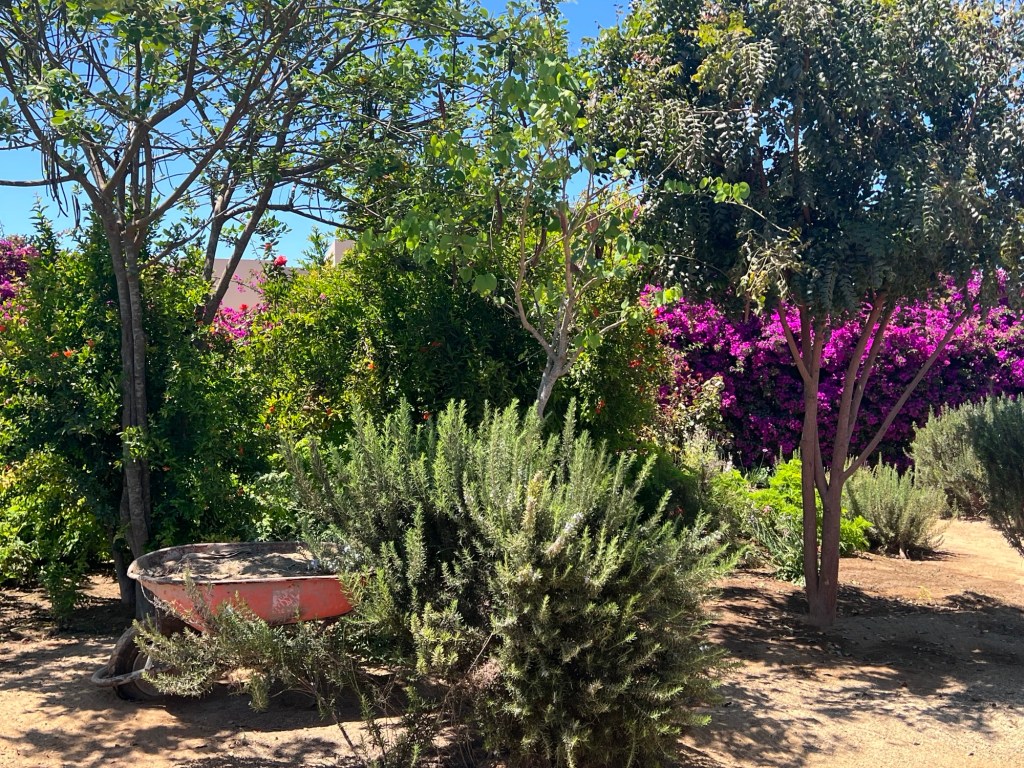
Example of landscaping

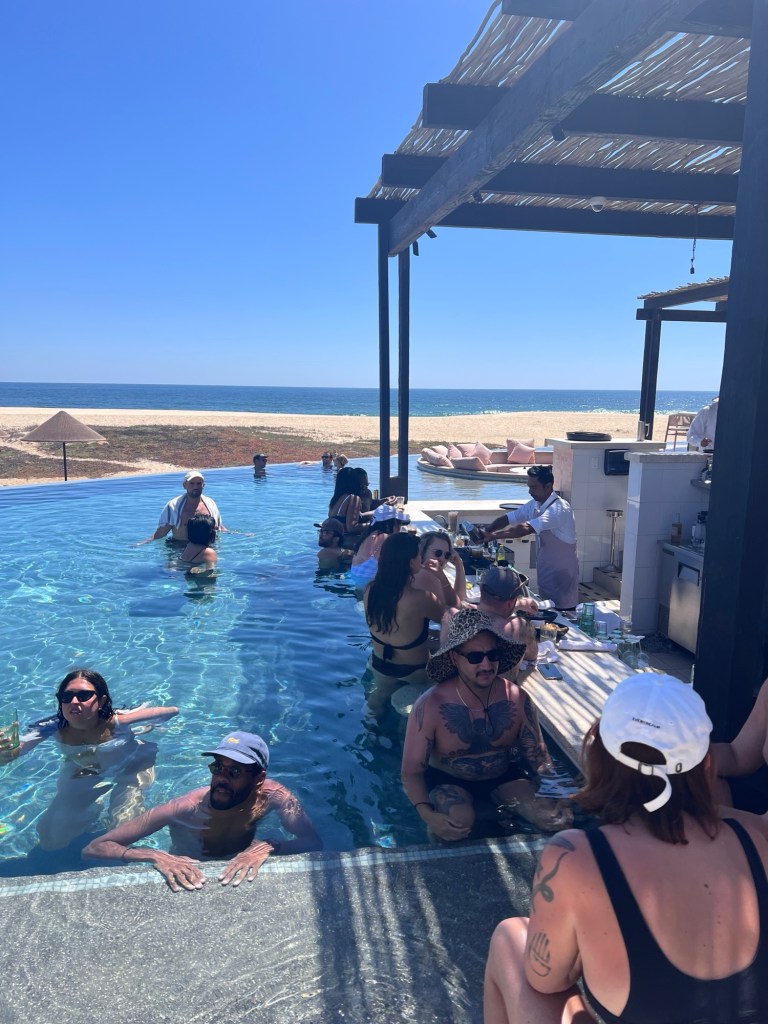
Our first stop on our initial exploration was to the infinity pool and bar. There we found many of the 99 people who traveled in for the wedding. I had met many of Mara and David’s friends, and David’s parents, when I had attended her shower in New York. Plus there were many of our family members sitting around the pool relaxing. After chatting a bit, we continued our walk and discovered the lovely botanical garden, three more pools, and the spa.

Infinity Pool
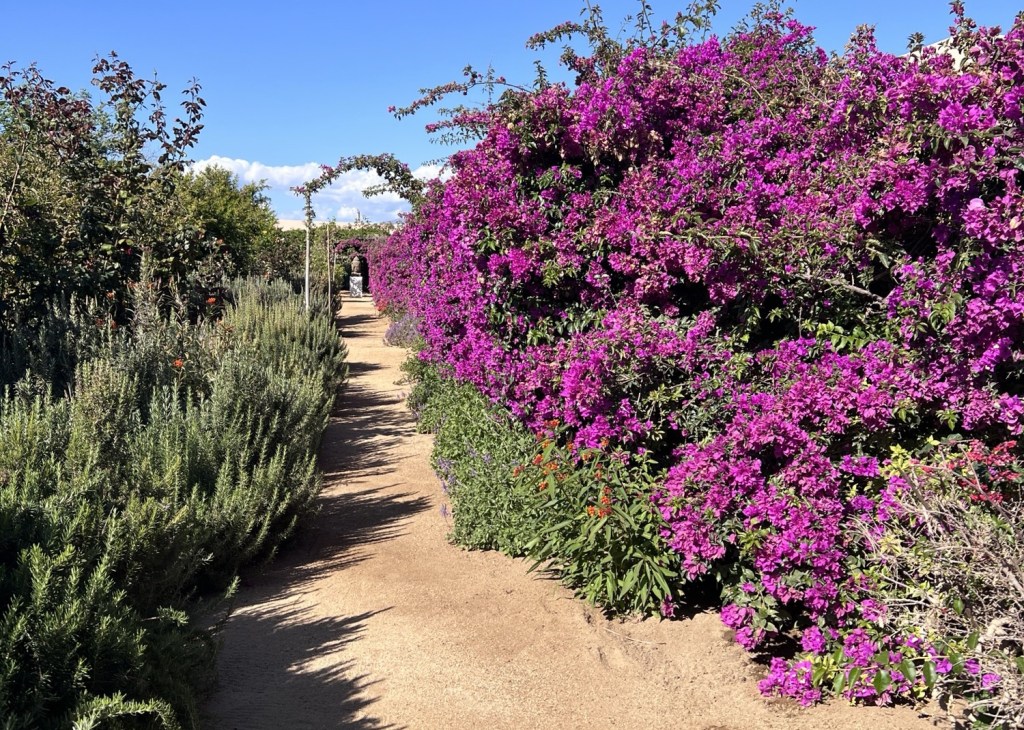
Botanical Garden
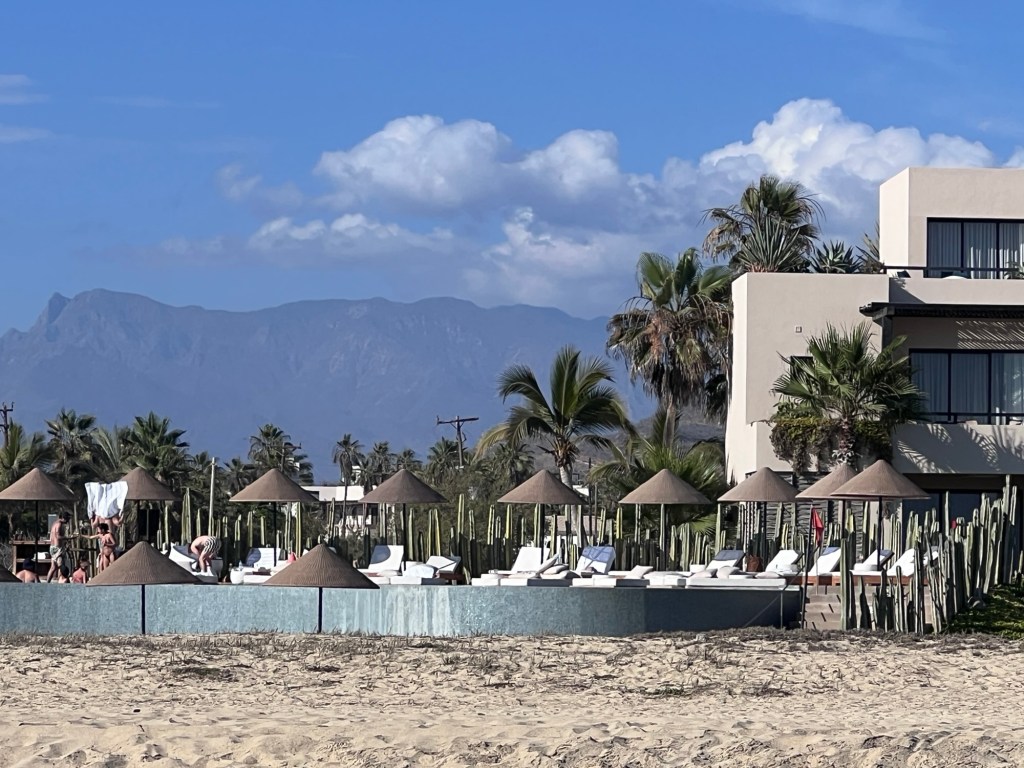
View of infinity pool from the beach with the sierra de la Laguna mountains in the background

Day 23 Home Sweet Home

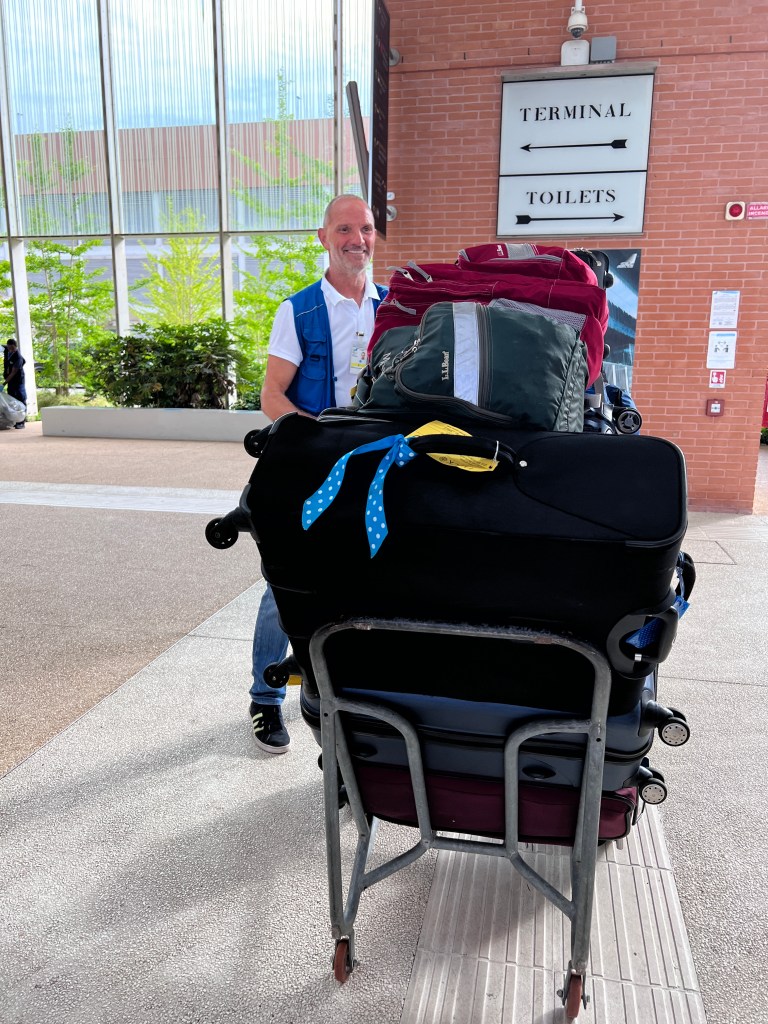
The hotel managed to have breakfast ready for us despite our early departure. Six of us were on the same flight to Newark. Going to the airport via boat is a different experience in and of itself. My suitcase was double stacked and I kept thinking how it could easily flip into the sea. After docking at the airport, however, the rest of the trip was ordinary- – thank goodness.

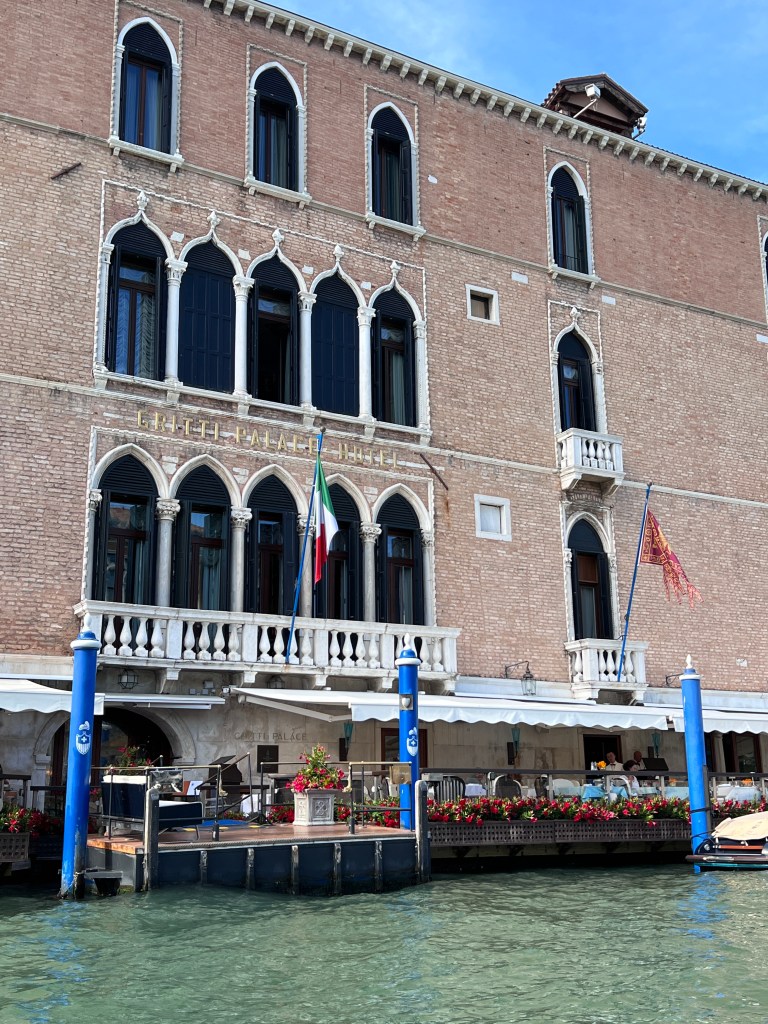
Leaving dock at Gritti Palace
Boat-Taxi that took us to Venice airport
Luggage unloaded from the boat at Venice airport

Getting to the gate was hassle free. I took some time shopping at the duty free shop for a bottle of wine for Jonathan. I used an app Paul Benfer had told me about called Vivino. It rates the quality of wine and I succeeded in finding a really good bottle at a decent price. Meanwhile, the airline needed more overhead bin space so they offered to check extra bags for free all the way through to your final destination. We said yes, and had one less bag to carry, with the bottle of wine safely wrapped in clothing.

Nothing of interest to relate from this point on because our flights were on time, customs were nonexistent, all of our luggage arrived, and our driver was waiting for us in Cleveland. It was great getting home that evening.

On the flight home Dan and I shared a few thoughts about our trip to Italy. I’ve listed them below.

1. Fresh is best whether it is pasta, tomatoes, olive oil, fruit, balsamic vinegar, pastry, cheese or wine.

2. It is very easy to get run over. Cars and motorcycles travel on narrow streets that should be reserved for people only.

3. Italy has more restaurants per square foot than anywhere else on earth. Restaurants could be found even in the darkest alleyways.

4. Highway rest stops in Italy are fantastic.

5. There are more churches per square foot than anywhere else in the world.

6. There is far too much to see.

7. The people are friendly. We would be standing reading our map when someone would stop to help us, and even lead us to where we wanted to go.

8. There is really no major difference between a 3 star hotel and a 5 star hotel in Italy, except for marble and chandeliers.

9. You need time to see Italy. It would be nice to stay in a place for a number of days in order to see the sights and then just enjoy being there.

10. Maps and street signs do not always match. Many streets are not labeled, or the name of the street keeps on changing as you move along it.

11. There were lines for gelato regardless of time of day. We had some almost every day.

12. The Italian designs for both women’s and men’s clothing were very colorful, and mostly nothing most of us would wear. This was especially true of high end stores.

13. Wealthy families ruled different parts of Italy for centuries, many of whom were tied to the Popes, and thus Christianity. Popes essentially became emperors and their friends and families benefited. Basically, it was a take off from the Roman emperors. Over the centuries there were constant power struggles between families, and this could be seen in the structure of their buildings, towns, and artwork.

14. For a Catholic country there was a large amount of nudity in public statues and paintings. We’ve never seen so many penises and breasts in a 3 week period.

15. Italy you find history, art, food, and culture everywhere you travel, and everywhere you look. Italy has kept much of what it was in the past in order to make it what it is today.

16. Italy is romantic…a place to return to.

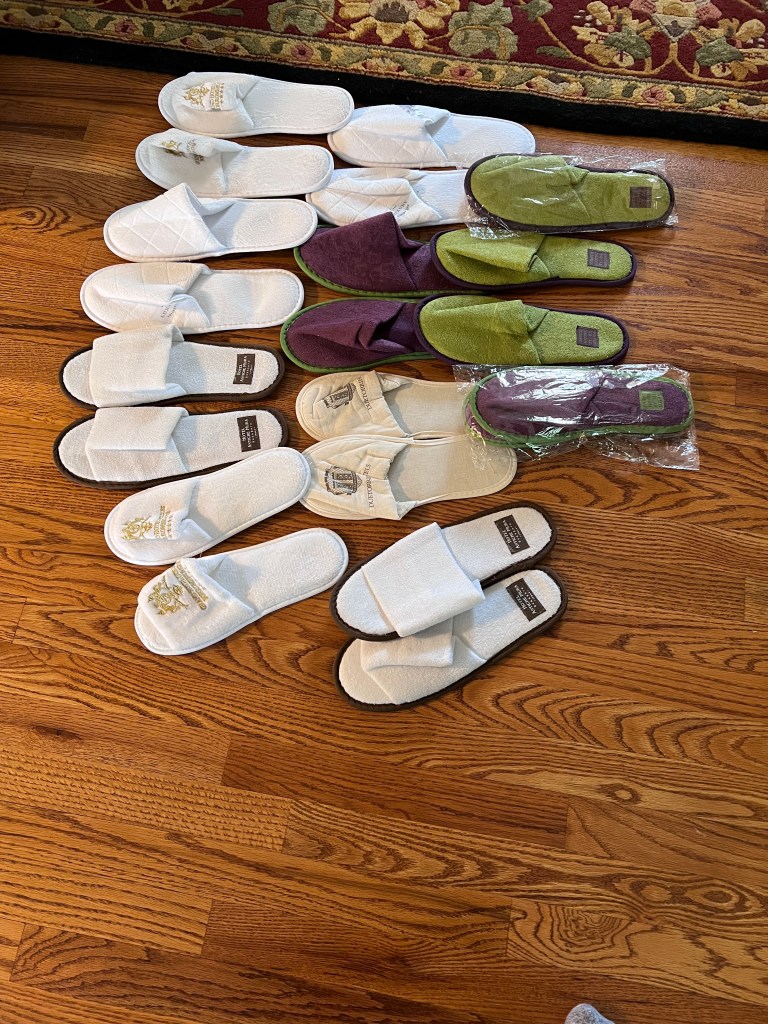
Our hotel slipper collection

Day 22 Last Day in Italy

The Gritti Palace has a lovely outdoor eating area on the canal. What a wonderful way to begin our day. What I hadn’t realized was that there was one activity planned for this morning, a visit to the Vecchio Murano Glass Factory.

The dock in front of Gritti Palace
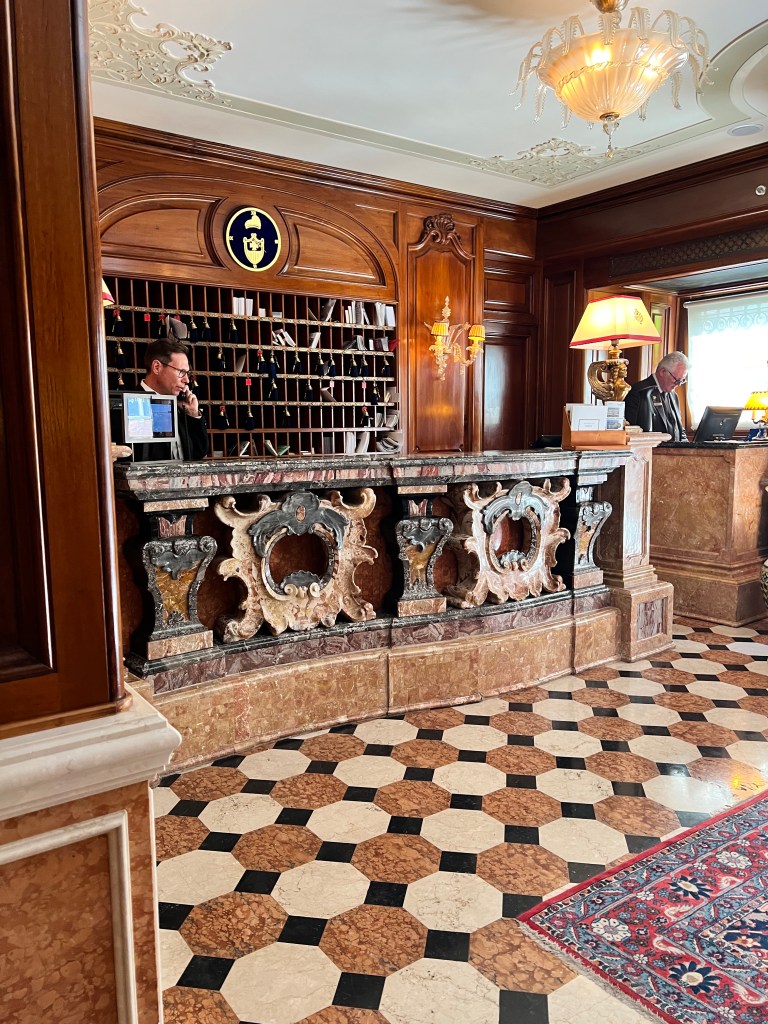
Reception at Gritti Palace
Room at Gritti Palace

Most of our group went to visit the glass factory. It began with a glass blowing demonstration where a bowl and a animal were created in a matter of minutes. We were then taken to a room where they described how some of the pieces are made. Frankly it was more of a sales presentation, but it was interesting and some of the pieces were outstanding. We were then free to wander about the store, which consisted of several floors filled with beauteous vases, pitchers, chandeliers, animals, bowls, jewelry, etc. If you could make it out of glass, you would find it here. I ended up purchasing a necklace and a small paperweight. I restrained myself from purchasing too much. The last thing we need are more tchotchkes. Ah! That’s a thought that demonstrates that I”m transitioning away from Italy and toward home.

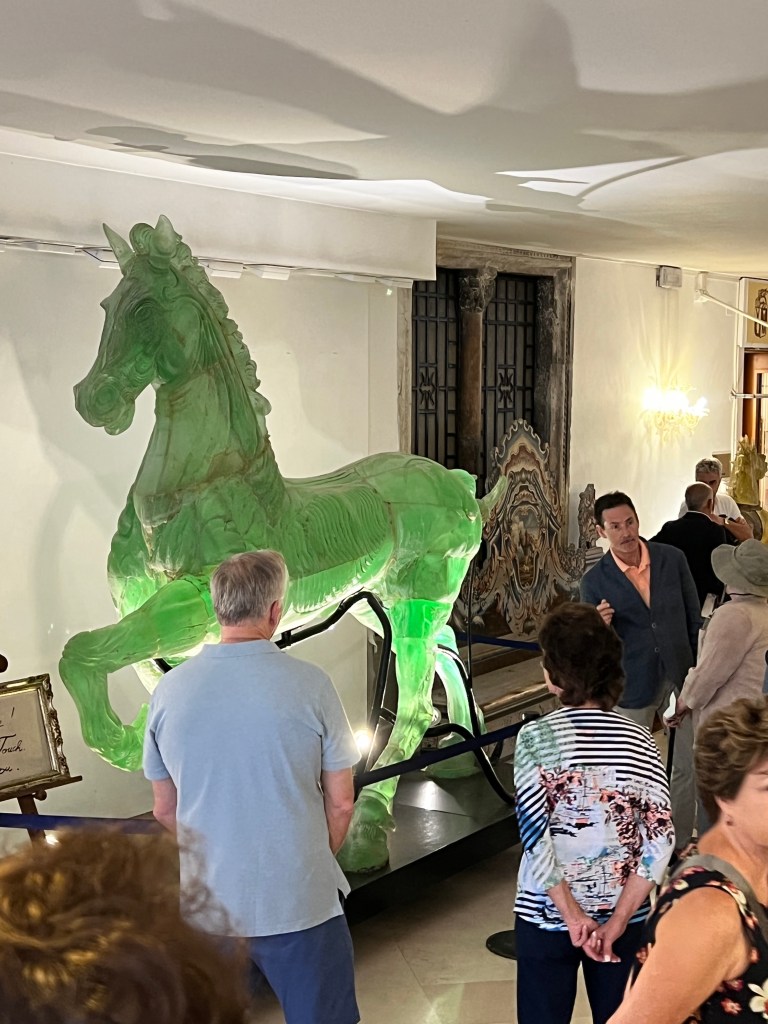
Glass horse at entrance to Vecchio Murano Glass Factory. No photos were allowed, but I didn’t know that when I took this picture.

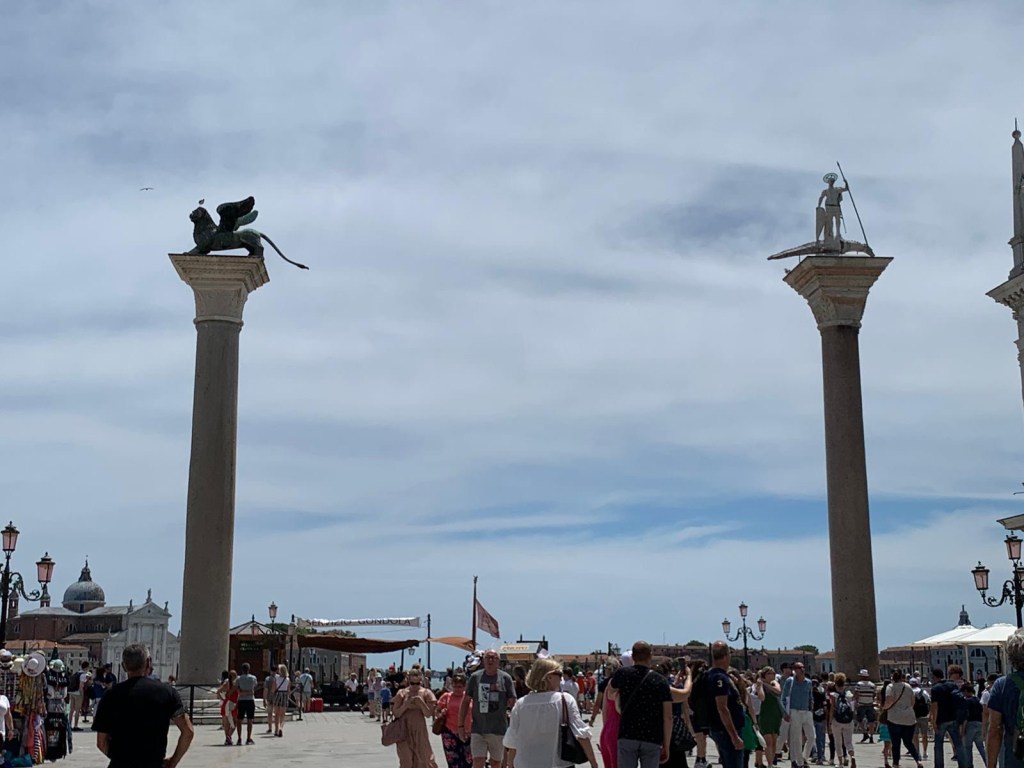
We dropped off our purchases in our room and headed back toward St. Mark’s Square and the Doge’s Palace. We had tickets at 11:30 AM for the Itinerari Segreti (the Secret Itineraries) tour, but had a little time to kill. You can’t but notice two stone columns that flank the entrance to St. Mark’s Square from the Grand Canal. They were erected in the mid-13th century. Gambling was allowed between them and public executions as well. One features a winged lion, the symbol of St. Mark and the other holds a statue of St. Theodore standing over a dead crocodile. He was Venice’s patron saint until he was replaced by St. Mark. What most people don’t know is that there were supposed to be three columns. A ship carrying one of them sunk, and given that the lagoon’s floor is thick with clay, it is most likely never going to be found.

Two columns
Gondolas on Grand Canal near Doge’s Palace

Now is an appropriate time to explain a little about how Venice was built. Why people would choose to live on wet, mud flats I don’t know, but I suppose it was desperation. They took tree trunks and pounded them into the ground until they were stuck solidly into the clay and used them as the foundation for their buildings. There is a forest of trees under Venice and over time they have become petrified.

Unfortunately flooding is getting worse due in part to the notorious acqua alta, which is when a high tide combines with strong sirocco winds and storms. Plus sea levels are increasing due to global warming. Both are making Venice more vulnerable to flooding. Venetians have constructed underwater gates on the sea floor at the three inlets where the sea enters the lagoon. When the sea water reaches a certain level they rise up and shut out the Adriatic. It has worked once, but many question how long they will be able to keep the sea out.

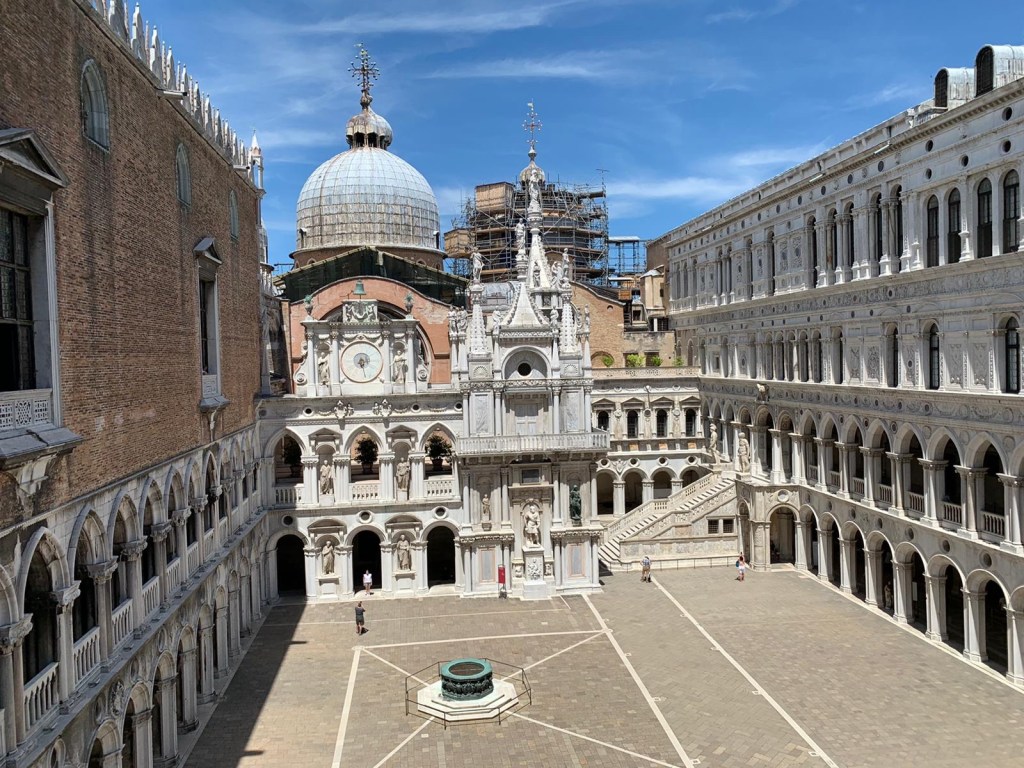
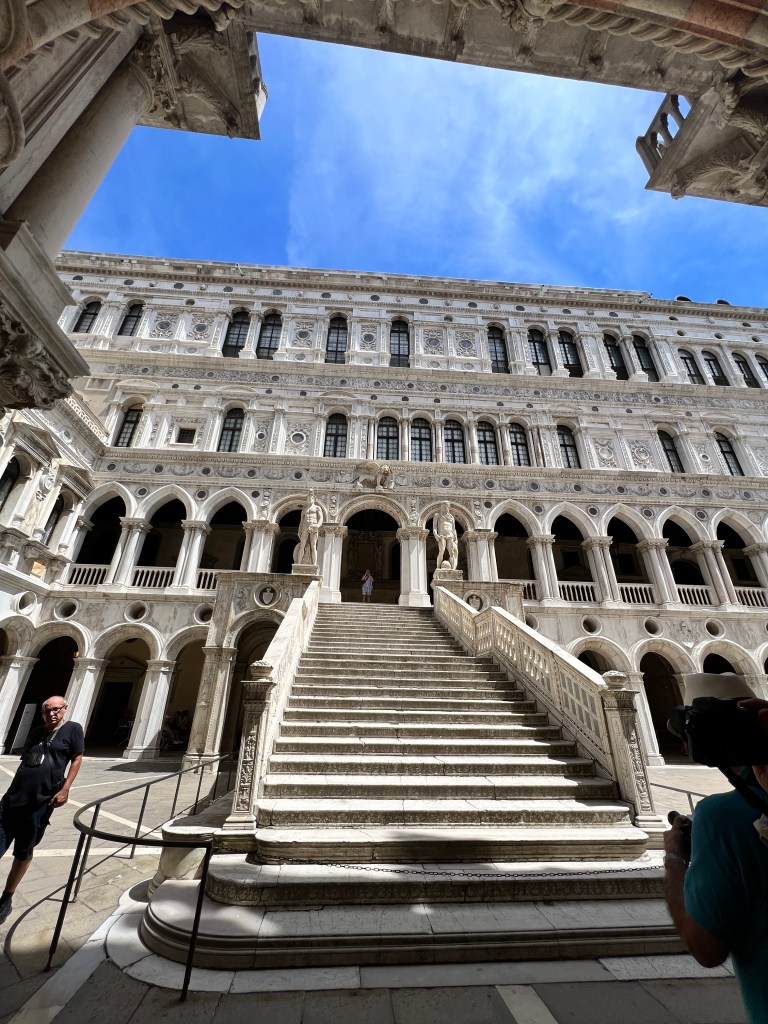
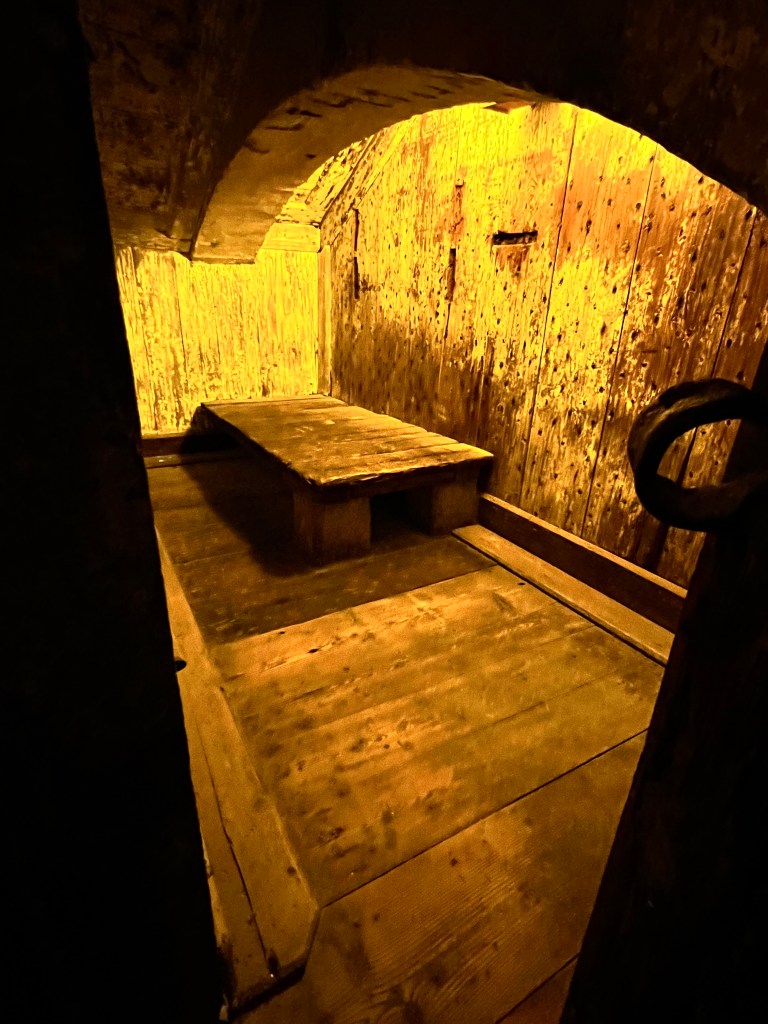
We are finally getting the hang of finding the correct line to stand in. Right on time Eileen and Jim join us for the tour. The Doge’s Palace was the seat of the Venetian government and home of its ruling duke or doge. The palace was built to show off the power of the republic and is resplendent in gold leaf, paintings, and glitz. Hiding behind the halls of power, was a prison that at one time held Casanova along with many others. He was not only a great seducer of women, but he was the only person who managed to escape from the prison. That was where our tour primarily took place. Frankly it wasn’t as interesting as I had hoped, but it is crazy to think about the juxtaposition of incredible wealth in contrast to cold, stone jail cells. In addition, the administrative offices for those running Venice were directly next to the prison and were devoid of any decoration, including the Doge’s office. The intention was for the doge himself to remain humble.

Courtyard at Doge Palace
Grand Staircase at Doge Palace
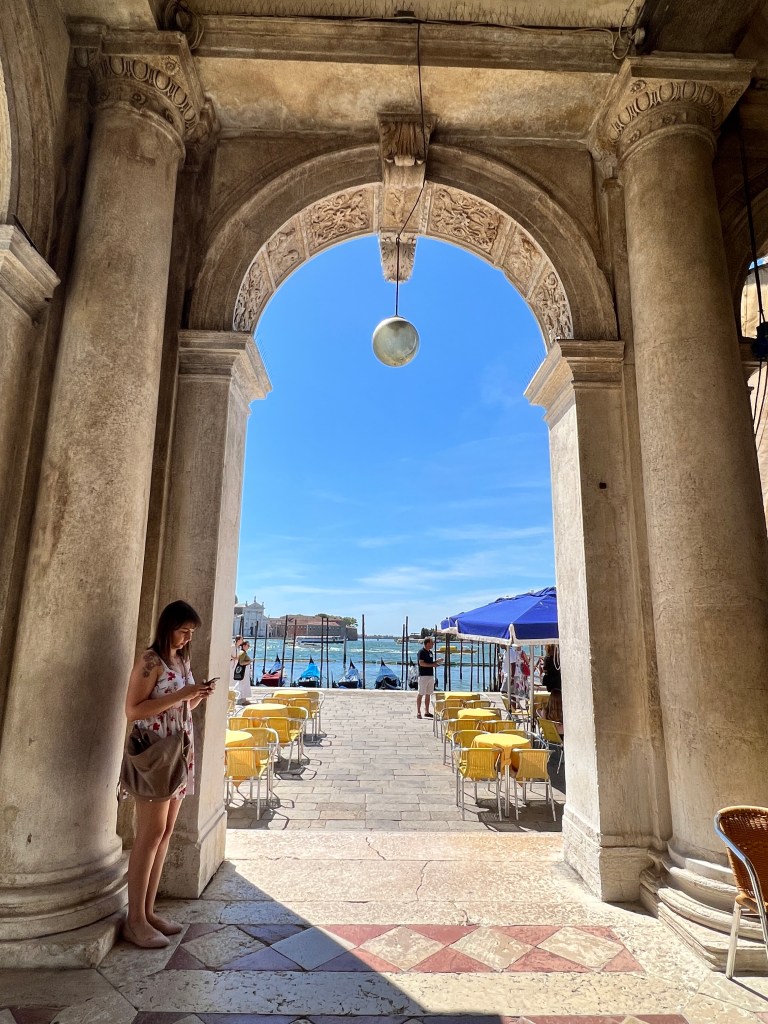
View out to Grand Canal from Doge Palace
Jail cell at Doge Palace

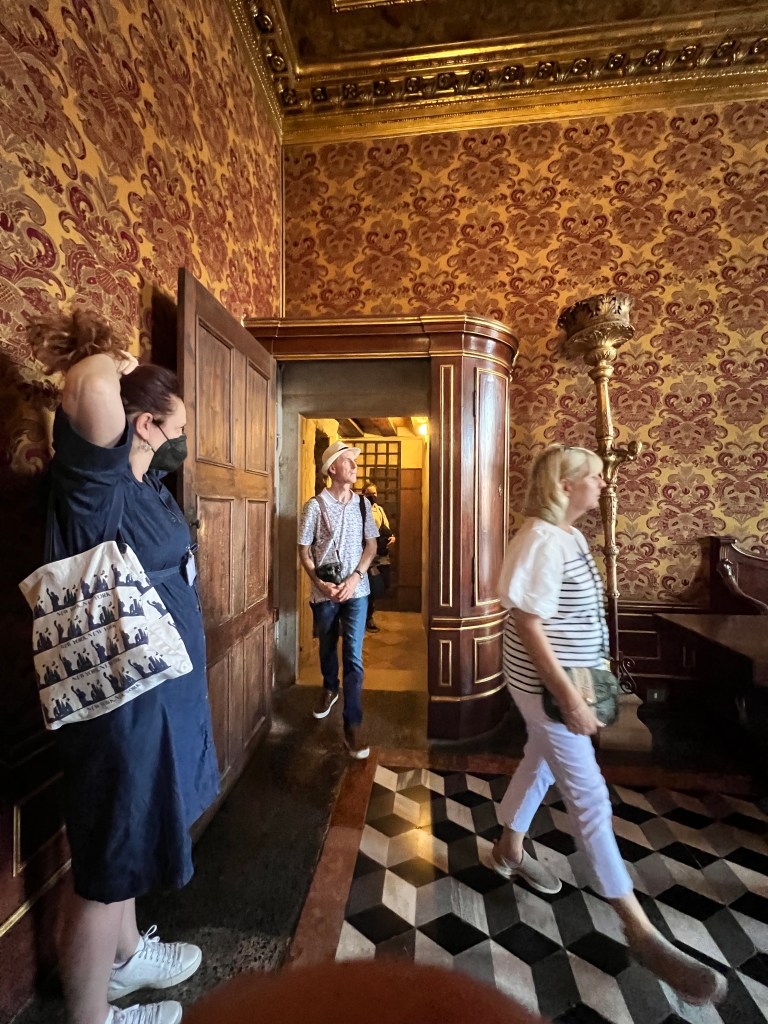
The guide led is through a “secret” door that took us into the opulent part of the palace. The door was part of a cabinet that appeared to be a permanent piece of furniture in the room. After the tour ended, the four of us wandered from room to room. Each room was larger and glitzier than the last. After a while it became too much. I think all of us felt the urge to escape at about the same time. I didn’t want to spend my last day in Venice staring at glitz.

Cabinet leading from prison into beautiful part of Doge Palace
Typical glitz

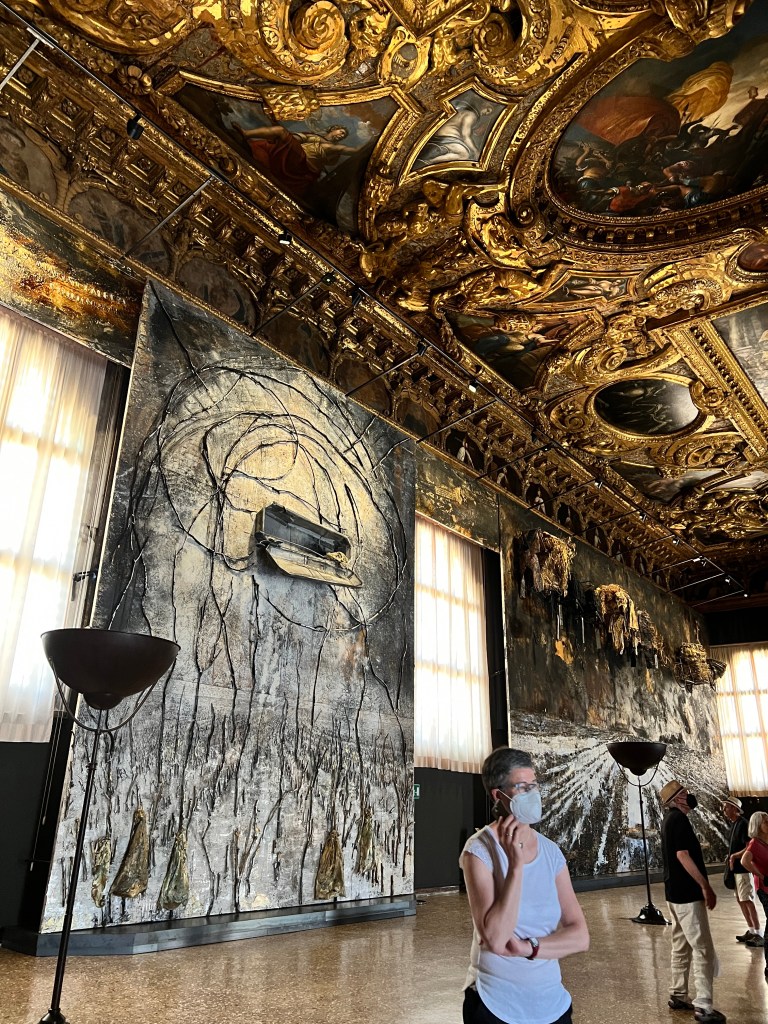
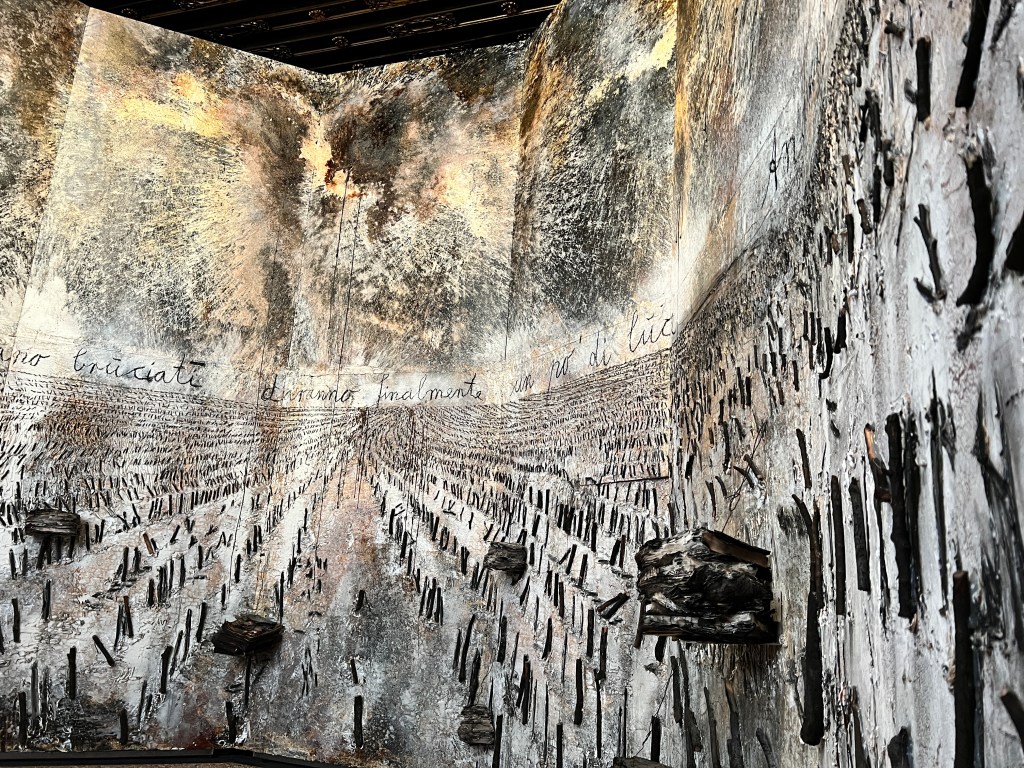
On our escape route out of the palace we came upon a special exhibit of modern art by German painter/sculptor Anselm Kiefer. He was invited to present a site-specific installation of paintings as part of the 59th Venice Biennale. He combines philosophical thought and literary references in his art and confronts Germany’s dark past, i.e. the Holocaust. The Biennale is a large scale exhibition of contemporary art held every two years in Venice. It has been held since 1895. The commingling of new and old art created a unique space.

Anselm Kiefer’s work amidst the glitz.
Kiefer’s dark art with light being shed on it

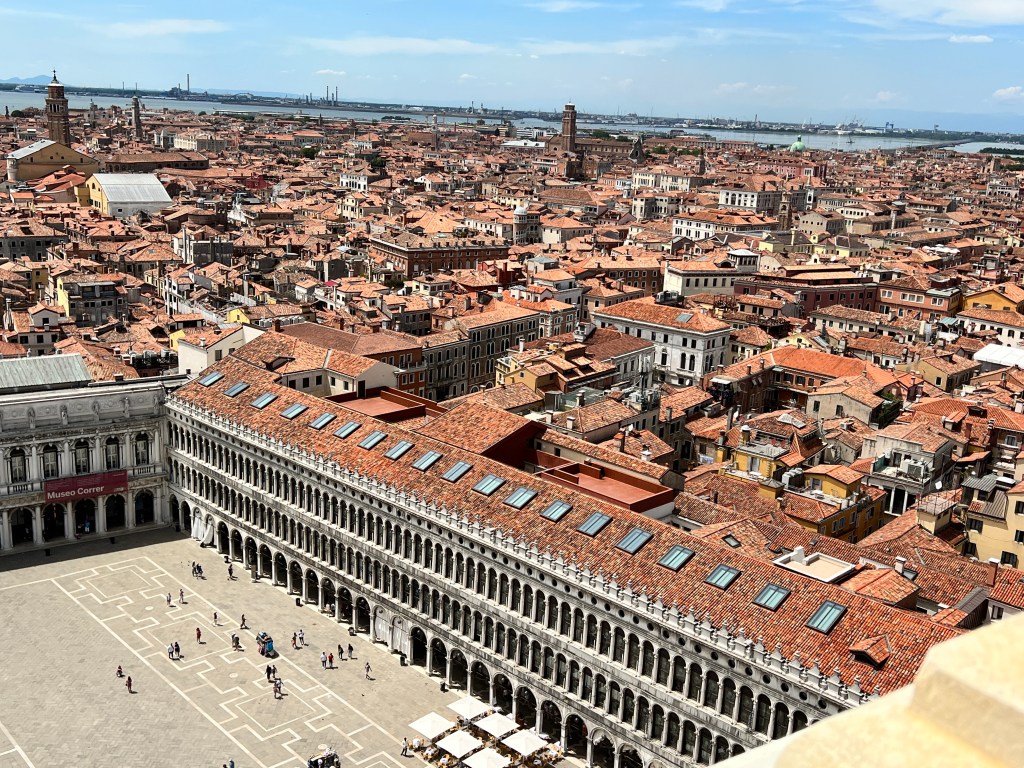
Upon our escape from the Doge’s Palace we stood in a surprisingly short line to go to the top of the Campanile Bell Tower by elevator. Thank goodness no steps this time. We had wonderful panoramic views of Venice from up there. We also had a deafening surprise when at 2:00 PM the bells began to ring. We were in a bell tower next to the bells after all. The campanile was completed in 1514 when the belfry and spire were completely rebuilt. It was originally intended as a watchtower, but eventually the bells served to regulate the civic and religious life of Venice marking the time of day, convocation of government assemblies, and public executions.

View of St. Mark’s Square and Venice from Campanile
One of several very loud bells

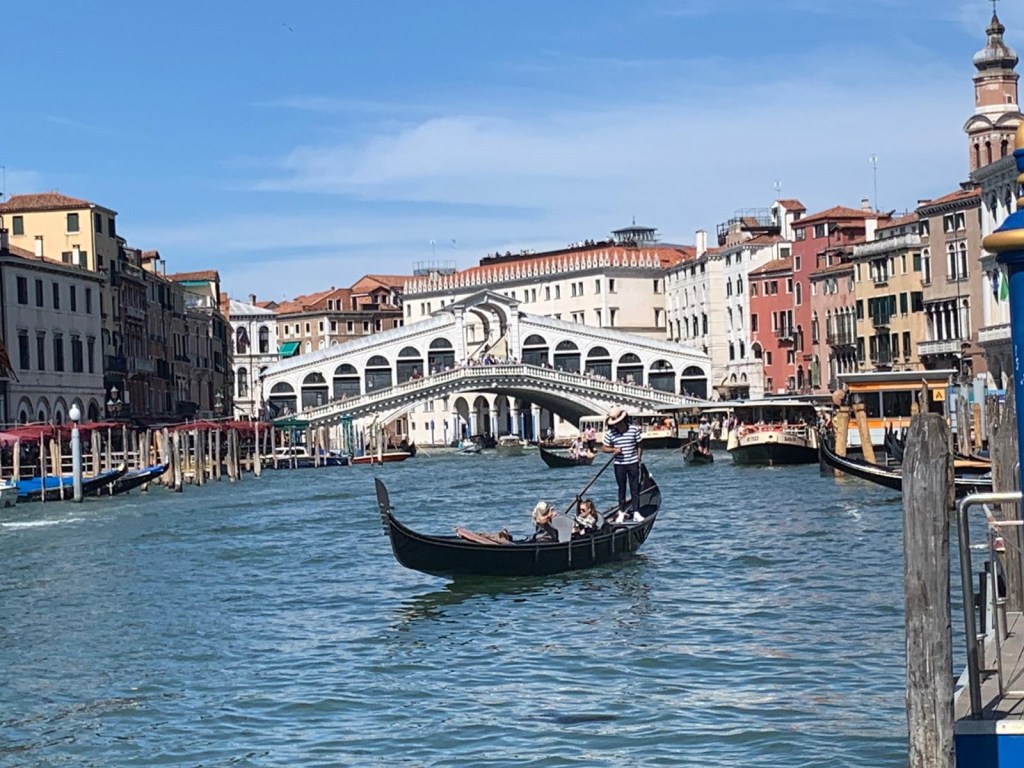
There was only so much one could do in a day, but Dan and I really wanted to see the famous Rialto Bridge. Made of stone and crossing the Grand Canal, it is one of the world’s most famous bridges. It was filled with shops and tourists. After a quick visit we headed away from the congestion. On our way back toward our hotel, we stopped for a last Aperol Spritz, and gelato.

Realto Bridge
Rialto Bridge from afar
Scene on our way back to hotel

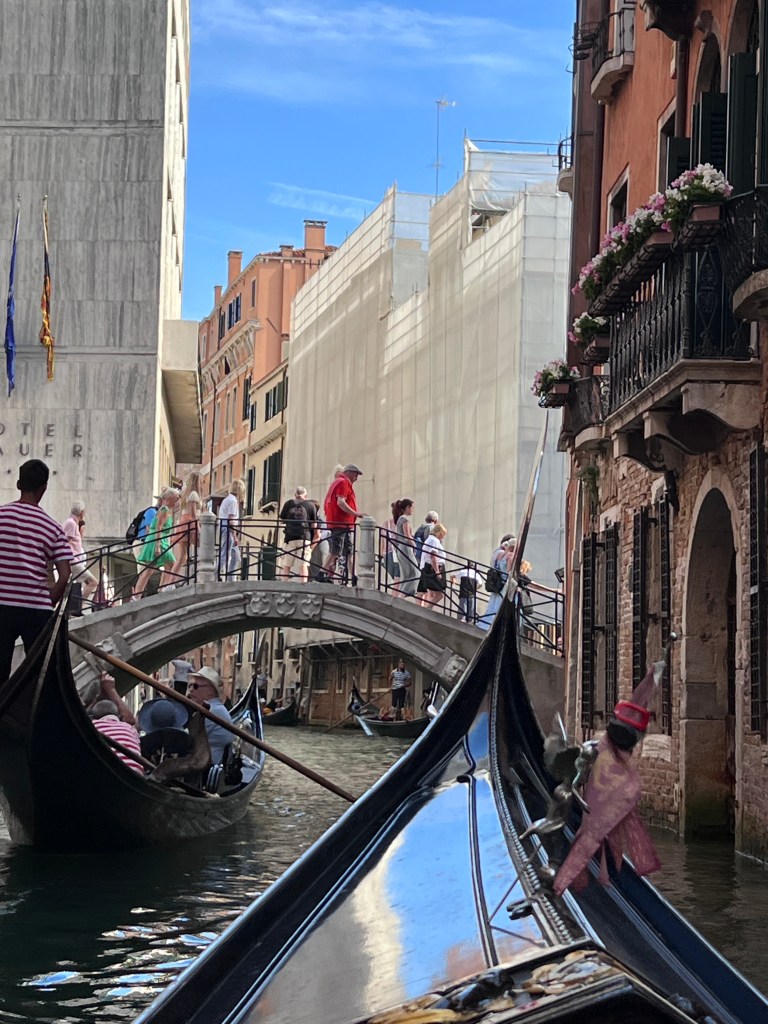
Twelve of us had made reservations for a gondola ride. As it turns out there are gondolas located all over the place, but these were located right in front of our hotel. All of us set out in three gondolas for a brief (and expensive) ride that basically took us around the block. We got a little more time onboard than expected because all of the gondolas around us had to sit and wait for a larger boat to pass. It looked like a gondola traffic jam.

The four of us and our gondolier
Gondola traffic jam

We ended our day in Venice with a safe exit from our gondola and a lovely farewell dinner at the hotel. I thought they were going to take a group photo like they always did when my parent’s took Tauck tours. Unfortunately they no longer do that, so I don’t have a photo of our group. By the end of our travels we got to know almost everyone. They were a lovely group of people and what a absolutely wonderful trip we had. Except for Dan’s cough it was a perfect journey. However, Dan and I are ready to head home.

P.S. I forgot about the COVID test we had to take before dinner. In order to get back home, we had to test negative for COVID within 24 hours of our departure. Fortunately, all of were allowed to go home. Could you imagine having to quarantine in the Hotel Gritti for five days?